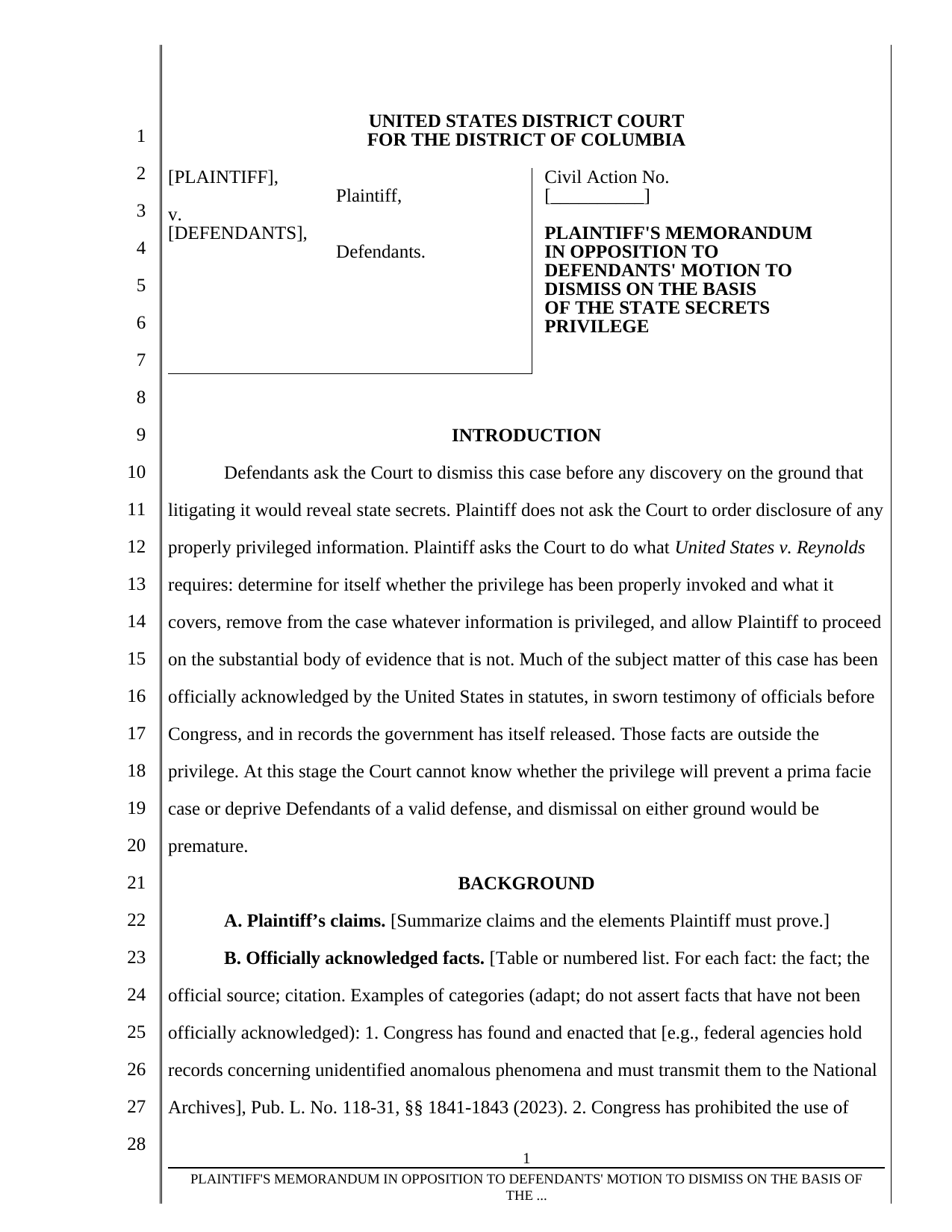
UNITED STATES DISTRICT COURT FOR THE DISTRICT OF COLUMBIA
[PLAINTIFF], Plaintiff, v. [DEFENDANTS], Defendants.
Civil Action No. [__________]
PLAINTIFF’S MEMORANDUM IN OPPOSITION TO DEFENDANTS’ MOTION TO DISMISS ON THE BASIS OF THE STATE SECRETS PRIVILEGE
INTRODUCTION
Defendants ask the Court to dismiss this case before any discovery on the ground that litigating it would reveal state secrets. Plaintiff does not ask the Court to order disclosure of any properly privileged information. Plaintiff asks the Court to do what United States v. Reynolds requires: determine for itself whether the privilege has been properly invoked and what it covers, remove from the case whatever information is privileged, and allow Plaintiff to proceed on the substantial body of evidence that is not. Much of the subject matter of this case has been officially acknowledged by the United States in statutes, in sworn testimony of officials before Congress, and in records the government has itself released. Those facts are outside the privilege. At this stage the Court cannot know whether the privilege will prevent a prima facie case or deprive Defendants of a valid defense, and dismissal on either ground would be premature.
BACKGROUND
A. Plaintiff’s claims. [Summarize claims and the elements Plaintiff must prove.]
B. Officially acknowledged facts. [Table or numbered list. For each fact: the fact; the official source; citation. Examples of categories (adapt; do not assert facts that have not been officially acknowledged): 1. Congress has found and enacted that [e.g., federal agencies hold records concerning unidentified anomalous phenomena and must transmit them to the National Archives], Pub. L. No. 118-31, §§ 1841-1843 (2023). 2. Congress has prohibited the use of funds for [UAP-related activities not reported to Congress], id. § 1687. 3. [Official], in sworn testimony before [committee] on [date], stated that [fact]. [Hearing cite at page.] 4. The Department of War released [record identifier] on [date], which states [fact].]
C. Defendants’ assertion of privilege. [Describe the declarations: who signed; whether the head of the department; whether based on personal consideration; categories claimed; whether a classified ex parte declaration was lodged.]
ARGUMENT
I. The Court must test the assertion under Reynolds.
The privilege “is not to be lightly invoked.” United States v. Reynolds, 345 U.S. 1, 7 (1953). It requires “formal claim of privilege, lodged by the head of the department which has control over the matter, after actual personal consideration by that officer.” Id. at 7-8. “The court itself must determine whether the circumstances are appropriate for the claim of privilege.” Id. at 8. “Judicial control over the evidence in a case cannot be abdicated to the caprice of executive officers.” Id. at 9-10. Plaintiff’s need for the information is substantial, which requires the Court to “probe” the claim more deeply. See id. at 11.
[If applicable:] The declaration offered here does not satisfy these requirements because [it was signed by a subordinate official; it does not reflect personal consideration; it describes harm in conclusory terms]. Defendants have also not shown compliance with the Attorney General’s policy, which requires a “detailed declaration based on personal knowledge” specifying the information to be protected, the significant harm disclosure could reasonably be expected to cause, and the reason disclosure is reasonably likely to cause that harm, and which requires the Attorney General’s personal approval. Memorandum from the Attorney General, Policies and Procedures Governing Invocation of the State Secrets Privilege §§ 2.A, 4 (Sept. 23, 2009). The Attorney General reaffirmed that policy in 2022 and added that the agency head’s declaration must be “based on personal consideration of the matter.” Memorandum from the Attorney General, Supplement to Policies and Procedures Governing Invocation of the State Secrets Privilege § A.1 (Sept. 30, 2022). The Court should direct Defendants to state whether those procedures were followed.
II. The privilege does not extend to officially acknowledged facts.
The privilege protects information whose official confirmation would harm national security. United States v. Zubaydah, 595 U.S. 195, 210-11 (2022). In Zubaydah, the Court held that widespread unofficial reporting did not defeat the privilege, because “official confirmation of sensitive information may pose risks that unofficial disclosure does not.” Id. That reasoning applies in reverse here. Every fact listed in Background Part B has already been confirmed by the United States itself, through Congress, through sworn testimony of federal officials, or through records the government released. Litigating those facts cannot cause the harm the privilege exists to prevent. Plaintiff’s prima facie case rests on those facts and on [Plaintiff’s own knowledge and other unclassified evidence]. [If a FOIA-style official-acknowledgment test is useful, cite Fitzgibbon v. CIA, 911 F.2d 755, 765 (D.C. Cir. 1990), and ACLU v. CIA, 710 F.3d 422 (D.C. Cir. 2013); confirm pins.]
III. At this stage the remedy is exclusion of privileged evidence.
When the privilege applies, “the evidence is unavailable, as though a witness had died, and the case will proceed accordingly, with no consequences save those resulting from the loss of the evidence.” In re Sealed Case, 494 F.3d 139, 144-45 (D.C. Cir. 2007) (quoting Ellsberg v. Mitchell, 709 F.2d 51, 64 (D.C. Cir. 1983)). Dismissal is warranted only if (1) the plaintiff cannot establish a prima facie case without privileged evidence, id. at 145; (2) the privilege deprives the defendant of information that would otherwise give it a valid defense, id. at 148-49; or (3) privileged evidence is so inseparable from nonprivileged information needed for the claims or defenses that “litigating the case to a judgment on the merits would present an unacceptable risk of disclosing state secrets,” Mohamed v. Jeppesen Dataplan, Inc., 614 F.3d 1070, 1083 (9th Cir. 2010) (en banc); see In re Sealed Case, 494 F.3d at 153. None applies.
A. Plaintiff can make a prima facie case with nonprivileged evidence. [Walk through each element and the unclassified evidence for it.] In In re Sealed Case, the D.C. Circuit reversed dismissal because the plaintiff could make out his claim even after privileged material, including portions of inspector general reports, was excluded. 494 F.3d at 145-48, 153.
B. Defendants have not shown that the privilege deprives them of a valid defense. A defendant seeking dismissal on this ground must identify a defense that the privileged information would actually establish. In the D.C. Circuit a “valid defense” is one that “is meritorious and not merely plausible and would require judgment for the defendant,” and the district court must verify it through “appropriately tailored in camera review of the privileged record.” In re Sealed Case, 494 F.3d at 149, 151. The Ninth Circuit’s 2024 decision in Fazaga v. FBI, 124 F.4th 637 (9th Cir. 2024), adopted that requirement in detail, though that judgment was later vacated on other grounds, FBI v. Fazaga, No. 25-430, 2026 WL 922539 (U.S. Apr. 6, 2026); its reasoning remains persuasive. Where the defense rests on a factual assertion, the privileged evidence must establish the defense, and Plaintiff must have an opportunity to be heard on whether it does. At the pleading stage, before Defendants have answered, the Court cannot make that determination. Cf. Jeppesen, 614 F.3d at 1093 (Hawkins, J., joined by four other judges, dissenting) (objecting that the majority dismissed “before Jeppesen has even filed an answer”).
The Fourth Circuit’s reasoning in Al Shimari v. CACI Premier Technology, Inc., 170 F.4th 162 (4th Cir. 2026), vacated on reh’g on other grounds, 2026 WL 2547096 (4th Cir. Aug. 28, 2026) (per curiam) (unpublished), shows how the inquiry should proceed; the opinion was vacated because intervening Supreme Court authority foreclosed the Alien Tort Statute claims, not because of its privilege analysis. There, the government asserted the privilege over the identities, training, interrogation plans, and contemporaneous reports of interrogators. The Fourth Circuit examined each avenue of defense the contractor claimed it had lost and held that the privilege did not prevent the contractor from contesting either whether the alleged treatment occurred or whether it was involved; the effect of pseudonymous and telephonic testimony on the defense was “qualitative[]” and did not require dismissal. Id. at 197-98. The case was tried to verdict.
C. The evidence is not so intertwined that litigation would risk disclosure. [Explain how claims can be tried on acknowledged facts; propose segregation.] Dismissal on this ground is appropriate only in the exceptional case, Jeppesen, 614 F.3d at 1083, 1089, and the D.C. Circuit in In re Sealed Case declined to dismiss where the plaintiff’s case could be tried on unprivileged evidence with the district court policing the line through in camera review, 494 F.3d at 151-54. The measures available here include the protective order Plaintiff has proposed [or the Court has entered], cleared counsel, closed sessions for classified matters, pseudonyms, unclassified summaries and stipulations, and in camera review of specific documents.
IV. The Totten bar does not apply. [Include if Defendants invoke it.] Totten v. United States, 92 U.S. 105 (1876), and Tenet v. Doe, 544 U.S. 1 (2005), bar suits whose very subject matter is a secret relationship with the government, such as an agreement to perform espionage. Plaintiff does not sue to enforce any secret agreement. Plaintiff’s claims arise under [statute / constitutional provision / state tort law] and concern [conduct], the existence and general nature of which the United States has officially acknowledged. The categorical bar has no application to claims of that kind. Cf. General Dynamics Corp. v. United States, 563 U.S. 478, 490 (2011) (limiting the remedy in contract cases to defenses supported by a prima facie showing).
V. Alternatively, the Court should defer ruling.
If the Court is not prepared to deny the motion, it should defer ruling until (1) Defendants answer; (2) the Court has reviewed in camera the information over which the privilege is claimed, in addition to the declarations describing it; and (3) the parties have presented proposals for protective measures. [If a declassification request or congressional inquiry is pending, ask for a stay pending its outcome.]
CONCLUSION
The motion to dismiss should be denied. The Court should determine the scope of the privilege by reviewing the underlying information in camera, exclude what it finds privileged, and set a schedule for discovery under appropriate protective measures.
Dated: [__________] Respectfully submitted, [signature block]
Alternative Part III for a case in the Fourth Circuit
[Replace Part III with the following when the case is pending in a district court in the Fourth Circuit. The Fourth Circuit applies Reynolds through a three-part analysis and does not follow the D.C. Circuit’s requirement that the court verify a “valid defense” in camera, so the argument shifts to the second step and to the scope of the claims.]
III. The privileged information is not so central to this case that it cannot be litigated.
The Fourth Circuit resolves a state secrets assertion in three steps: whether the procedural requirements for the claim were met, whether the information is privileged, and how the case should proceed in light of a successful claim. El-Masri v. United States, 479 F.3d 296, 304 (4th Cir. 2007); Wikimedia Foundation v. National Security Agency, 14 F.4th 276, 302-03 (4th Cir. 2021). The doctrine “does not represent a surrender of judicial control over access to the courts.” El-Masri, 479 F.3d at 312. “If a proceeding involving state secrets can be fairly litigated without resort to the privileged information, it may continue.” Id. at 306. Dismissal follows only where the plaintiff cannot make a prima facie case without privileged evidence, where the defendant could not properly defend itself without it, or where further litigation would present an unjustifiable risk of disclosure. Abilt v. CIA, 848 F.3d 305, 313-14 (4th Cir. 2017); Wikimedia, 14 F.4th at 303.
A. The Court should define what is privileged before deciding what follows. The second step is where the Court may examine the government’s showing most closely. “[W]here there is a strong showing of necessity, the claim of privilege should not be lightly accepted,” and the Court may consider the evidence it needs, including in camera, to decide whether the information is in fact a state secret. El-Masri, 479 F.3d at 305; Wikimedia, 14 F.4th at 303 (citing Sterling v. Tenet, 416 F.3d 338, 345 (4th Cir. 2005)). Plaintiff’s need here is strong, and the facts on which Plaintiff relies have been officially acknowledged (Part II). The Court should sustain the privilege, if at all, only for the identified categories in Defendants’ declarations and should state that officially acknowledged facts fall outside it. See Wikimedia, 14 F.4th at 302 (reading the district court’s ruling not “to make privileged what’s already public”).
B. Plaintiff’s prima facie case rests on nonprivileged evidence. [Walk through each element and the unclassified evidence for it, as in the main Part III.A.]
C. This is not a case in which every valid defense would reveal state secrets. The Fourth Circuit has distinguished a case in which the government points to “possible defenses” that cannot be pursued without privileged material from one in which “any valid defense … would require resort to privileged materials,” and dismissed without further inquiry only in the second category. Wikimedia, 14 F.4th at 304 (discussing In re Sealed Case, 494 F.3d 139, 149 (D.C. Cir. 2007), and leaving open whether to require proof that a defense is valid). Dismissal in that category is reserved for a case in which state secrets are “so central to [the] proceeding that it cannot be litigated without threatening their disclosure.” Id. (quoting El-Masri, 479 F.3d at 308). In Wikimedia the claim was that the agency acquired all communications on a monitored cable, and no answer was possible without revealing how and where the surveillance was done. In El-Masri the claims required proof of how the rendition program was run and who ran it. 479 F.3d at 309-11. In Abilt and Sterling the employment claims required comparison of covert employees and the agency’s internal assignment criteria. 848 F.3d at 313-16; 416 F.3d at 346-48. Here, by contrast, [state how each claim and each likely defense can be tried on acknowledged facts and unclassified evidence: e.g., the defense that records were transferred lawfully turns on dates, statutes, and unclassified correspondence, not on program details]. Program names, locations, and technical details are not elements of any claim.
D. The Court should adopt measures short of dismissal. [As in the main Part III.C: protective order, cleared counsel, closed sessions, pseudonyms, unclassified summaries and stipulations.] If the Court concludes that some claims cannot proceed, it should dismiss only those claims and allow the rest to go forward.