UNITED STATES DISTRICT COURT FOR THE DISTRICT OF COLUMBIA
[PLAINTIFF], [address], Plaintiff,
v.
[DEPARTMENT OF WAR / AGENCY], [address],
and
NATIONAL ARCHIVES AND RECORDS ADMINISTRATION, [address], Defendants.
Civil Action No. [__________]
COMPLAINT FOR DECLARATORY AND INJUNCTIVE RELIEF
INTRODUCTION
Congress has directed every federal office to identify its records relating to unidentified anomalous phenomena (“UAP”), to transmit them to a UAP Records Collection at the National Archives, and to make them public unless the original classification authority finds, by clear and convincing evidence, that one of four narrow grounds for postponement applies. National Defense Authorization Act for Fiscal Year 2024, Pub. L. No. 118-31, §§1841-1843, 137 Stat. 136, 699-706 (2023) (44 U.S.C. §2107 note) (the “Records Collection provisions”).
Congress also commanded that no UAP record created outside the federal government be withheld or redacted (except for protected names), that no record already made public be withheld again, that each continued postponement be explained in an unclassified written description published in the Federal Register, and that every UAP record be disclosed in full within 25 years of its creation unless the President certifies otherwise. Id. §§1842(a)(2), 1842(g)(2).
[Defendant agency] has not complied with these discrete, mandatory duties with respect to the records described below, and it has unlawfully withheld the same records in response to Plaintiff’s request under the Freedom of Information Act, 5 U.S.C. §552.
JURISDICTION AND VENUE
This Court has jurisdiction under 28 U.S.C. §1331 and 5 U.S.C. §552(a)(4)(B). The Administrative Procedure Act, 5 U.S.C. §§702, 706, waives sovereign immunity for the non-monetary relief sought.
Venue is proper under 5 U.S.C. §552(a)(4)(B) and 28 U.S.C. §1391(e).
PARTIES
Plaintiff [name] is [description: journalist / researcher / nonprofit], which [gathers and publishes information about UAP; describe use of records]. [Facts supporting informational injury and standing.]
Defendant [agency] is an agency within the meaning of 5 U.S.C. §§551(1) and 552(f)(1) and a “Government office” within the meaning of the Records Collection provisions. It has possession, custody, or control of the records at issue.
Defendant National Archives and Records Administration (“NARA”) is an agency within the meaning of 5 U.S.C. §551(1) and administers the UAP Records Collection (Record Group 615).
STATUTORY BACKGROUND
The UAP Records Collection consists of “record copies of all Government, Government-provided, or Government-funded records relating to unidentified anomalous phenomena, technologies of unknown origin, and non-human intelligence (or equivalent subjects by any other name with the specific and sole exclusion of temporarily non-attributed objects).” §1841(a)(1)(C). Each head of a Government office must identify and organize UAP records and prepare them for transmission (§1842(a)(1)), and must review them for public disclosure and transmission within 300 days of enactment (§1842(c)(1)). No UAP record may be destroyed, altered, or mutilated; no record previously made public may be withheld, redacted, postponed, or reclassified; and no record created outside the federal government may be withheld or redacted except for protected names and identities (§1842(a)(2)). Disclosure may be postponed only if the original classification authority determines that there is “clear and convincing evidence” that one of the grounds in §1843(a) applies. Each continued postponement requires an unclassified written description of the reason, published in the Federal Register (§1842(g)(2)(B)), and every record must be disclosed in full within 25 years after its creation unless the President certifies that continued postponement is necessary because of an identifiable harm that outweighs the public interest (§1842(g)(2)(D)).
The Records Collection provisions impose duties that are discrete and mandatory: they use the word “shall,” specify the act to be performed, and leave no discretion as to whether to perform it.
FACTS
[The records. Describe with specificity, e.g., “the [title] report dated [date], identified as [number], which [agency] referenced in [public document]”; “all records of [event] on [date] at [place]”; or a category tied to an official acknowledgment.] These are “unidentified anomalous phenomena records” within §1841(a)(1)(C).
[Age. If more than 25 years old:] The records were created more than 25 years ago. On information and belief, the President has not certified under §1842(g)(2)(D) that continued postponement of these records is necessary.
[Non-federal origin. If applicable:] Records [identify] were created by [person or entity outside the federal government] and are therefore subject to §1842(a)(2)(C).
[Previously public. If applicable:] Records [identify] were released to the public on [date] by [source] and have since been withheld or redacted.
[Postponement without notice.] On information and belief, [agency] has postponed public disclosure of records [identify] without publishing in the Federal Register an unclassified written description of the reason, as §1842(g)(2)(B) requires. A search of the Federal Register on [date] found no such notice.
[Transmission.] On [date], Plaintiff asked NARA whether the records had been transmitted to the Collection. NARA responded [describe]. As of the filing of this Complaint, the records do not appear in the Collection’s online catalog.
FOIA request. On [date], Plaintiff submitted a FOIA request to [agency] for [records]. Exhibit A. [Agency] acknowledged the request on [date] and assigned number [__]. [Describe: no determination within 20 working days; or denial on [date] and administrative appeal on [date], decided / not decided.] Plaintiff has exhausted administrative remedies or is deemed to have done so under 5 U.S.C. §552(a)(6)(C)(i).
Official acknowledgment. The existence and subject of the records have been officially acknowledged in [list]. [Agency] cannot properly refuse to confirm or deny their existence.
COUNT I: Freedom of Information Act, 5 U.S.C. §552 (against [agency])
Plaintiff incorporates the preceding paragraphs.
[Agency] has failed to make a timely determination on, conduct an adequate search for, and release all reasonably segregable non-exempt portions of the requested records. In particular, [agency] has not shown that it searched all locations likely to contain responsive records using all reasonable search terms, including “UAP,” “UFO,” and “unidentified anomalous phenomena.” See Slaughter v. Dep’t of the Air Force, No. 1:24-cv-862-RCL, 2026 WL 571249, at *4 (D.D.C. Mar. 2, 2026).
20A. [Agency] has also withheld information without showing that it “reasonably foresees that disclosure would harm an interest protected by an exemption.” 5 U.S.C. §552(a)(8)(A)(i); Reporters Comm. for Freedom of the Press v. FBI, 3 F.4th 350, 369-70 (D.C. Cir. 2021).
- Plaintiff is entitled to an order compelling an adequate search and release of the records.
COUNT II: APA, 5 U.S.C. §706(1): Agency action unlawfully withheld (against [agency])
Plaintiff incorporates the preceding paragraphs.
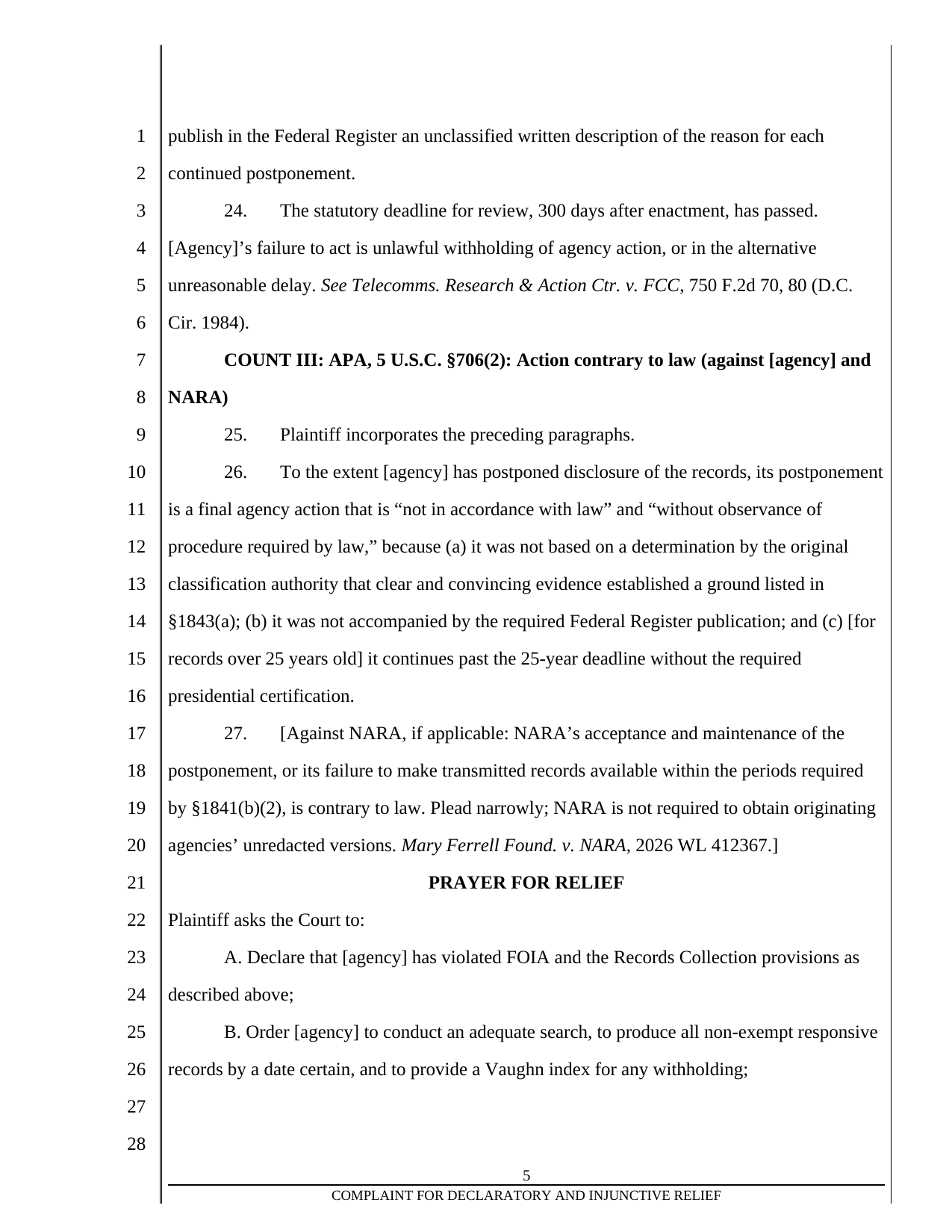
[Agency] has failed to take the following discrete actions that the Records Collection provisions require it to take: (a) transmit the identified UAP records to the Archivist for inclusion in the Collection; (b) [for non-federal records] release records created outside the federal government without withholding or redaction other than protected names; (c) [for previously public records] refrain from withholding records previously made public; and (d) publish in the Federal Register an unclassified written description of the reason for each continued postponement.
The statutory deadline for review, 300 days after enactment, has passed. [Agency]’s failure to act is unlawful withholding of agency action, or in the alternative unreasonable delay. See Telecomms. Research & Action Ctr. v. FCC, 750 F.2d 70, 80 (D.C. Cir. 1984).
COUNT III: APA, 5 U.S.C. §706(2): Action contrary to law (against [agency] and NARA)
Plaintiff incorporates the preceding paragraphs.
To the extent [agency] has postponed disclosure of the records, its postponement is a final agency action that is “not in accordance with law” and “without observance of procedure required by law,” because (a) it was not based on a determination by the original classification authority that clear and convincing evidence established a ground listed in §1843(a); (b) it was not accompanied by the required Federal Register publication; and (c) [for records over 25 years old] it continues past the 25-year deadline without the required presidential certification.
[Against NARA, if applicable: NARA’s acceptance and maintenance of the postponement, or its failure to make transmitted records available within the periods required by §1841(b)(2), is contrary to law. Plead narrowly; NARA is not required to obtain originating agencies’ unredacted versions. Mary Ferrell Found. v. NARA, 2026 WL 412367.]
PRAYER FOR RELIEF
Plaintiff asks the Court to:
A. Declare that [agency] has violated FOIA and the Records Collection provisions as described above;
B. Order [agency] to conduct an adequate search, to produce all non-exempt responsive records by a date certain, and to provide a Vaughn index for any withholding;
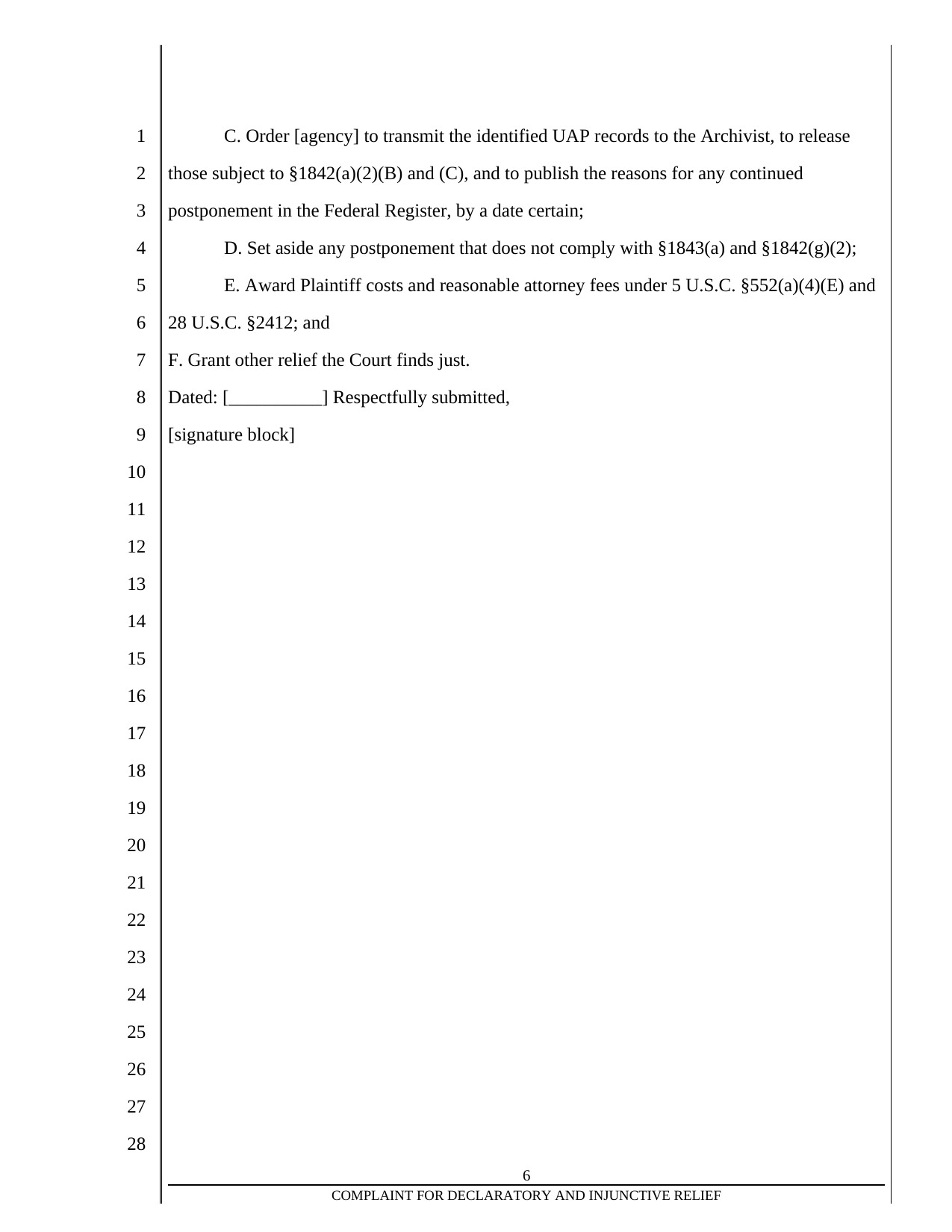
C. Order [agency] to transmit the identified UAP records to the Archivist, to release those subject to §1842(a)(2)(B) and (C), and to publish the reasons for any continued postponement in the Federal Register, by a date certain;
D. Set aside any postponement that does not comply with §1843(a) and §1842(g)(2);
E. Award Plaintiff costs and reasonable attorney fees under 5 U.S.C. §552(a)(4)(E) and 28 U.S.C. §2412; and
F. Grant other relief the Court finds just.
Dated: [__________] Respectfully submitted, [signature block]
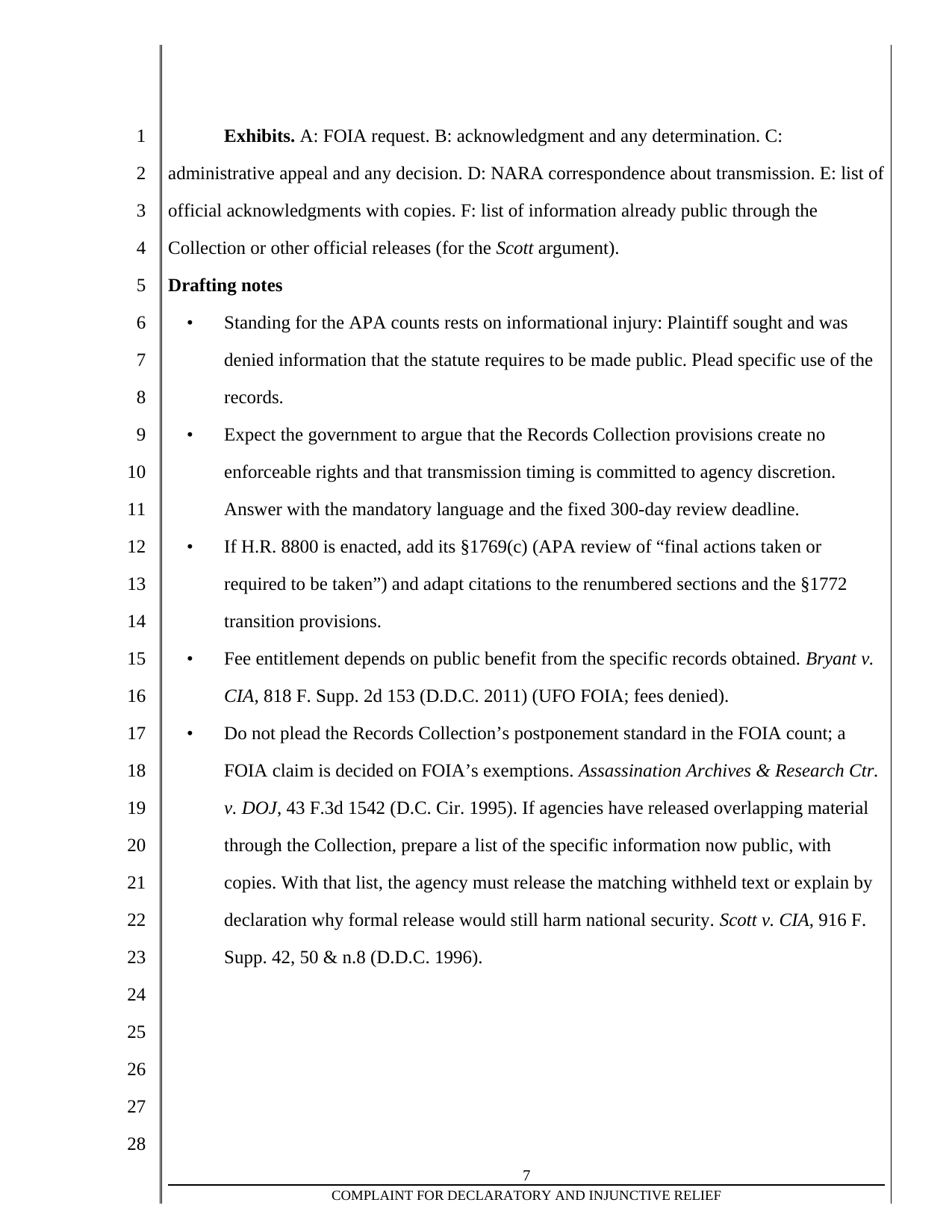
Exhibits. A: FOIA request. B: acknowledgment and any determination. C: administrative appeal and any decision. D: NARA correspondence about transmission. E: list of official acknowledgments with copies. F: list of information already public through the Collection or other official releases (for the Scott argument).