Article __. Publication and Fundamental Research
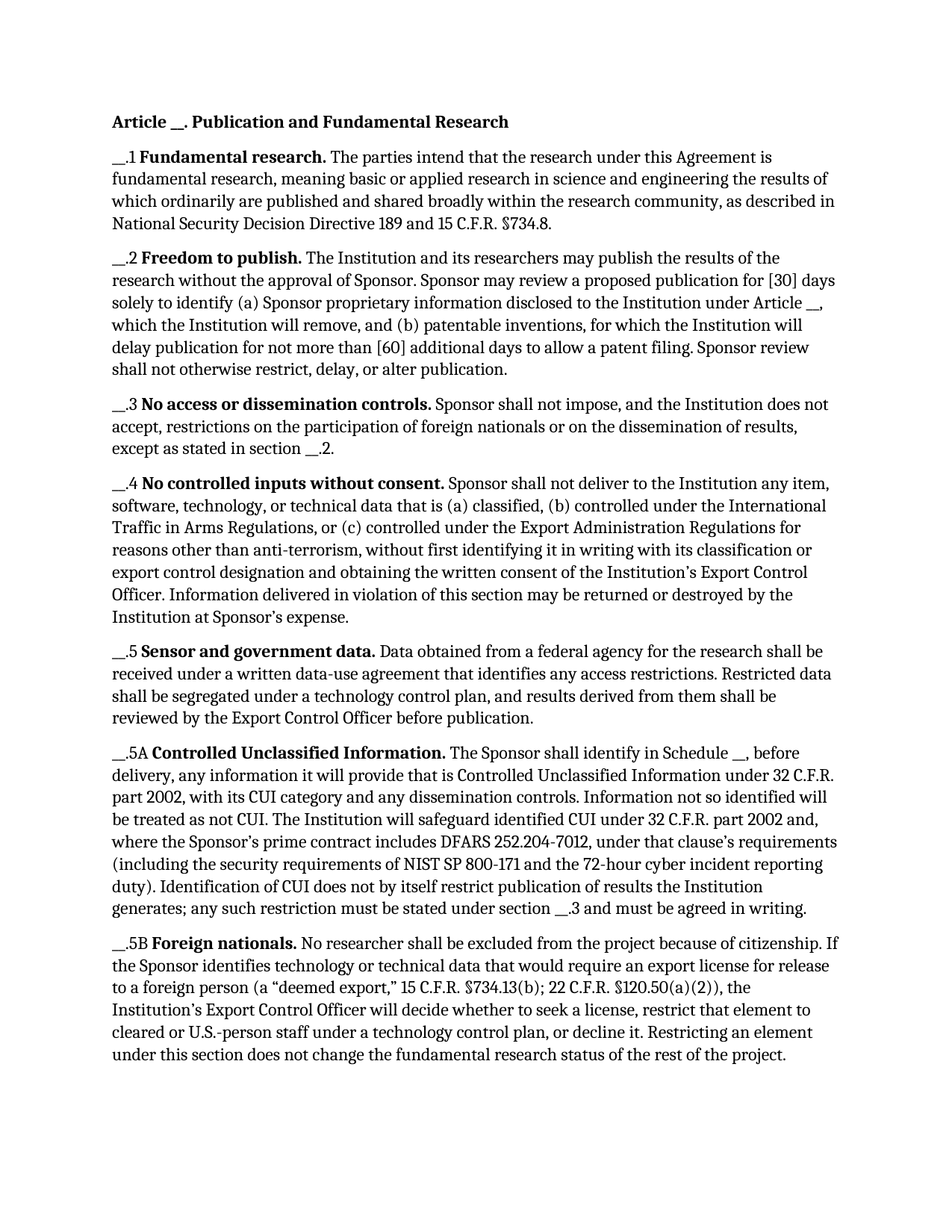
__.1 Fundamental research. The parties intend that the research under this Agreement is fundamental research, meaning basic or applied research in science and engineering the results of which ordinarily are published and shared broadly within the research community, as described in National Security Decision Directive 189 and 15 C.F.R. §734.8.
__.2 Freedom to publish. The Institution and its researchers may publish the results of the research without the approval of Sponsor. Sponsor may review a proposed publication for [30] days solely to identify (a) Sponsor proprietary information disclosed to the Institution under Article __, which the Institution will remove, and (b) patentable inventions, for which the Institution will delay publication for not more than [60] additional days to allow a patent filing. Sponsor review shall not otherwise restrict, delay, or alter publication.
__.3 No access or dissemination controls. Sponsor shall not impose, and the Institution does not accept, restrictions on the participation of foreign nationals or on the dissemination of results, except as stated in section __.2.
__.4 No controlled inputs without consent. Sponsor shall not deliver to the Institution any item, software, technology, or technical data that is (a) classified, (b) controlled under the International Traffic in Arms Regulations, or (c) controlled under the Export Administration Regulations for reasons other than anti-terrorism, without first identifying it in writing with its classification or export control designation and obtaining the written consent of the Institution’s Export Control Officer. Information delivered in violation of this section may be returned or destroyed by the Institution at Sponsor’s expense.
__.5 Sensor and government data. Data obtained from a federal agency for the research shall be received under a written data-use agreement that identifies any access restrictions. Restricted data shall be segregated under a technology control plan, and results derived from them shall be reviewed by the Export Control Officer before publication.
__.5A Controlled Unclassified Information. The Sponsor shall identify in Schedule __, before delivery, any information it will provide that is Controlled Unclassified Information under 32 C.F.R. part 2002, with its CUI category and any dissemination controls. Information not so identified will be treated as not CUI. The Institution will safeguard identified CUI under 32 C.F.R. part 2002 and, where the Sponsor’s prime contract includes DFARS 252.204-7012, under that clause’s requirements (including the security requirements of NIST SP 800-171 and the 72-hour cyber incident reporting duty). Identification of CUI does not by itself restrict publication of results the Institution generates; any such restriction must be stated under section __.3 and must be agreed in writing.
__.5B Foreign nationals. No researcher shall be excluded from the project because of citizenship. If the Sponsor identifies technology or technical data that would require an export license for release to a foreign person (a “deemed export,” 15 C.F.R. §734.13(b); 22 C.F.R. §120.50(a)(2)), the Institution’s Export Control Officer will decide whether to seek a license, restrict that element to cleared or U.S.-person staff under a technology control plan, or decline it. Restricting an element under this section does not change the fundamental research status of the rest of the project.
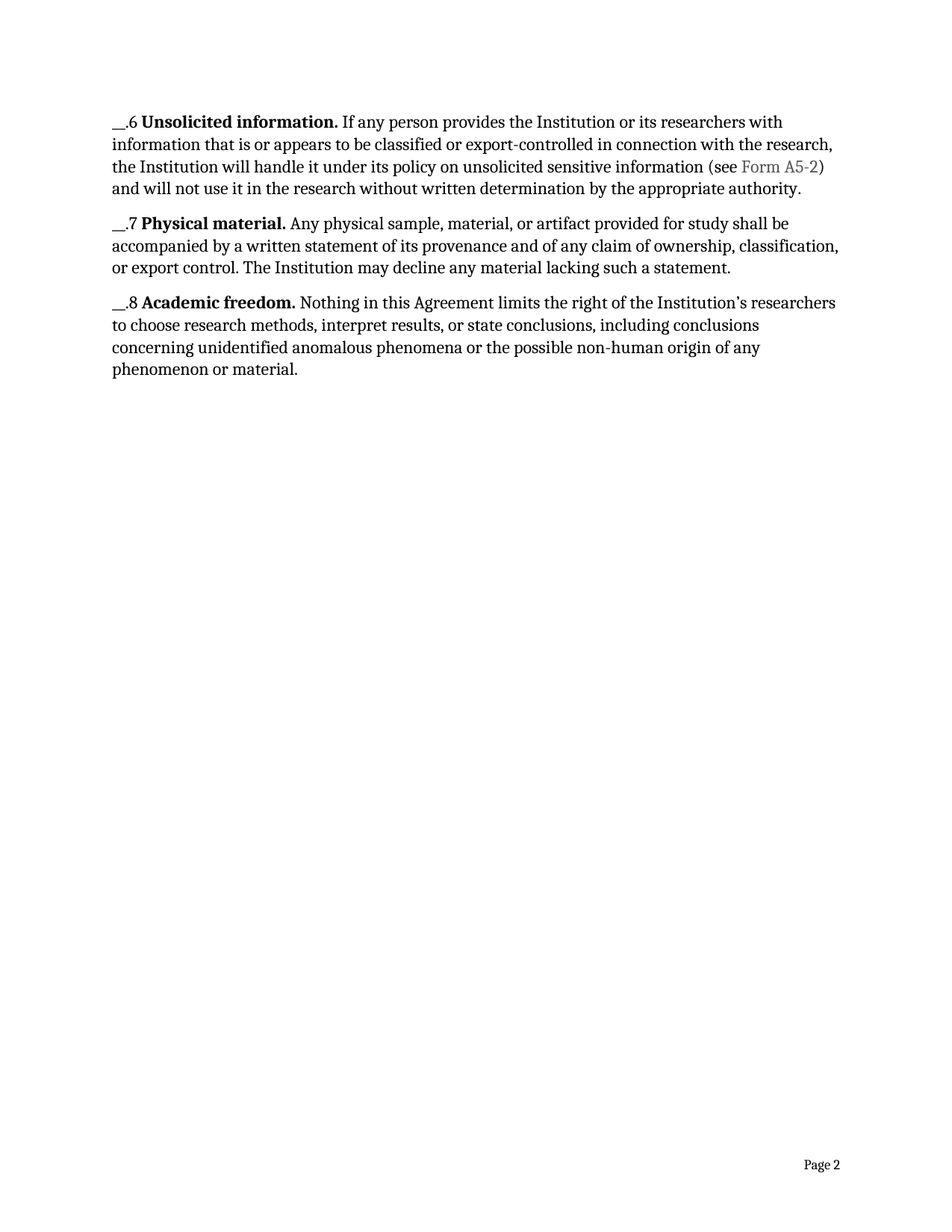
__.6 Unsolicited information. If any person provides the Institution or its researchers with information that is or appears to be classified or export-controlled in connection with the research, the Institution will handle it under its policy on unsolicited sensitive information (see Form A5-2) and will not use it in the research without written determination by the appropriate authority.
__.7 Physical material. Any physical sample, material, or artifact provided for study shall be accompanied by a written statement of its provenance and of any claim of ownership, classification, or export control. The Institution may decline any material lacking such a statement.
__.8 Academic freedom. Nothing in this Agreement limits the right of the Institution’s researchers to choose research methods, interpret results, or state conclusions, including conclusions concerning unidentified anomalous phenomena or the possible non-human origin of any phenomenon or material.