Sample documents · Issue D1. Congressional oversight
Form D1-2. Member's Request for a Committee Vote to Disclose UAP Information (S. Res. 400 §8 / House Rule X cl. 11(g))
Template. Sample template for use by or with a licensed attorney. Not legal advice. Laws differ by jurisdiction and change; adapt the document to your facts and check every citation before relying on it.
Use. Congress can release classified information itself. A member of either intelligence committee may ask the committee to vote on whether the public interest would be served by disclosing information the committee holds. If the executive branch asked that the information be kept secret, the President has five days to object personally and in writing, and the question then goes to the full chamber in closed session (Issue D1 §4).
When to use. The committee holds specific UAP information that a Member believes should be public. Not for: Information the committee does not yet have (use Form D1-1 first), or Members not on either intelligence committee, who may ask a committee member to make the request.
Deadlines. S. Res. 400 §8 and Rule X cl. 11(g) give the President five days after notification to object. The committee sets its own schedule for the vote.
The document
1 page, laid out as in the PDF and Word downloads. Select a page to open the PDF at that page.
Text version of the document
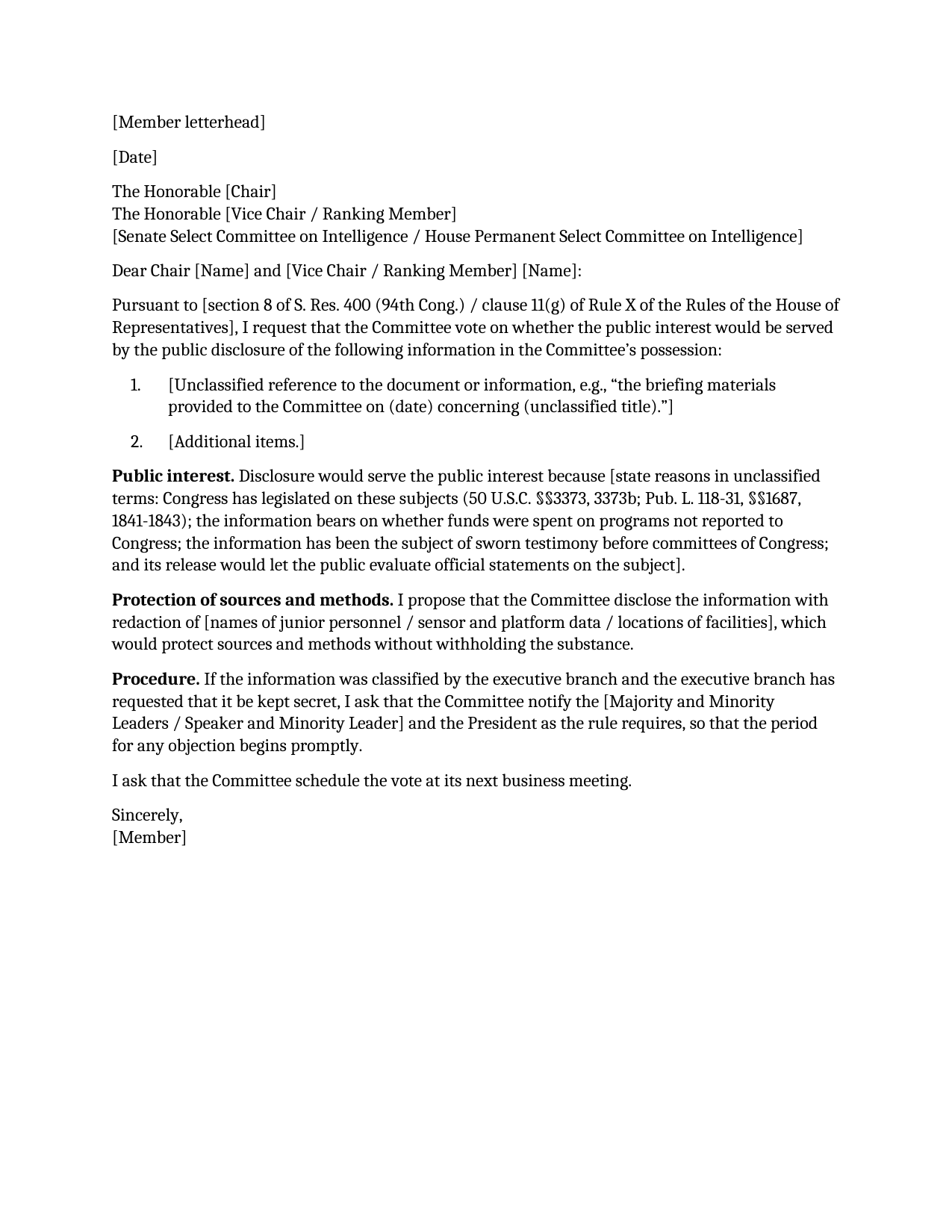
[Member letterhead]
[Date]
The Honorable [Chair] The Honorable [Vice Chair / Ranking Member] [Senate Select Committee on Intelligence / House Permanent Select Committee on Intelligence]
Dear Chair [Name] and [Vice Chair / Ranking Member] [Name]:
Pursuant to [section 8 of S. Res. 400 (94th Cong.) / clause 11(g) of Rule X of the Rules of the House of Representatives], I request that the Committee vote on whether the public interest would be served by the public disclosure of the following information in the Committee’s possession:
- [Unclassified reference to the document or information, e.g., “the briefing materials provided to the Committee on (date) concerning (unclassified title).”]
- [Additional items.]
Public interest. Disclosure would serve the public interest because [state reasons in unclassified terms: Congress has legislated on these subjects (50 U.S.C. §§3373, 3373b; Pub. L. 118-31, §§1687, 1841-1843); the information bears on whether funds were spent on programs not reported to Congress; the information has been the subject of sworn testimony before committees of Congress; and its release would let the public evaluate official statements on the subject].
Protection of sources and methods. I propose that the Committee disclose the information with redaction of [names of junior personnel / sensor and platform data / locations of facilities], which would protect sources and methods without withholding the substance.
Procedure. If the information was classified by the executive branch and the executive branch has requested that it be kept secret, I ask that the Committee notify the [Majority and Minority Leaders / Speaker and Minority Leader] and the President as the rule requires, so that the period for any objection begins promptly.
I ask that the Committee schedule the vote at its next business meeting.
Sincerely, [Member]
Drafting notes
- The rule’s text. Under S. Res. 400 §8 the Committee may disclose after determining “that the public interest would be served by such disclosure”; when the executive branch has asked for secrecy, the Committee must notify and consult the leaders and notify the President, and it may disclose after five days unless the President, “personally in writing,” objects and certifies that the threat to the national interest “is of such gravity that it outweighs any public interest in the disclosure.” The leaders or the Committee may then refer the question to the Senate (S. Res. 400 §8(a)-(b), printed in the Committee’s rules, 169 Cong. Rec. S518 (daily ed. Feb. 28, 2023)). House Rule X, clause 11(g) provides the House equivalent (Rules of the House, 119th Cong., §785).
- No precedent for completion. No chamber is known to have completed the procedure over a presidential objection. The request still forces a recorded committee decision.
- Keep the letter unclassified. Describe the information only by its unclassified title or date of receipt.
- Speech or Debate. The Member’s request and vote are legislative acts (Gravel v. United States, 408 U.S. 606, 616-17 (1972)); the protection does not extend to private republication.
- Related: Issue D1, A3, D3; Form D1-1.