Form D5-1. FTCA Administrative Claim (SF-95) Narrative Attachment for an Injury Involving a Possible UAP

Version 1.10 · October 2026 Download: PDF Word

Template. Sample template for use by or with a licensed attorney. Not legal advice. Laws differ by jurisdiction and change; adapt the document to your facts and check every citation before relying on it.

When to use. Presenting an FTCA administrative claim for injury or damage in a UAP-related event. Not for: Claims by service members incident to service, which the Feres doctrine bars, or claims under benefit programs (Issue D5).

Deadlines. Present within two years of accrual; sue within six months of a written denial (28 U.S.C. §2401(b)); after six months without a decision the claimant may treat the claim as denied (§2675(a)).

The document

1 page, laid out as in the PDF and Word downloads. Select a page to open the PDF at that page.

Form D5-1, page 1 of 1. The text version follows the pages.
Text version of the document

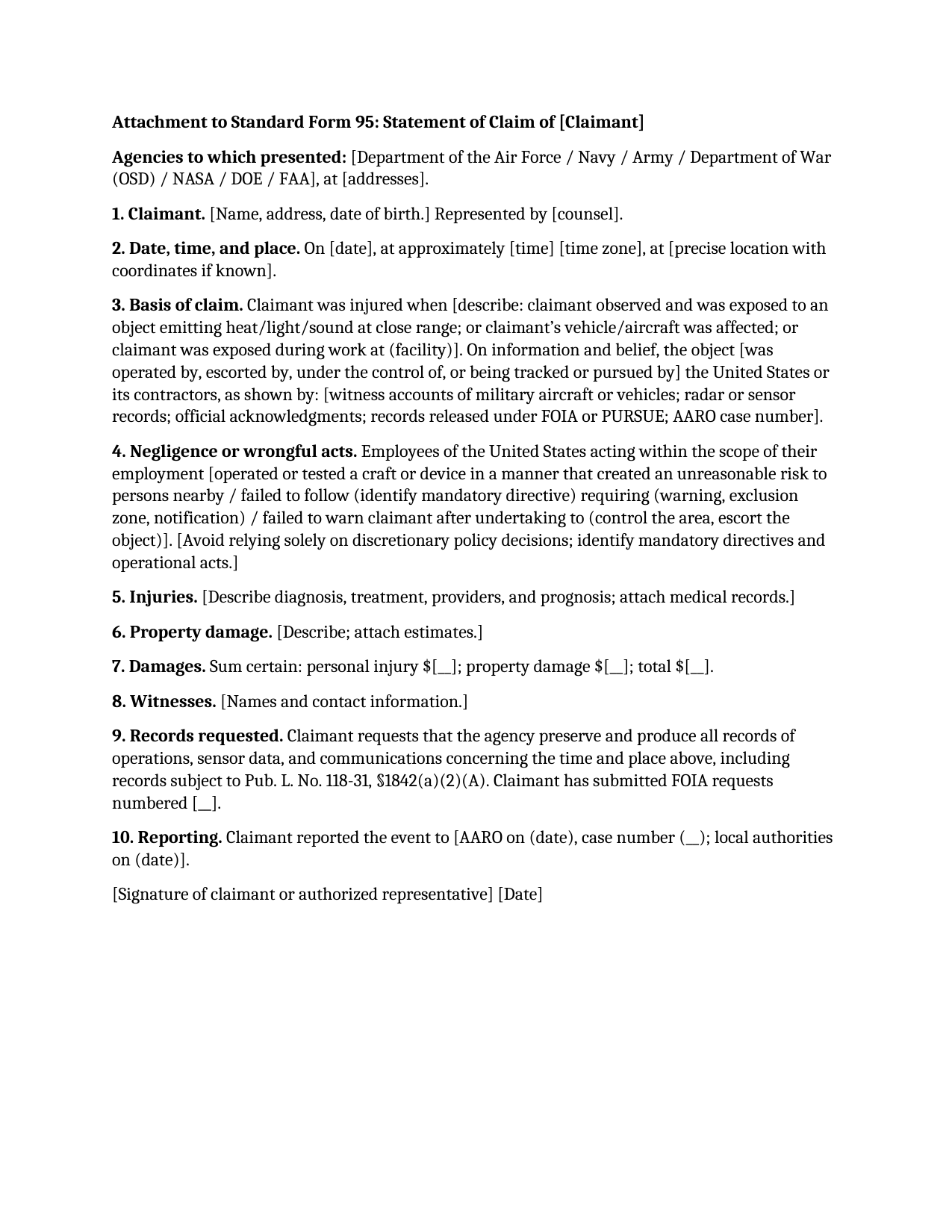
Attachment to Standard Form 95: Statement of Claim of [Claimant]

Agencies to which presented: [Department of the Air Force / Navy / Army / Department of War (OSD) / NASA / DOE / FAA], at [addresses].

1. Claimant. [Name, address, date of birth.] Represented by [counsel].

2. Date, time, and place. On [date], at approximately [time] [time zone], at [precise location with coordinates if known].

3. Basis of claim. Claimant was injured when [describe: claimant observed and was exposed to an object emitting heat/light/sound at close range; or claimant’s vehicle/aircraft was affected; or claimant was exposed during work at (facility)]. On information and belief, the object [was operated by, escorted by, under the control of, or being tracked or pursued by] the United States or its contractors, as shown by: [witness accounts of military aircraft or vehicles; radar or sensor records; official acknowledgments; records released under FOIA or PURSUE; AARO case number].

4. Negligence or wrongful acts. Employees of the United States acting within the scope of their employment [operated or tested a craft or device in a manner that created an unreasonable risk to persons nearby / failed to follow (identify mandatory directive) requiring (warning, exclusion zone, notification) / failed to warn claimant after undertaking to (control the area, escort the object)]. [Avoid relying solely on discretionary policy decisions; identify mandatory directives and operational acts.]

5. Injuries. [Describe diagnosis, treatment, providers, and prognosis; attach medical records.]

6. Property damage. [Describe; attach estimates.]

7. Damages. Sum certain: personal injury $[__]; property damage $[__]; total $[__].

8. Witnesses. [Names and contact information.]

9. Records requested. Claimant requests that the agency preserve and produce all records of operations, sensor data, and communications concerning the time and place above, including records subject to Pub. L. No. 118-31, §1842(a)(2)(A). Claimant has submitted FOIA requests numbered [__].

10. Reporting. Claimant reported the event to [AARO on (date), case number (__); local authorities on (date)].

[Signature of claimant or authorized representative] [Date]
Drafting notes

  • Sum certain. A claim is not “presented” unless it states a sum certain (28 C.F.R. §14.2(a)). Write a figure for each category and a total, for example “personal injury $750,000; property damage $12,400; total $762,400.” Do not write “in excess of $750,000,” “to be determined,” or “at least”; agencies reject those claims, and if the two-year period in 28 U.S.C. §2401(b) has run by the time the defect is noticed, the claim is barred.
  • The figure caps the lawsuit. Suit is limited to the amount claimed unless the increase rests on newly discovered evidence not reasonably discoverable when the claim was filed, or on intervening facts (28 U.S.C. §2675(b)). Claim the full value of injuries that may worsen, with medical support for future care. The claim may be amended before final agency action (28 C.F.R. §14.2(c)).
  • Timing. File within two years after the claim accrues; suit must be filed within six months after a written denial, or the claimant may treat the agency’s failure to decide within six months as a denial (28 U.S.C. §§2401(b), 2675(a)). Accrual for latent injury runs from when the claimant knew of the injury and its cause (United States v. Kubrick, 444 U.S. 111, 122 (1979)).
  • Which agency. Send the claim to every agency whose employees may have been involved; a claim sent to the wrong agency must be transferred, but filing with each avoids the dispute (28 C.F.R. §14.2(b)(1)).
  • Related: Issue D5, D4; Forms D4-1, B1-1.
↑