Form D7-1. Pilot's Letter to an Air Carrier After a UAP Report: Protected Activity and Preservation

Version 1.10 · October 2026 Download: PDF Word

Template. Sample template for use by or with a licensed attorney. Not legal advice. Laws differ by jurisdiction and change; adapt the document to your facts and check every citation before relying on it.

Use. The letter tells the carrier that the report was protected activity under AIR21, asks it to preserve the records, and asks for the basis of any action taken. It also creates the record an AIR21 complaint will rest on (Issue D7 §3).

When to use. After a crew member reports a UAP and the carrier removes the employee from duty, orders an evaluation, or signals discipline. Not for: Military or federal employees, who use 10 U.S.C. §1034 or other reprisal remedies (Issue C1).

Deadlines. The AIR21 complaint to OSHA must be filed within 90 days of the adverse action (49 U.S.C. §42121(b)(1)). This letter does not extend that period.

The document

2 pages, laid out as in the PDF and Word downloads. Select a page to open the PDF at that page.

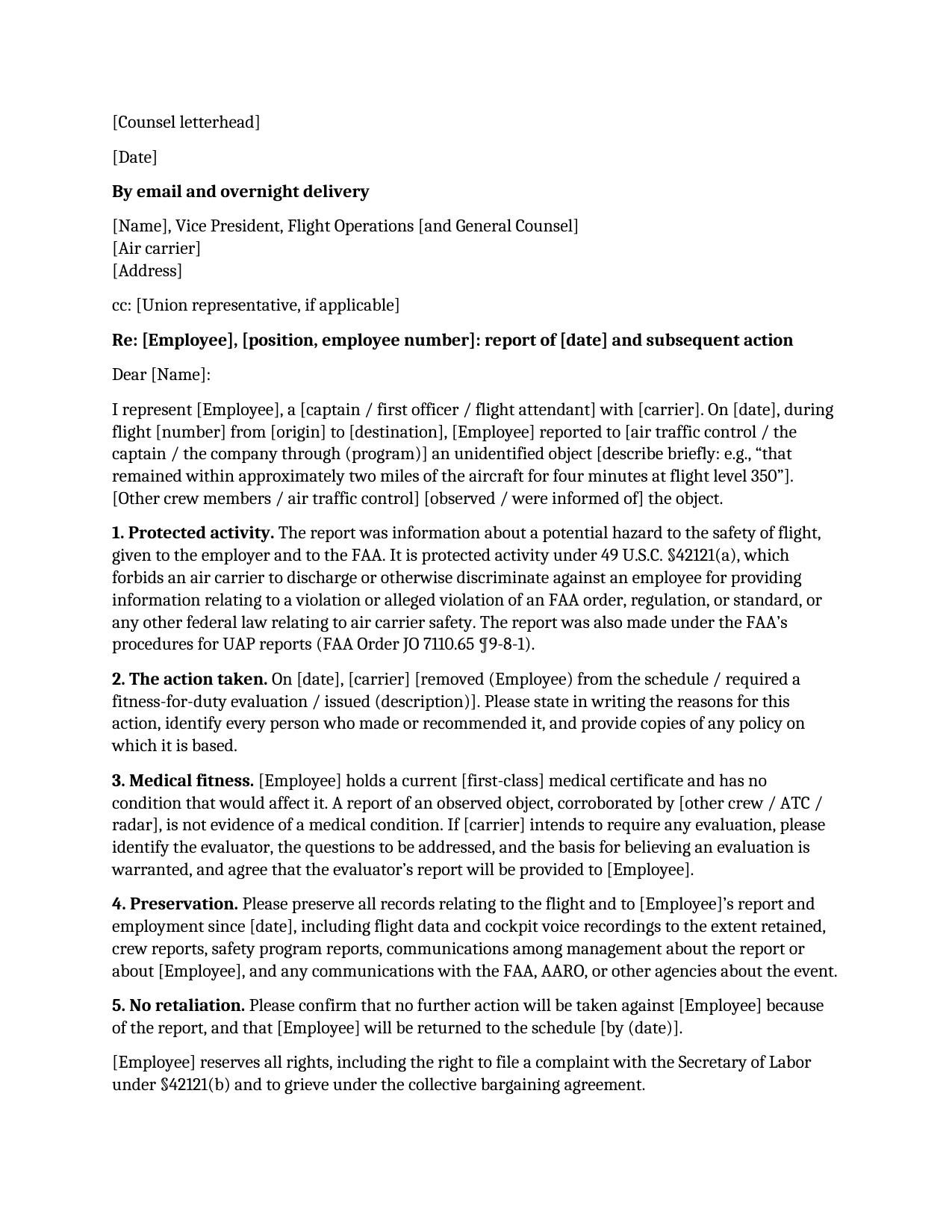
Form D7-1, page 1 of 2. The text version follows the pages. Form D7-1, page 2 of 2. The text version follows the pages.
Text version of the document

[Counsel letterhead]

[Date]

By email and overnight delivery

[Name], Vice President, Flight Operations [and General Counsel] [Air carrier] [Address]

cc: [Union representative, if applicable]

Re: [Employee], [position, employee number]: report of [date] and subsequent action

Dear [Name]:

I represent [Employee], a [captain / first officer / flight attendant] with [carrier]. On [date], during flight [number] from [origin] to [destination], [Employee] reported to [air traffic control / the captain / the company through (program)] an unidentified object [describe briefly: e.g., “that remained within approximately two miles of the aircraft for four minutes at flight level 350”]. [Other crew members / air traffic control] [observed / were informed of] the object.

1. Protected activity. The report was information about a potential hazard to the safety of flight, given to the employer and to the FAA. It is protected activity under 49 U.S.C. §42121(a), which forbids an air carrier to discharge or otherwise discriminate against an employee for providing information relating to a violation or alleged violation of an FAA order, regulation, or standard, or any other federal law relating to air carrier safety. The report was also made under the FAA’s procedures for UAP reports (FAA Order JO 7110.65 ¶9-8-1).

2. The action taken. On [date], [carrier] [removed (Employee) from the schedule / required a fitness-for-duty evaluation / issued (description)]. Please state in writing the reasons for this action, identify every person who made or recommended it, and provide copies of any policy on which it is based.

3. Medical fitness. [Employee] holds a current [first-class] medical certificate and has no condition that would affect it. A report of an observed object, corroborated by [other crew / ATC / radar], is not evidence of a medical condition. If [carrier] intends to require any evaluation, please identify the evaluator, the questions to be addressed, and the basis for believing an evaluation is warranted, and agree that the evaluator’s report will be provided to [Employee].

4. Preservation. Please preserve all records relating to the flight and to [Employee]’s report and employment since [date], including flight data and cockpit voice recordings to the extent retained, crew reports, safety program reports, communications among management about the report or about [Employee], and any communications with the FAA, AARO, or other agencies about the event.

5. No retaliation. Please confirm that no further action will be taken against [Employee] because of the report, and that [Employee] will be returned to the schedule [by (date)].

[Employee] reserves all rights, including the right to file a complaint with the Secretary of Labor under §42121(b) and to grieve under the collective bargaining agreement.

Sincerely, [Counsel]
Drafting notes

  • File with OSHA on time. Do not wait for the carrier’s answer. If an adverse action has occurred, the 90-day period is running.
  • The union. A grievance under the collective bargaining agreement runs separately under the Railway Labor Act (45 U.S.C. §184). Coordinate with the union’s representative before sending.
  • ASRS. If the event involved any deviation from a clearance, confirm that an ASRS report was filed within 10 days (AC 00-46F ¶12.3.4).
  • FAA letters. If the FAA has also sent a letter of investigation, do not respond without counsel; a response is optional and may be used as evidence (Pilot’s Bill of Rights §2(b)).
  • Describe, do not characterize. Paragraph 1 should describe what was seen in the crew’s words. Do not call the object a craft or attribute it to anyone.
  • Paragraph 3 and the evaluation. A compulsory evaluation under the pilots’ contract is not retaliation in itself, but becomes an adverse action when it is pretextual or in bad faith; the length of the process and the treatment of other pilots are the main evidence. Petitt v. Delta Airlines, Inc., ARB No. 2021-0014, 2022 WL 1091413, at *9-11 (ARB Mar. 29, 2022). Ask for the carrier’s referral criteria and for how often it has referred other pilots who made safety reports.
  • The employee’s own conduct. A carrier wins when it can point to the employee’s later conduct as the reason for the referral. Robinson v. Northwest Airlines, Inc., ARB No. 04-041, 2005 WL 3263822 (ARB Nov. 30, 2005). Advise the client to keep every later statement about the event, to the carrier and in public, factual.
  • Manual entries. If the carrier’s manual required the report or logbook entry, say so in paragraph 1; an entry the manual requires is protected activity. Continental Airlines, Inc. v. Administrative Review Board, 638 F. App’x 283, 287-89 (5th Cir. 2016).
  • Related: Issue D7, D4, E5; Forms D4-1, E5-2.
↑