Sample documents · Issue E3. Found material
Form E3-1. Declaration of Provenance and Chain of Custody for Found Material
Template. Sample template for use by or with a licensed attorney. Not legal advice. Laws differ by jurisdiction and change; adapt the document to your facts and check every citation before relying on it.
When to use. A finder or landowner documenting provenance and custody of material found on private land. Not for: Material obtained from a government program.
Deadlines. Prepare as soon as possible after discovery and update at each transfer.
The document
2 pages, laid out as in the PDF and Word downloads. Select a page to open the PDF at that page.
Text version of the document
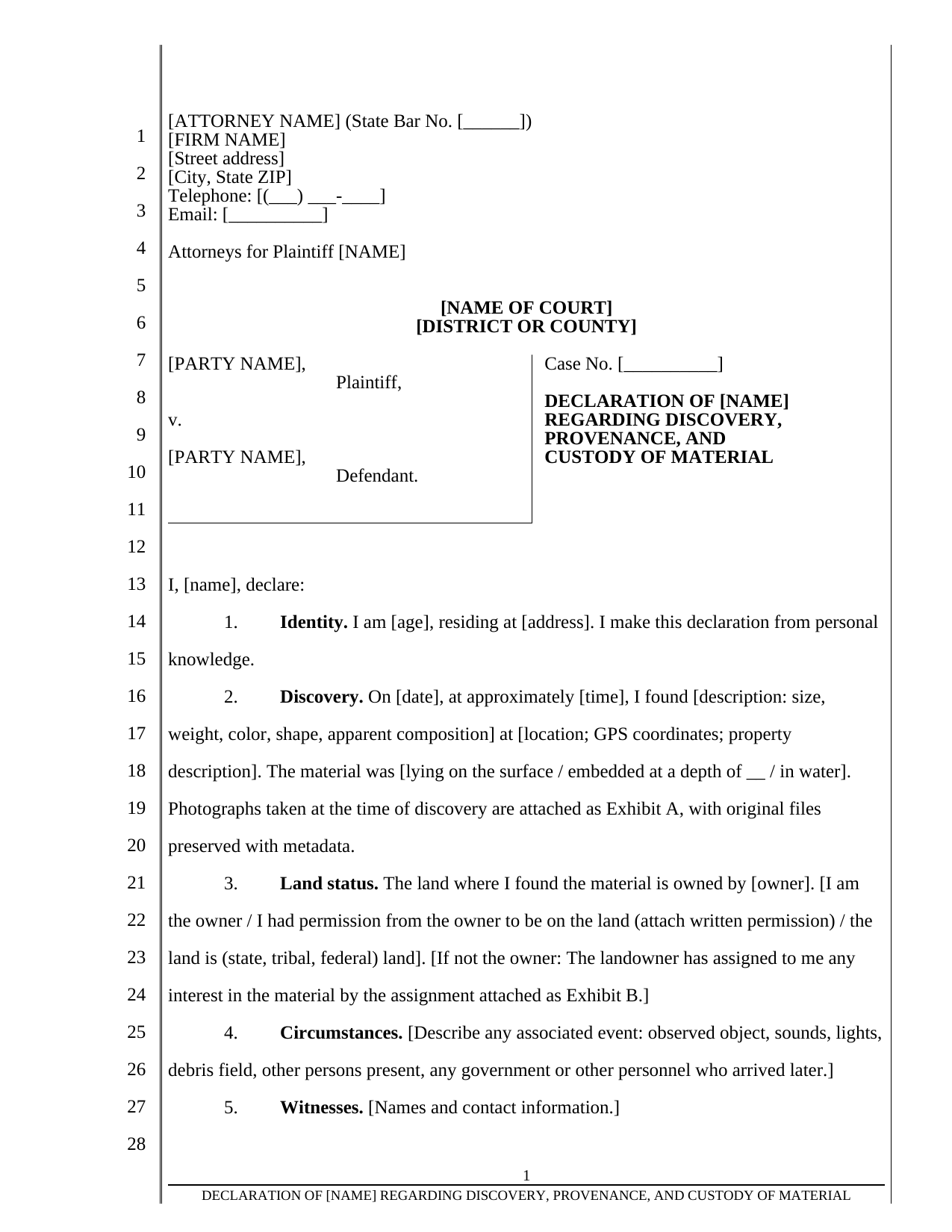
DECLARATION OF [NAME] REGARDING DISCOVERY, PROVENANCE, AND CUSTODY OF MATERIAL
I, [name], declare:
Identity. I am [age], residing at [address]. I make this declaration from personal knowledge.
Discovery. On [date], at approximately [time], I found [description: size, weight, color, shape, apparent composition] at [location; GPS coordinates; property description]. The material was [lying on the surface / embedded at a depth of __ / in water]. Photographs taken at the time of discovery are attached as Exhibit A, with original files preserved with metadata.
Land status. The land where I found the material is owned by [owner]. [I am the owner / I had permission from the owner to be on the land (attach written permission) / the land is (state, tribal, federal) land]. [If not the owner: The landowner has assigned to me any interest in the material by the assignment attached as Exhibit B.]
Circumstances. [Describe any associated event: observed object, sounds, lights, debris field, other persons present, any government or other personnel who arrived later.]
Witnesses. [Names and contact information.]
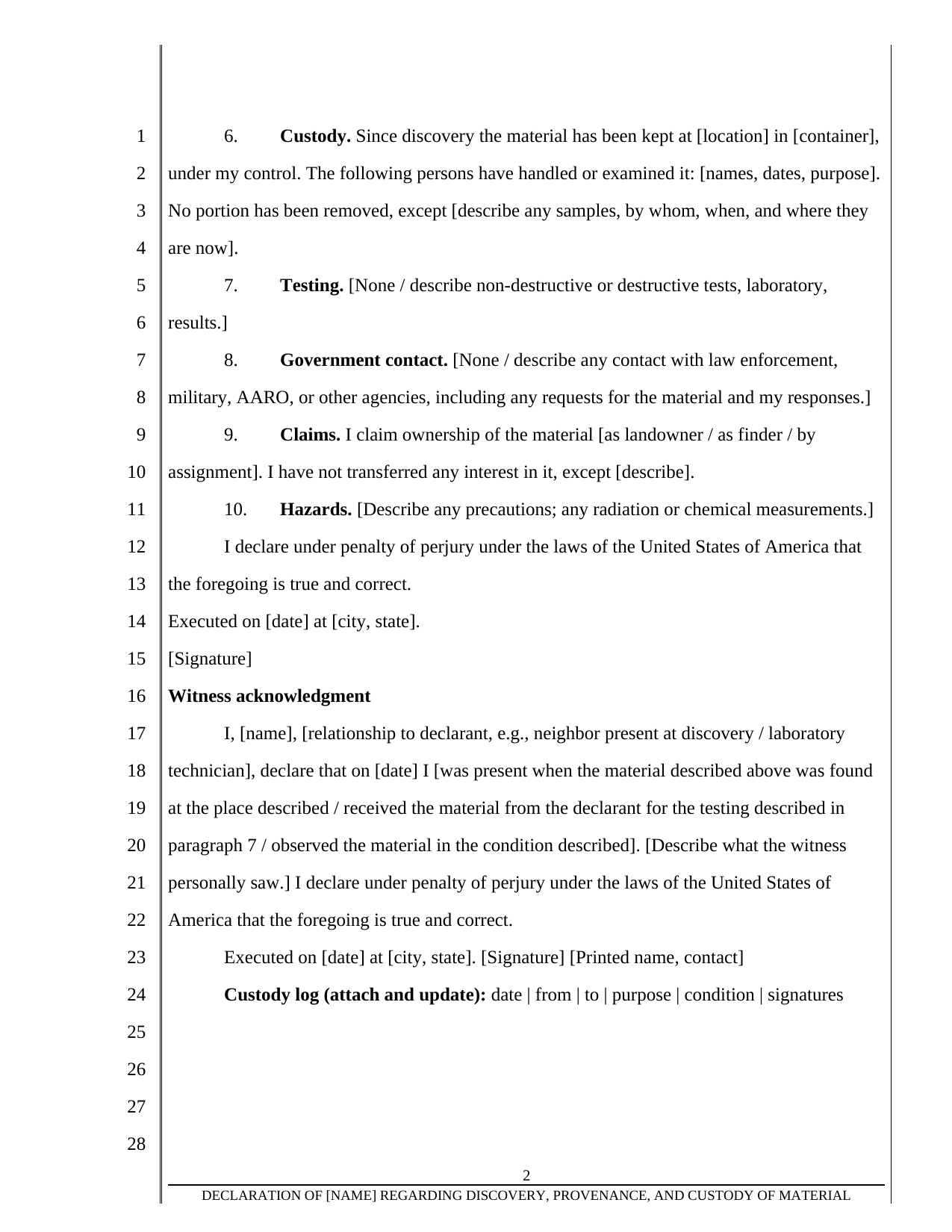
Custody. Since discovery the material has been kept at [location] in [container], under my control. The following persons have handled or examined it: [names, dates, purpose]. No portion has been removed, except [describe any samples, by whom, when, and where they are now].
Testing. [None / describe non-destructive or destructive tests, laboratory, results.]
Government contact. [None / describe any contact with law enforcement, military, AARO, or other agencies, including any requests for the material and my responses.]
Claims. I claim ownership of the material [as landowner / as finder / by assignment]. I have not transferred any interest in it, except [describe].
Hazards. [Describe any precautions; any radiation or chemical measurements.]
I declare under penalty of perjury under the laws of the United States of America that the foregoing is true and correct.
Executed on [date] at [city, state].
[Signature]
Witness acknowledgment
I, [name], [relationship to declarant, e.g., neighbor present at discovery / laboratory technician], declare that on [date] I [was present when the material described above was found at the place described / received the material from the declarant for the testing described in paragraph 7 / observed the material in the condition described]. [Describe what the witness personally saw.] I declare under penalty of perjury under the laws of the United States of America that the foregoing is true and correct.
Executed on [date] at [city, state]. [Signature] [Printed name, contact]
Custody log (attach and update): date | from | to | purpose | condition | signatures
Drafting notes
- Witnesses. Have each person who was present at discovery, or who handled the material, sign a witness acknowledgment as soon as possible. Contemporaneous statements are the best answer to an authentication challenge under Fed. R. Evid. 901(b)(1) and to a later claim that the material was planted or substituted.
- Photographs and location. Photograph the material where found before moving it, with a scale and a GPS-tagged image, and photograph each container seal. Keep the original files with their metadata.
- Testing protocol.
- Begin with non-destructive tests (photography, weight, dimensions, X-ray fluorescence, radiation survey).
- Use an independent, accredited laboratory (ISO/IEC 17025) with its own chain-of-custody forms.
- Split any sample used for destructive testing, keep a retained portion sealed, and record its weight.
- Have the laboratory describe methods and uncertainty in its report, so the results can meet Fed. R. Evid. 702.
- Do not send material outside the United States, or give foreign nationals access to technical results, without export-control advice (Issue A5).
- Hazards. If a radiation or chemical measurement is elevated, stop and contact the state radiation control program or a hazardous materials professional before further handling.
- Related: Issue E3, E1; Forms E1-1, A5-1.