Part A. Risk factor (Item 105)
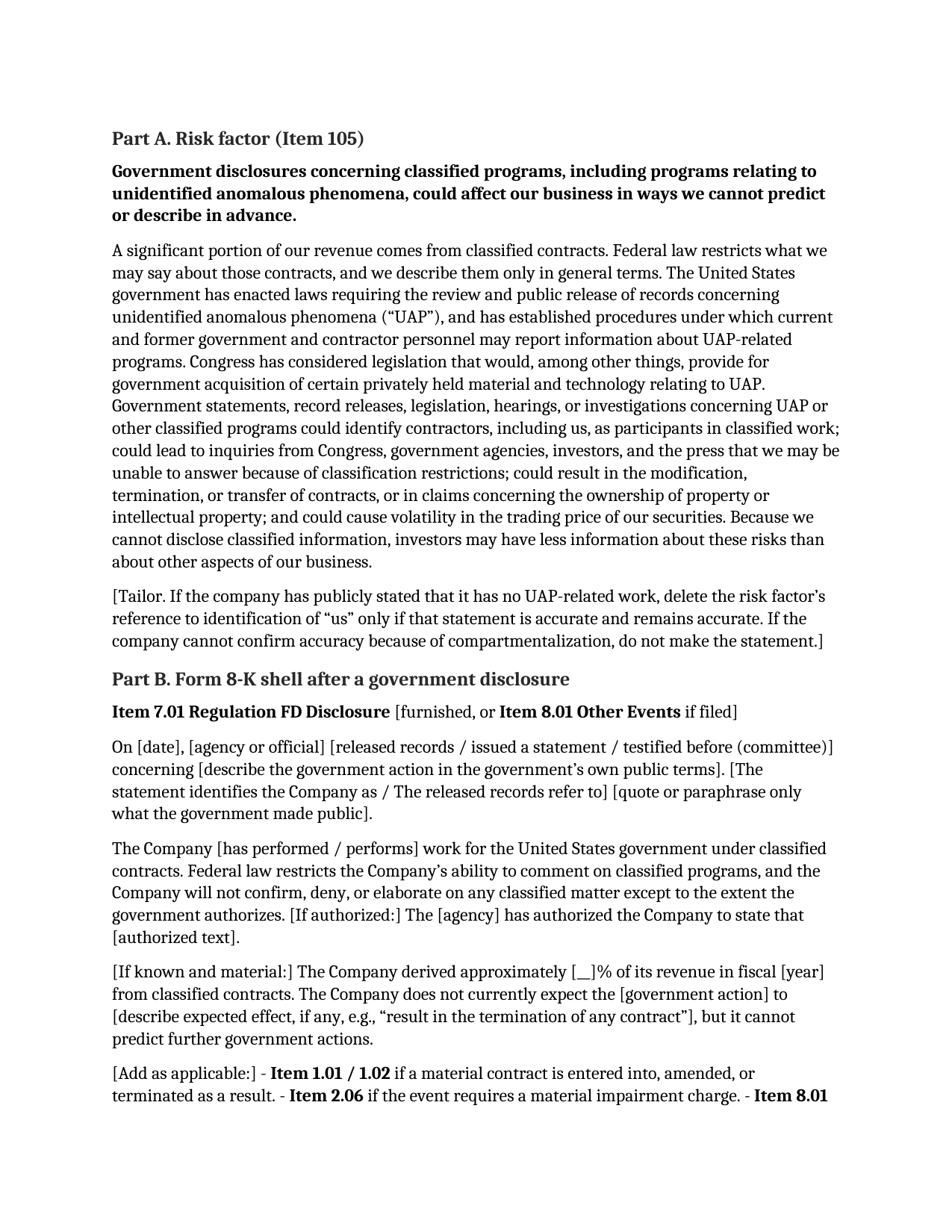
Government disclosures concerning classified programs, including programs relating to unidentified anomalous phenomena, could affect our business in ways we cannot predict or describe in advance.
A significant portion of our revenue comes from classified contracts. Federal law restricts what we may say about those contracts, and we describe them only in general terms. The United States government has enacted laws requiring the review and public release of records concerning unidentified anomalous phenomena (“UAP”), and has established procedures under which current and former government and contractor personnel may report information about UAP-related programs. Congress has considered legislation that would, among other things, provide for government acquisition of certain privately held material and technology relating to UAP. Government statements, record releases, legislation, hearings, or investigations concerning UAP or other classified programs could identify contractors, including us, as participants in classified work; could lead to inquiries from Congress, government agencies, investors, and the press that we may be unable to answer because of classification restrictions; could result in the modification, termination, or transfer of contracts, or in claims concerning the ownership of property or intellectual property; and could cause volatility in the trading price of our securities. Because we cannot disclose classified information, investors may have less information about these risks than about other aspects of our business.
[Tailor. If the company has publicly stated that it has no UAP-related work, delete the risk factor’s reference to identification of “us” only if that statement is accurate and remains accurate. If the company cannot confirm accuracy because of compartmentalization, do not make the statement.]
Item 7.01 Regulation FD Disclosure [furnished, or Item 8.01 Other Events if filed]
On [date], [agency or official] [released records / issued a statement / testified before (committee)] concerning [describe the government action in the government’s own public terms]. [The statement identifies the Company as / The released records refer to] [quote or paraphrase only what the government made public].
The Company [has performed / performs] work for the United States government under classified contracts. Federal law restricts the Company’s ability to comment on classified programs, and the Company will not confirm, deny, or elaborate on any classified matter except to the extent the government authorizes. [If authorized:] The [agency] has authorized the Company to state that [authorized text].
[If known and material:] The Company derived approximately [__]% of its revenue in fiscal [year] from classified contracts. The Company does not currently expect the [government action] to [describe expected effect, if any, e.g., “result in the termination of any contract”], but it cannot predict further government actions.
[Add as applicable:] - Item 1.01 / 1.02 if a material contract is entered into, amended, or terminated as a result. - Item 2.06 if the event requires a material impairment charge. - Item 8.01 for a government demand to inspect, transfer, or acquire Company property (see Issue E1), describing the demand in unclassified terms.
Forward-looking statements. [Standard safe-harbor language, adapted to identify the government action, contract modifications, property claims, and investigations as risk factors.]
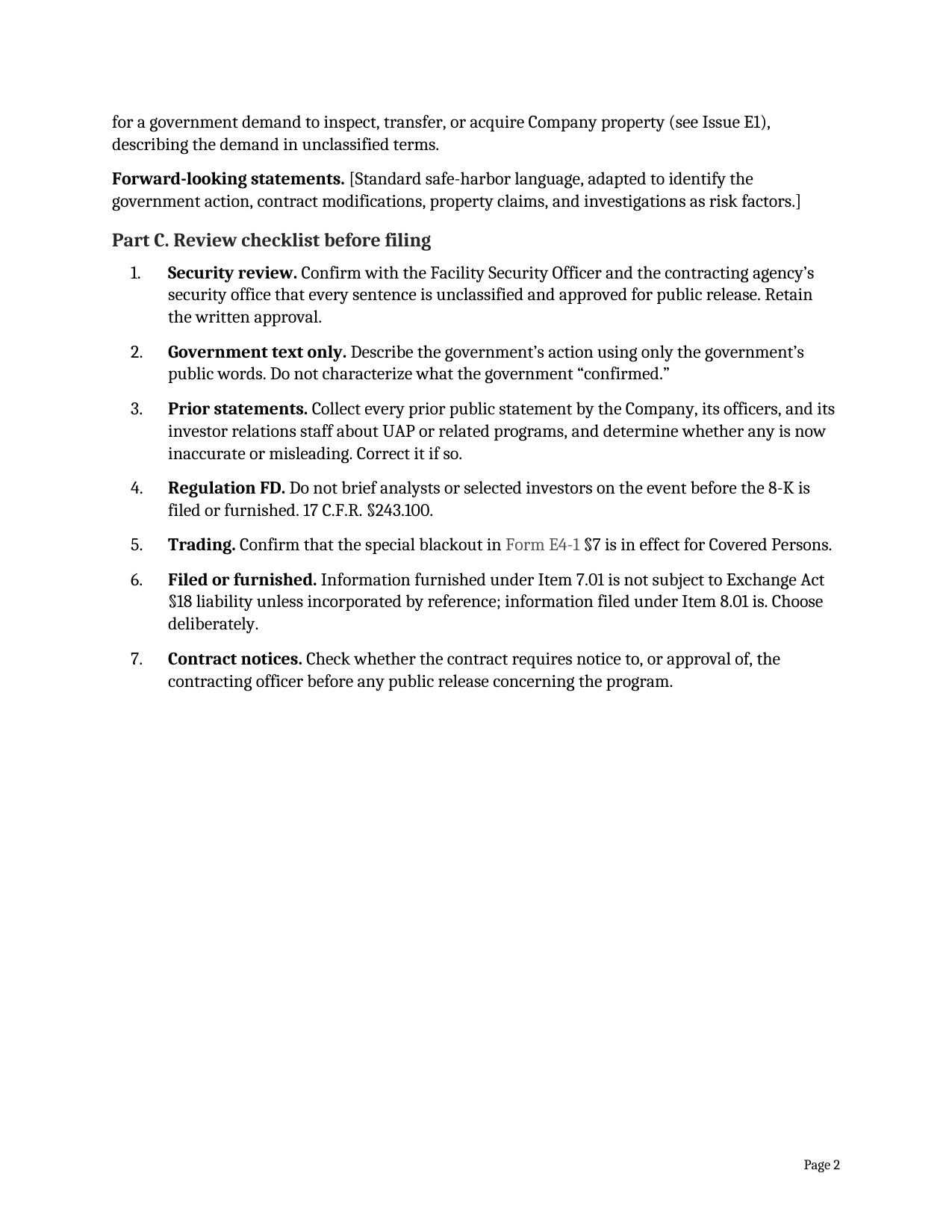
Part C. Review checklist before filing
- Security review. Confirm with the Facility Security Officer and the contracting agency’s security office that every sentence is unclassified and approved for public release. Retain the written approval.
- Government text only. Describe the government’s action using only the government’s public words. Do not characterize what the government “confirmed.”
- Prior statements. Collect every prior public statement by the Company, its officers, and its investor relations staff about UAP or related programs, and determine whether any is now inaccurate or misleading. Correct it if so.
- Regulation FD. Do not brief analysts or selected investors on the event before the 8-K is filed or furnished. 17 C.F.R. §243.100.
- Trading. Confirm that the special blackout in Form E4-1 §7 is in effect for Covered Persons.
- Filed or furnished. Information furnished under Item 7.01 is not subject to Exchange Act §18 liability unless incorporated by reference; information filed under Item 8.01 is. Choose deliberately.
- Contract notices. Check whether the contract requires notice to, or approval of, the contracting officer before any public release concerning the program.