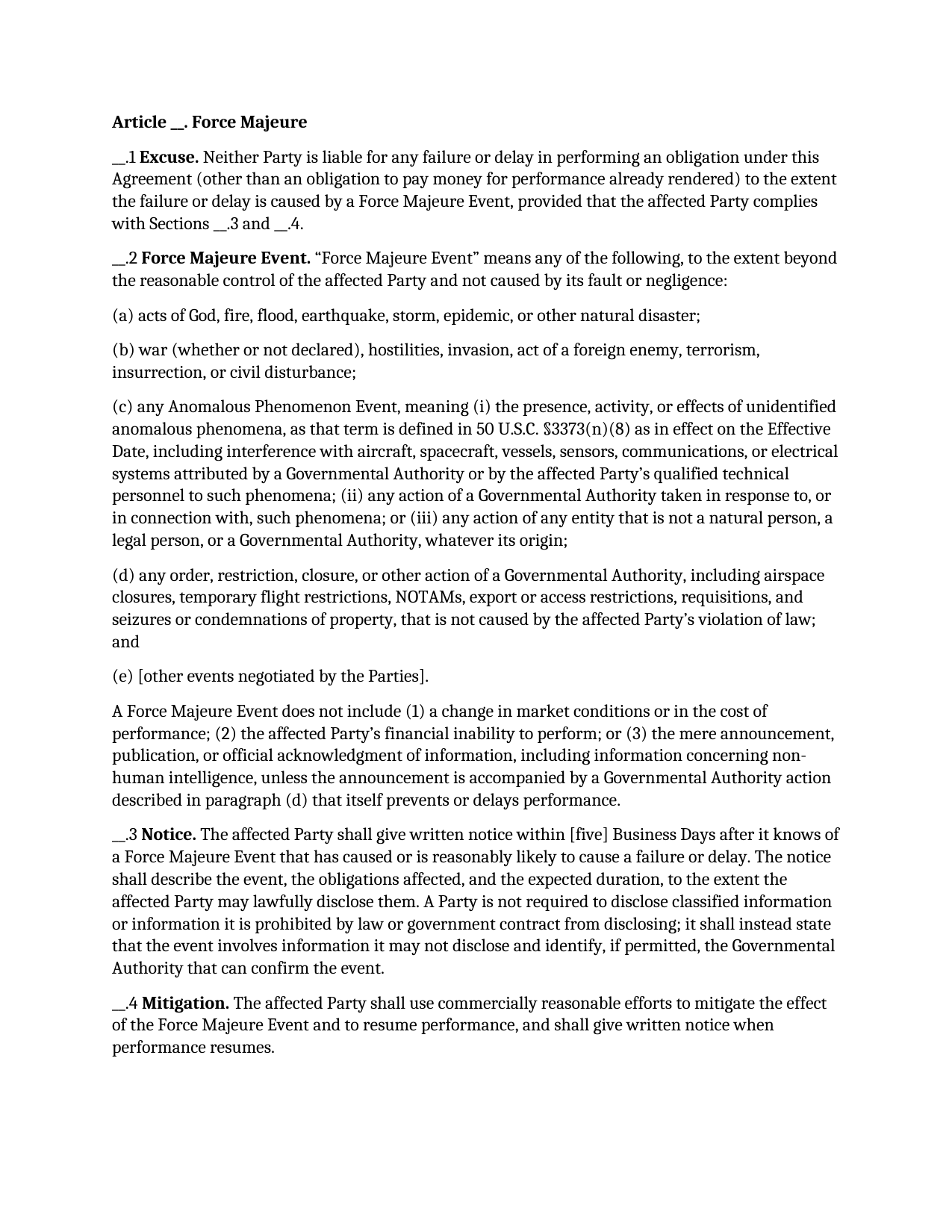
Article __. Force Majeure
__.1 Excuse. Neither Party is liable for any failure or delay in performing an obligation under this Agreement (other than an obligation to pay money for performance already rendered) to the extent the failure or delay is caused by a Force Majeure Event, provided that the affected Party complies with Sections __.3 and __.4.
__.2 Force Majeure Event. “Force Majeure Event” means any of the following, to the extent beyond the reasonable control of the affected Party and not caused by its fault or negligence:
(a) acts of God, fire, flood, earthquake, storm, epidemic, or other natural disaster;
(b) war (whether or not declared), hostilities, invasion, act of a foreign enemy, terrorism, insurrection, or civil disturbance;
(c) any Anomalous Phenomenon Event, meaning (i) the presence, activity, or effects of unidentified anomalous phenomena, as that term is defined in 50 U.S.C. §3373(n)(8) as in effect on the Effective Date, including interference with aircraft, spacecraft, vessels, sensors, communications, or electrical systems attributed by a Governmental Authority or by the affected Party’s qualified technical personnel to such phenomena; (ii) any action of a Governmental Authority taken in response to, or in connection with, such phenomena; or (iii) any action of any entity that is not a natural person, a legal person, or a Governmental Authority, whatever its origin;
(d) any order, restriction, closure, or other action of a Governmental Authority, including airspace closures, temporary flight restrictions, NOTAMs, export or access restrictions, requisitions, and seizures or condemnations of property, that is not caused by the affected Party’s violation of law; and
(e) [other events negotiated by the Parties].
A Force Majeure Event does not include (1) a change in market conditions or in the cost of performance; (2) the affected Party’s financial inability to perform; or (3) the mere announcement, publication, or official acknowledgment of information, including information concerning non-human intelligence, unless the announcement is accompanied by a Governmental Authority action described in paragraph (d) that itself prevents or delays performance.
__.3 Notice. The affected Party shall give written notice within [five] Business Days after it knows of a Force Majeure Event that has caused or is reasonably likely to cause a failure or delay. The notice shall describe the event, the obligations affected, and the expected duration, to the extent the affected Party may lawfully disclose them. A Party is not required to disclose classified information or information it is prohibited by law or government contract from disclosing; it shall instead state that the event involves information it may not disclose and identify, if permitted, the Governmental Authority that can confirm the event.
__.4 Mitigation. The affected Party shall use commercially reasonable efforts to mitigate the effect of the Force Majeure Event and to resume performance, and shall give written notice when performance resumes.
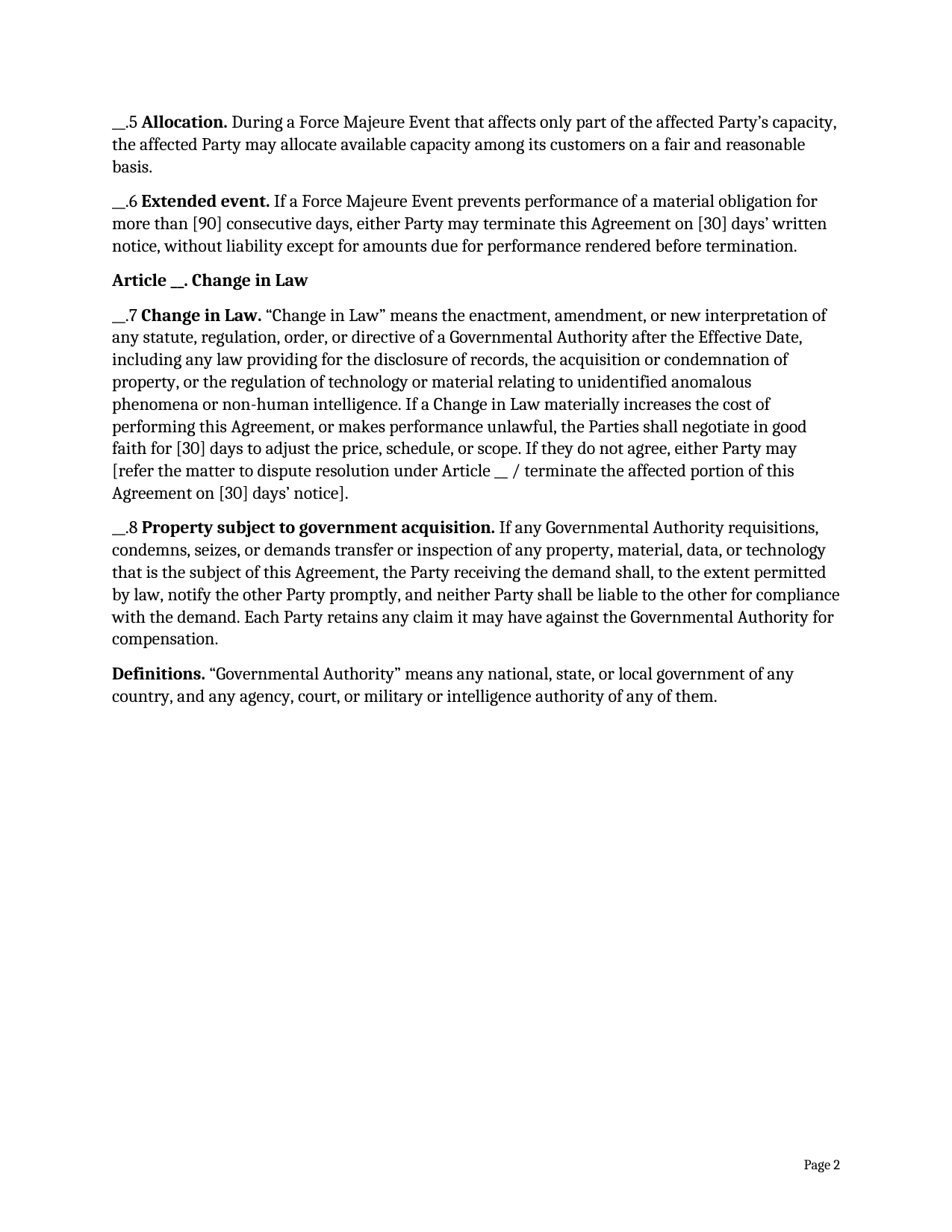
__.5 Allocation. During a Force Majeure Event that affects only part of the affected Party’s capacity, the affected Party may allocate available capacity among its customers on a fair and reasonable basis.
__.6 Extended event. If a Force Majeure Event prevents performance of a material obligation for more than [90] consecutive days, either Party may terminate this Agreement on [30] days’ written notice, without liability except for amounts due for performance rendered before termination.
Article __. Change in Law
__.7 Change in Law. “Change in Law” means the enactment, amendment, or new interpretation of any statute, regulation, order, or directive of a Governmental Authority after the Effective Date, including any law providing for the disclosure of records, the acquisition or condemnation of property, or the regulation of technology or material relating to unidentified anomalous phenomena or non-human intelligence. If a Change in Law materially increases the cost of performing this Agreement, or makes performance unlawful, the Parties shall negotiate in good faith for [30] days to adjust the price, schedule, or scope. If they do not agree, either Party may [refer the matter to dispute resolution under Article __ / terminate the affected portion of this Agreement on [30] days’ notice].
__.8 Property subject to government acquisition. If any Governmental Authority requisitions, condemns, seizes, or demands transfer or inspection of any property, material, data, or technology that is the subject of this Agreement, the Party receiving the demand shall, to the extent permitted by law, notify the other Party promptly, and neither Party shall be liable to the other for compliance with the demand. Each Party retains any claim it may have against the Governmental Authority for compensation.
Definitions. “Governmental Authority” means any national, state, or local government of any country, and any agency, court, or military or intelligence authority of any of them.