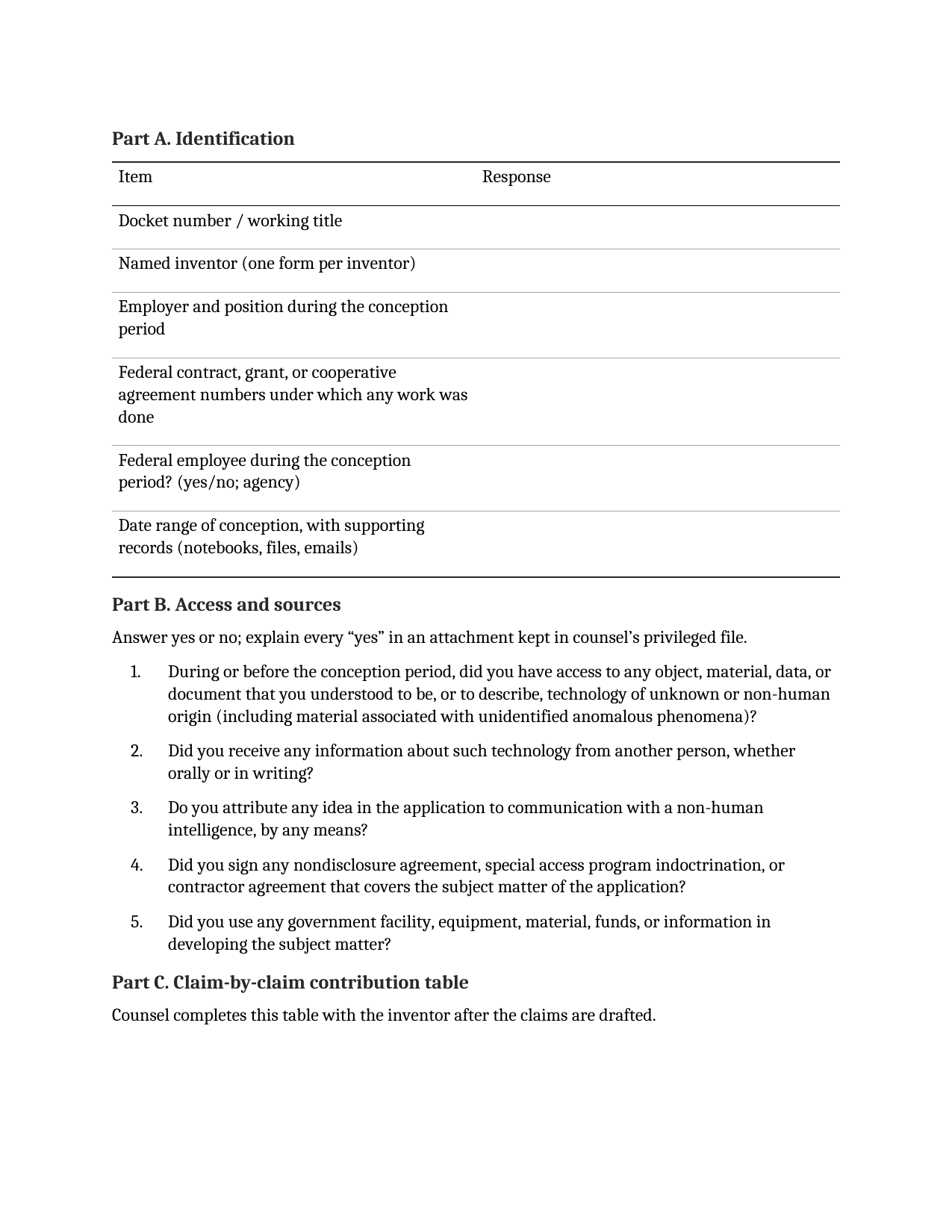
Part A. Identification
| Docket number / working title |
|
| Named inventor (one form per inventor) |
|
| Employer and position during the conception period |
|
| Federal contract, grant, or cooperative agreement numbers under which any work was done |
|
| Federal employee during the conception period? (yes/no; agency) |
|
| Date range of conception, with supporting records (notebooks, files, emails) |
|
Part B. Access and sources
Answer yes or no; explain every “yes” in an attachment kept in counsel’s privileged file.
- During or before the conception period, did you have access to any object, material, data, or document that you understood to be, or to describe, technology of unknown or non-human origin (including material associated with unidentified anomalous phenomena)?
- Did you receive any information about such technology from another person, whether orally or in writing?
- Do you attribute any idea in the application to communication with a non-human intelligence, by any means?
- Did you sign any nondisclosure agreement, special access program indoctrination, or contractor agreement that covers the subject matter of the application?
- Did you use any government facility, equipment, material, funds, or information in developing the subject matter?
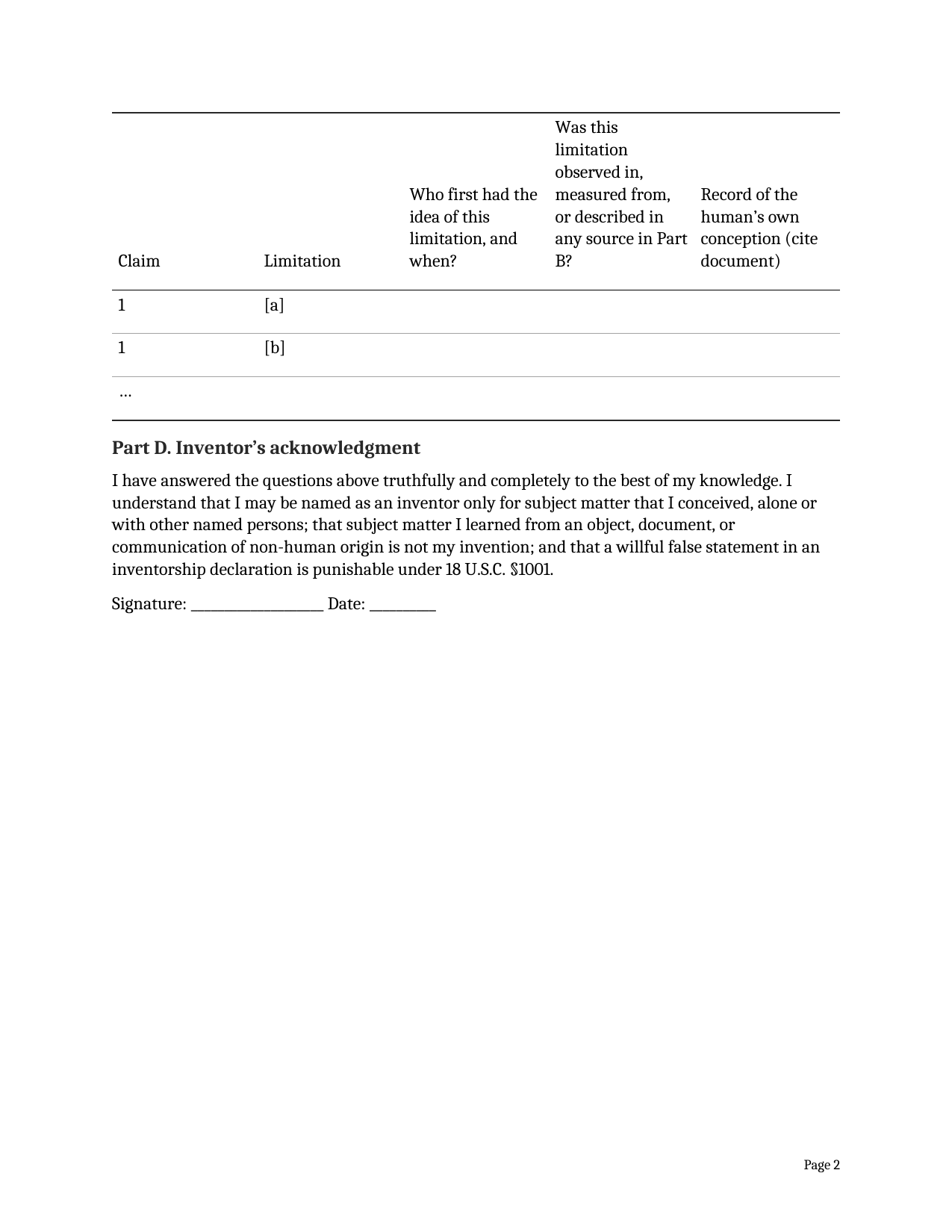
Part C. Claim-by-claim contribution table
Counsel completes this table with the inventor after the claims are drafted.
Part D. Inventor’s acknowledgment
I have answered the questions above truthfully and completely to the best of my knowledge. I understand that I may be named as an inventor only for subject matter that I conceived, alone or with other named persons; that subject matter I learned from an object, document, or communication of non-human origin is not my invention; and that a willful false statement in an inventorship declaration is punishable under 18 U.S.C. §1001.
Signature: ____________________ Date: __________
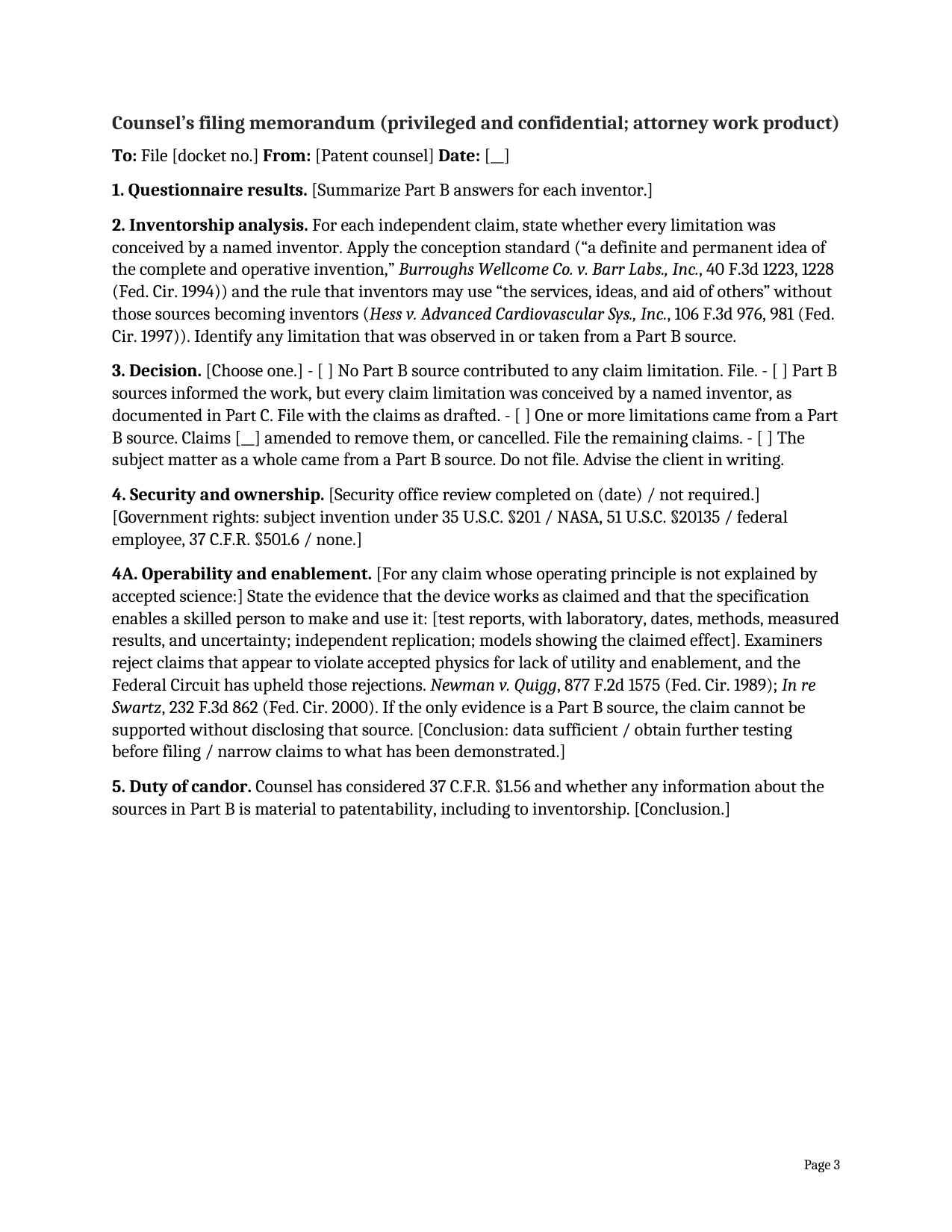
Counsel’s filing memorandum (privileged and confidential; attorney work product)
To: File [docket no.] From: [Patent counsel] Date: [__]
1. Questionnaire results. [Summarize Part B answers for each inventor.]
2. Inventorship analysis. For each independent claim, state whether every limitation was conceived by a named inventor. Apply the conception standard (“a definite and permanent idea of the complete and operative invention,” Burroughs Wellcome Co. v. Barr Labs., Inc., 40 F.3d 1223, 1228 (Fed. Cir. 1994)) and the rule that inventors may use “the services, ideas, and aid of others” without those sources becoming inventors (Hess v. Advanced Cardiovascular Sys., Inc., 106 F.3d 976, 981 (Fed. Cir. 1997)). Identify any limitation that was observed in or taken from a Part B source.
3. Decision. [Choose one.] - [ ] No Part B source contributed to any claim limitation. File. - [ ] Part B sources informed the work, but every claim limitation was conceived by a named inventor, as documented in Part C. File with the claims as drafted. - [ ] One or more limitations came from a Part B source. Claims [__] amended to remove them, or cancelled. File the remaining claims. - [ ] The subject matter as a whole came from a Part B source. Do not file. Advise the client in writing.
4. Security and ownership. [Security office review completed on (date) / not required.] [Government rights: subject invention under 35 U.S.C. §201 / NASA, 51 U.S.C. §20135 / federal employee, 37 C.F.R. §501.6 / none.]
4A. Operability and enablement. [For any claim whose operating principle is not explained by accepted science:] State the evidence that the device works as claimed and that the specification enables a skilled person to make and use it: [test reports, with laboratory, dates, methods, measured results, and uncertainty; independent replication; models showing the claimed effect]. Examiners reject claims that appear to violate accepted physics for lack of utility and enablement, and the Federal Circuit has upheld those rejections. Newman v. Quigg, 877 F.2d 1575 (Fed. Cir. 1989); In re Swartz, 232 F.3d 862 (Fed. Cir. 2000). If the only evidence is a Part B source, the claim cannot be supported without disclosing that source. [Conclusion: data sufficient / obtain further testing before filing / narrow claims to what has been demonstrated.]
5. Duty of candor. Counsel has considered 37 C.F.R. §1.56 and whether any information about the sources in Part B is material to patentability, including to inventorship. [Conclusion.]