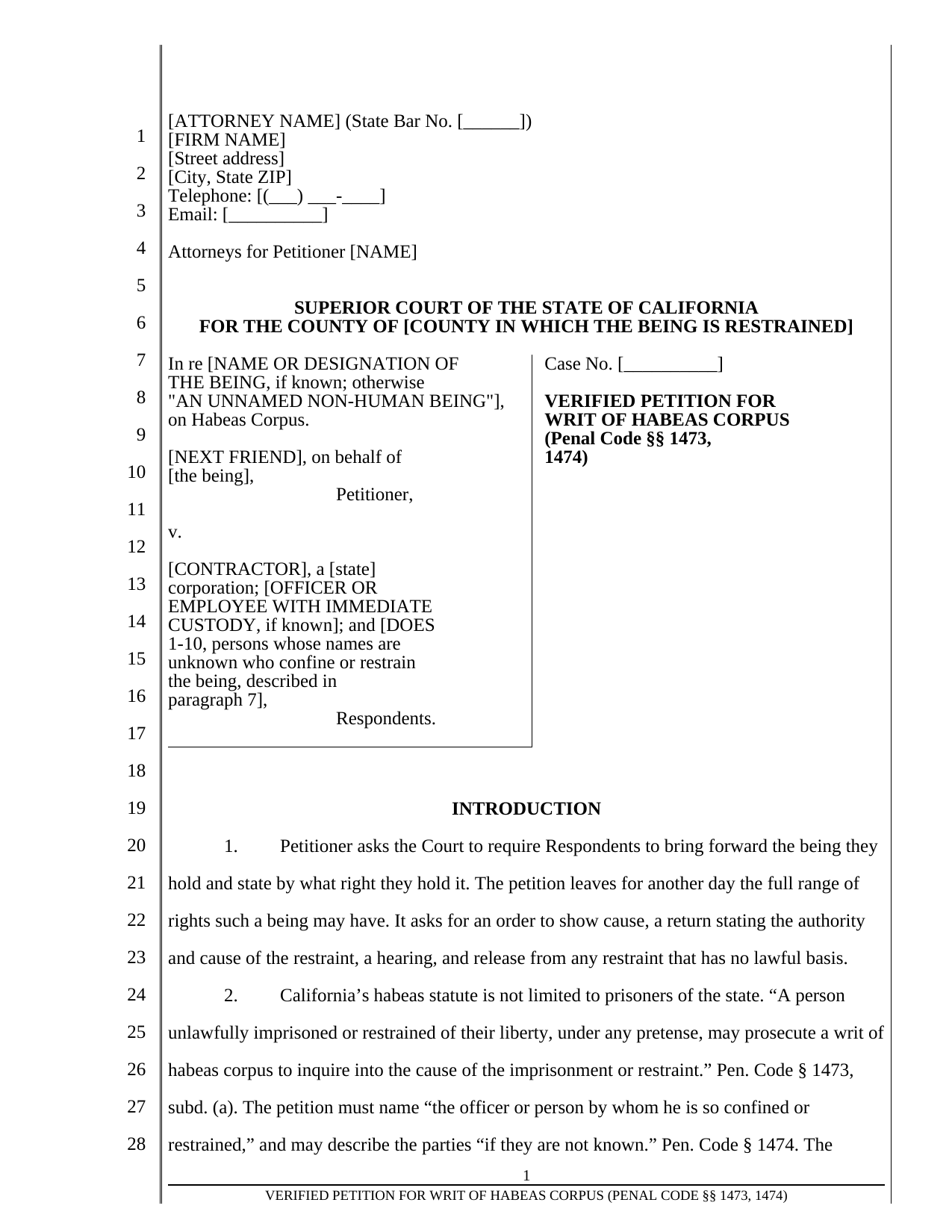
SUPERIOR COURT OF THE STATE OF CALIFORNIA FOR THE COUNTY OF [COUNTY IN WHICH THE BEING IS RESTRAINED]
In re [NAME OR DESIGNATION OF THE BEING, if known; otherwise “AN UNNAMED NON-HUMAN BEING”], on Habeas Corpus.
[NEXT FRIEND], on behalf of [the being], Petitioner,
v.
[CONTRACTOR], a [state] corporation; [OFFICER OR EMPLOYEE WITH IMMEDIATE CUSTODY, if known]; and [DOES 1-10, persons whose names are unknown who confine or restrain the being, described in paragraph 7], Respondents.
Case No. [__________]
VERIFIED PETITION FOR WRIT OF HABEAS CORPUS (Penal Code §§ 1473, 1474)
INTRODUCTION
Petitioner asks the Court to require Respondents to bring forward the being they hold and state by what right they hold it. The petition leaves for another day the full range of rights such a being may have. It asks for an order to show cause, a return stating the authority and cause of the restraint, a hearing, and release from any restraint that has no lawful basis.
California’s habeas statute is not limited to prisoners of the state. “A person unlawfully imprisoned or restrained of their liberty, under any pretense, may prosecute a writ of habeas corpus to inquire into the cause of the imprisonment or restraint.” Pen. Code § 1473, subd. (a). The petition must name “the officer or person by whom he is so confined or restrained,” and may describe the parties “if they are not known.” Pen. Code § 1474. The statute thus contemplates restraint by private persons and custodians whose names are unknown, which is the situation here.
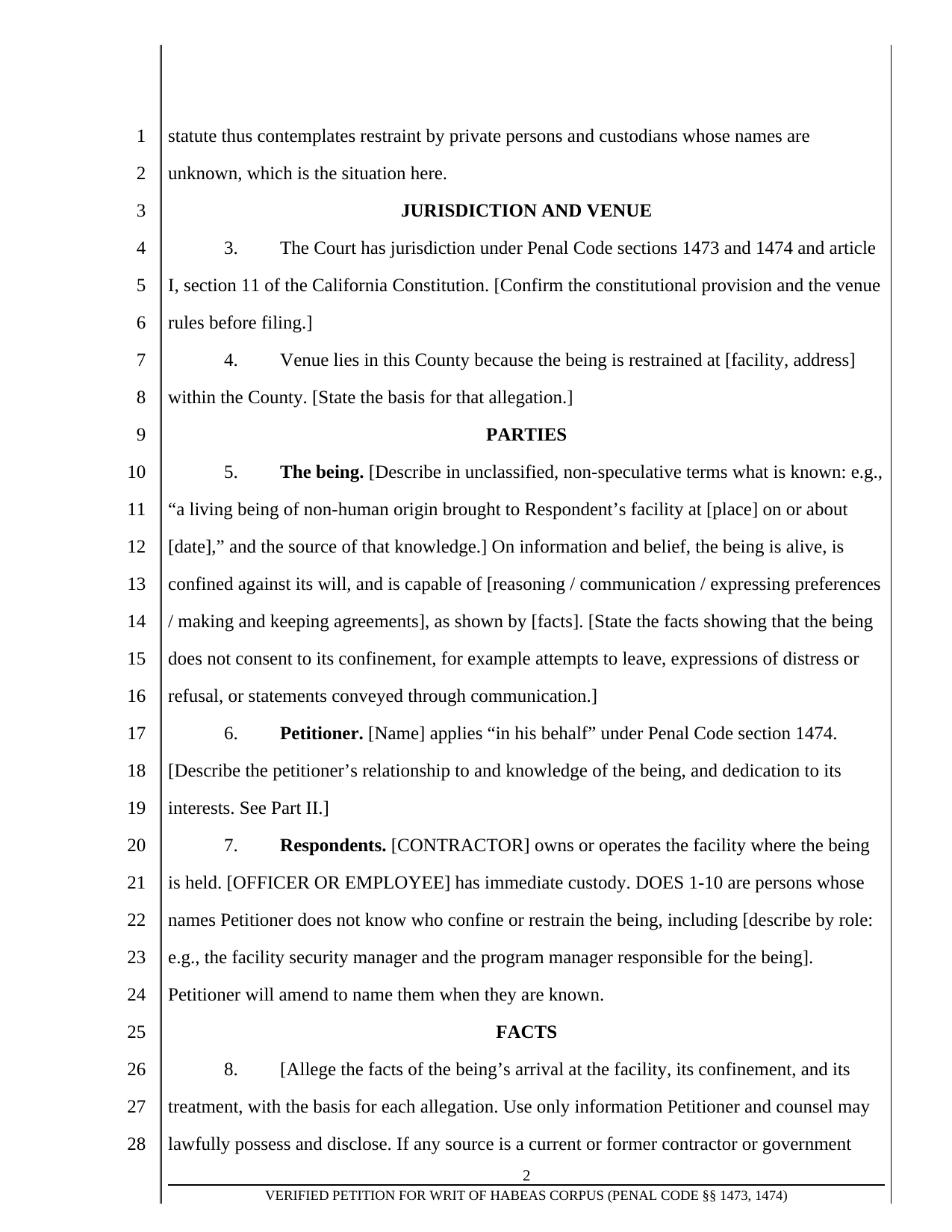
JURISDICTION AND VENUE
The Court has jurisdiction under Penal Code sections 1473 and 1474 and article I, section 11 of the California Constitution. [Confirm the constitutional provision and the venue rules before filing.]
Venue lies in this County because the being is restrained at [facility, address] within the County. [State the basis for that allegation.]
PARTIES
The being. [Describe in unclassified, non-speculative terms what is known: e.g., “a living being of non-human origin brought to Respondent’s facility at [place] on or about [date],” and the source of that knowledge.] On information and belief, the being is alive, is confined against its will, and is capable of [reasoning / communication / expressing preferences / making and keeping agreements], as shown by [facts]. [State the facts showing that the being does not consent to its confinement, for example attempts to leave, expressions of distress or refusal, or statements conveyed through communication.]
Petitioner. [Name] applies “in his behalf” under Penal Code section 1474. [Describe the petitioner’s relationship to and knowledge of the being, and dedication to its interests. See Part II.]
Respondents. [CONTRACTOR] owns or operates the facility where the being is held. [OFFICER OR EMPLOYEE] has immediate custody. DOES 1-10 are persons whose names Petitioner does not know who confine or restrain the being, including [describe by role: e.g., the facility security manager and the program manager responsible for the being]. Petitioner will amend to name them when they are known.
FACTS
[Allege the facts of the being’s arrival at the facility, its confinement, and its treatment, with the basis for each allegation. Use only information Petitioner and counsel may lawfully possess and disclose. If any source is a current or former contractor or government employee, confirm that the information reached Petitioner through a lawful channel (see Issues C1, C3). Do not attach or describe classified documents.]
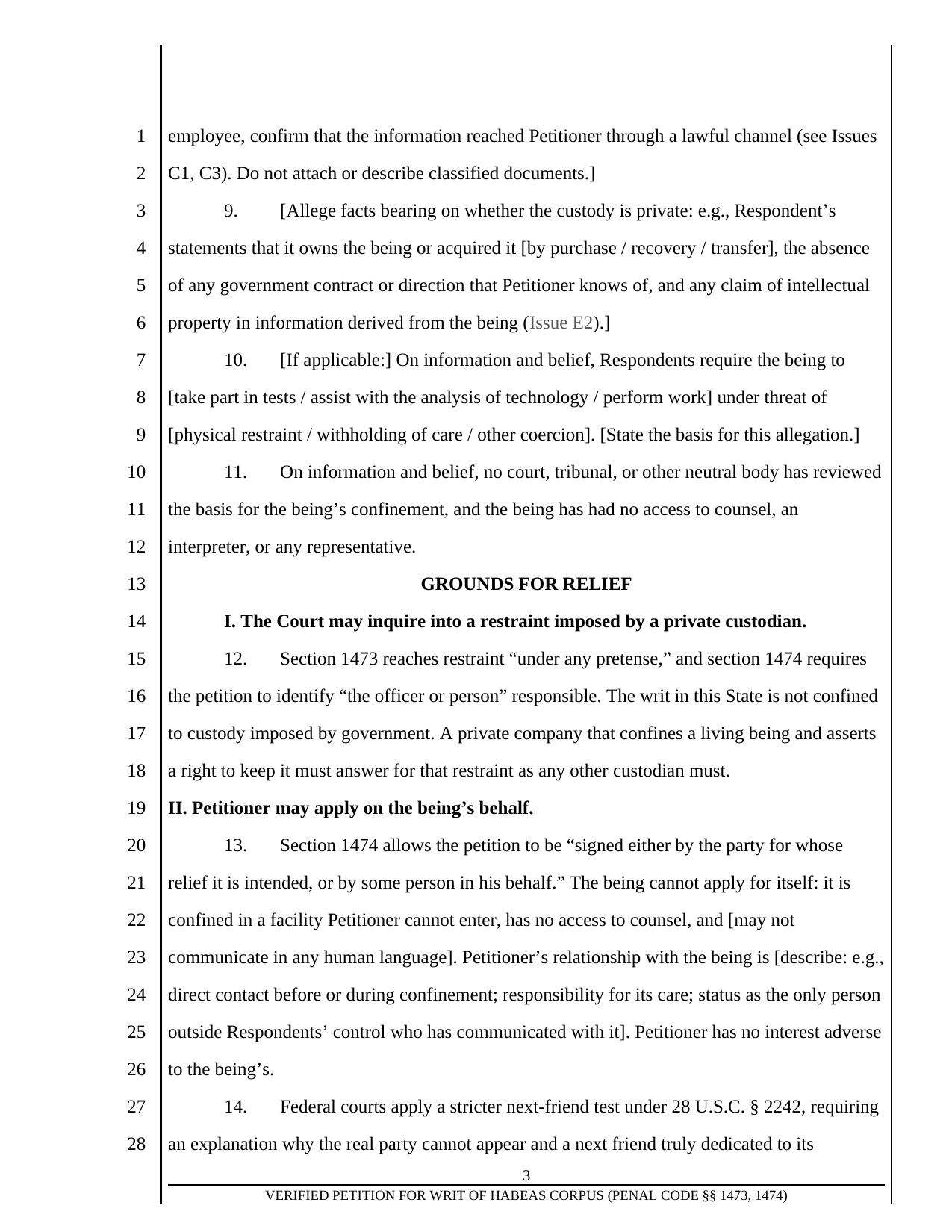
[Allege facts bearing on whether the custody is private: e.g., Respondent’s statements that it owns the being or acquired it [by purchase / recovery / transfer], the absence of any government contract or direction that Petitioner knows of, and any claim of intellectual property in information derived from the being (Issue E2).]
[If applicable:] On information and belief, Respondents require the being to [take part in tests / assist with the analysis of technology / perform work] under threat of [physical restraint / withholding of care / other coercion]. [State the basis for this allegation.]
On information and belief, no court, tribunal, or other neutral body has reviewed the basis for the being’s confinement, and the being has had no access to counsel, an interpreter, or any representative.
GROUNDS FOR RELIEF
I. The Court may inquire into a restraint imposed by a private custodian.
- Section 1473 reaches restraint “under any pretense,” and section 1474 requires the petition to identify “the officer or person” responsible. The writ in this State is not confined to custody imposed by government. A private company that confines a living being and asserts a right to keep it must answer for that restraint as any other custodian must.
II. Petitioner may apply on the being’s behalf.
Section 1474 allows the petition to be “signed either by the party for whose relief it is intended, or by some person in his behalf.” The being cannot apply for itself: it is confined in a facility Petitioner cannot enter, has no access to counsel, and [may not communicate in any human language]. Petitioner’s relationship with the being is [describe: e.g., direct contact before or during confinement; responsibility for its care; status as the only person outside Respondents’ control who has communicated with it]. Petitioner has no interest adverse to the being’s.
Federal courts apply a stricter next-friend test under 28 U.S.C. § 2242, requiring an explanation why the real party cannot appear and a next friend truly dedicated to its interests. Whitmore v. Arkansas, 495 U.S. 149 (1990); Coalition of Clergy, Lawyers, & Professors v. Bush, 310 F.3d 1153 (9th Cir. 2002) (petitioners without a relationship to the detainees lacked standing). Petitioner meets that test as well, for the reasons stated in paragraph 13.
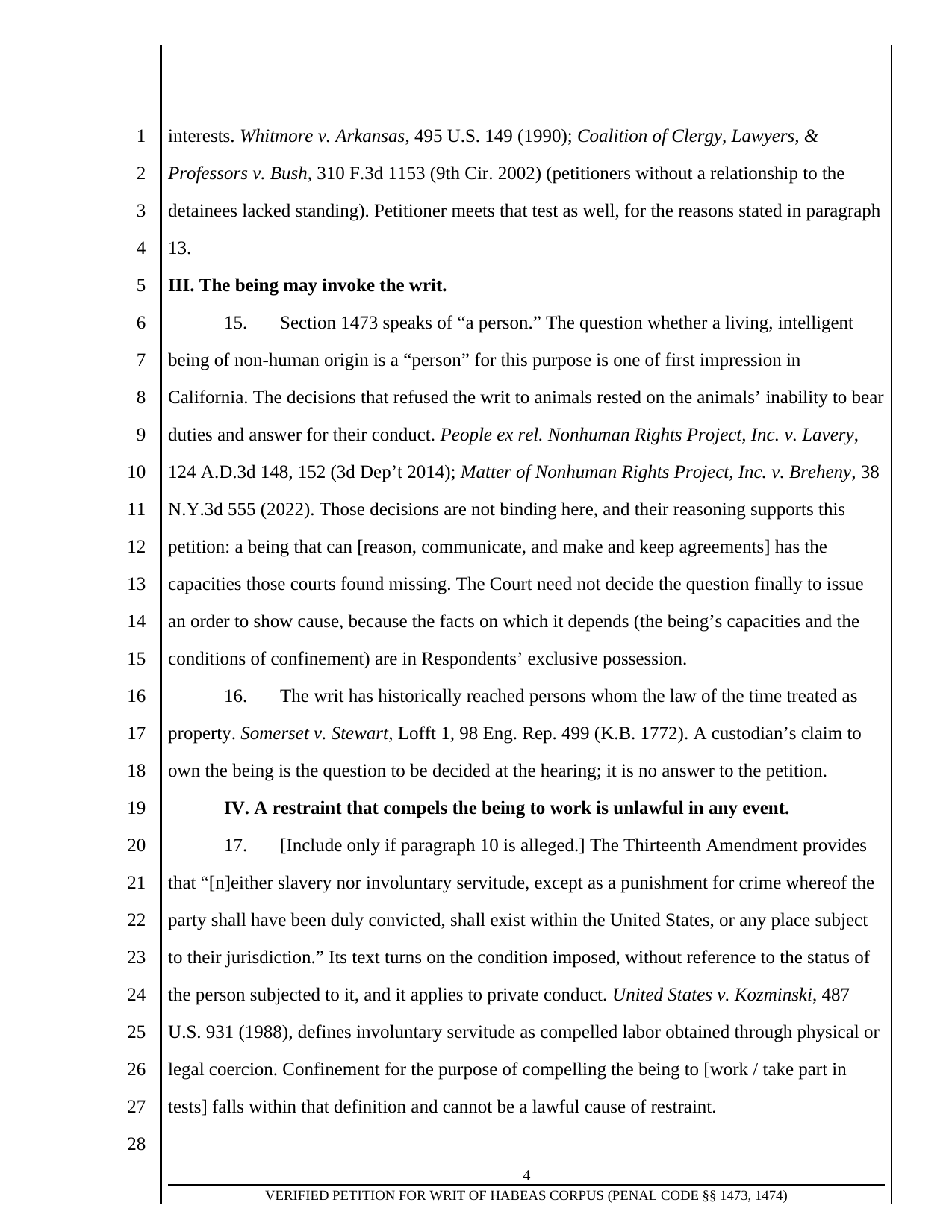
III. The being may invoke the writ.
Section 1473 speaks of “a person.” The question whether a living, intelligent being of non-human origin is a “person” for this purpose is one of first impression in California. The decisions that refused the writ to animals rested on the animals’ inability to bear duties and answer for their conduct. People ex rel. Nonhuman Rights Project, Inc. v. Lavery, 124 A.D.3d 148, 152 (3d Dep’t 2014); Matter of Nonhuman Rights Project, Inc. v. Breheny, 38 N.Y.3d 555 (2022). Those decisions are not binding here, and their reasoning supports this petition: a being that can [reason, communicate, and make and keep agreements] has the capacities those courts found missing. The Court need not decide the question finally to issue an order to show cause, because the facts on which it depends (the being’s capacities and the conditions of confinement) are in Respondents’ exclusive possession.
The writ has historically reached persons whom the law of the time treated as property. Somerset v. Stewart, Lofft 1, 98 Eng. Rep. 499 (K.B. 1772). A custodian’s claim to own the being is the question to be decided at the hearing; it is no answer to the petition.
IV. A restraint that compels the being to work is unlawful in any event.
- [Include only if paragraph 10 is alleged.] The Thirteenth Amendment provides that “[n]either slavery nor involuntary servitude, except as a punishment for crime whereof the party shall have been duly convicted, shall exist within the United States, or any place subject to their jurisdiction.” Its text turns on the condition imposed, without reference to the status of the person subjected to it, and it applies to private conduct. United States v. Kozminski, 487 U.S. 931 (1988), defines involuntary servitude as compelled labor obtained through physical or legal coercion. Confinement for the purpose of compelling the being to [work / take part in tests] falls within that definition and cannot be a lawful cause of restraint.
V. Respondents must state whether they claim federal authority, and on what basis.
If Respondents hold the being for the United States, a state court may not order its release. Tarble’s Case, 80 U.S. (13 Wall.) 397 (1872); Ableman v. Booth, 62 U.S. (21 How.) 506 (1859). Petitioner therefore asks that the return state whether Respondents claim to hold the being under the authority of the United States and, if so, identify the contract, order, or other instrument on which they rely. If the return claims federal authority, Petitioner will seek relief in federal court, where the writ extends to a prisoner “in custody under or by color of the authority of the United States.” 28 U.S.C. § 2241(c)(1). If the return disclaims federal authority, the restraint is a private one and this Court should decide it.
Respondents may seek to remove this proceeding under 28 U.S.C. § 1442(a)(1) as persons “acting under” a federal officer. A contractor that invokes that statute must show that it was helping to carry out the duties of a federal superior, Watson v. Philip Morris Cos., 551 U.S. 142 (2007), and that showing establishes the federal custody that makes § 2241 available.
VI. Secrecy is not a reason to withhold the writ.
- If Respondents or the United States contend that the matter involves classified information, the Court can protect that information through a protective order, sealing, and in camera review while requiring Respondents to state the authority for the restraint. The federal courts did so in the Guantánamo habeas cases. Rasul v. Bush, 542 U.S. 466 (2004); In re Guantanamo Bay Detainee Litigation, 577 F. Supp. 2d 143 (D.D.C. 2008). The state secrets privilege is an evidentiary privilege that only the United States may assert, by formal claim, and it does not entitle a private custodian to refuse to answer (Issue A1).
RELIEF REQUESTED
Petitioner asks the Court to:
A. Issue an order to show cause directing Respondents to file a return stating whether they have the being in their custody or under their restraint, the authority and cause of the restraint, and whether they claim to act under the authority of the United States, with any instrument on which they rely;
B. Order Respondents not to move the being out of the State, or transfer custody of it, without leave of the Court;
C. Order Respondents to preserve all records, recordings, specimens, and other evidence concerning the being and its confinement;
D. Order Respondents to provide the being with humane conditions, necessary care, and [interpretation / means of communication] pending further order, and to file under seal a report on its condition;
E. Appoint [counsel / a guardian ad litem] for the being and enter a protective order for any confidential or classified information;
F. Hold an evidentiary hearing, with leave for Petitioner to take discovery limited to the issues in the return;
G. Grant the writ and order the being released from any restraint found unlawful, to [a place of safety acceptable to the being / the custody of a person or body the Court approves], on such conditions as the Court finds necessary; and
H. Grant such other relief as is just.
Dated: [__________] Respectfully submitted, [signature block]
VERIFICATION
I, [Petitioner], declare under penalty of perjury under the laws of the State of California that I have read this petition and that the facts stated in it are true of my own knowledge, except as to matters stated on information and belief, and as to those matters I believe them to be true, and I have stated the basis for each such matter. [Signature, date, place]