Form F4-2. Request to the Comptroller General for a Decision on Whether UAP-Related Public Communications Violated the Publicity or Propaganda Prohibition

Version 1.10 · October 2026 Download: PDF Word

Template. Sample template for use by or with a licensed attorney. Not legal advice. Laws differ by jurisdiction and change; adapt the document to your facts and check every citation before relying on it.

Use. GAO issues decisions on the propaganda prohibition, typically at the request of Members of Congress, and has read it to bar self-aggrandizement, purely partisan material, and covert propaganda, meaning material whose government origin is concealed from its audience (Issue F4). A violation of an appropriations restriction can also be a violation of the Antideficiency Act, 31 U.S.C. §1341(a), which agencies must report. Private parties cannot obtain a GAO decision directly, so this letter is written for a congressional office. Attach the records that support it (for example, records obtained with Form F4-1).

When to use. A Member or committee asking GAO to decide whether UAP-related public communications violated the propaganda rider. Not for: Private persons; GAO issues appropriations-law decisions at the request of agency officials and Members of Congress, so a private person should ask a Member to send the letter.

Deadlines. None; cite the appropriations act in force for the period at issue.

The document

2 pages, laid out as in the PDF and Word downloads. Select a page to open the PDF at that page.

Form F4-2, page 1 of 2. The text version follows the pages. Form F4-2, page 2 of 2. The text version follows the pages.
Text version of the document

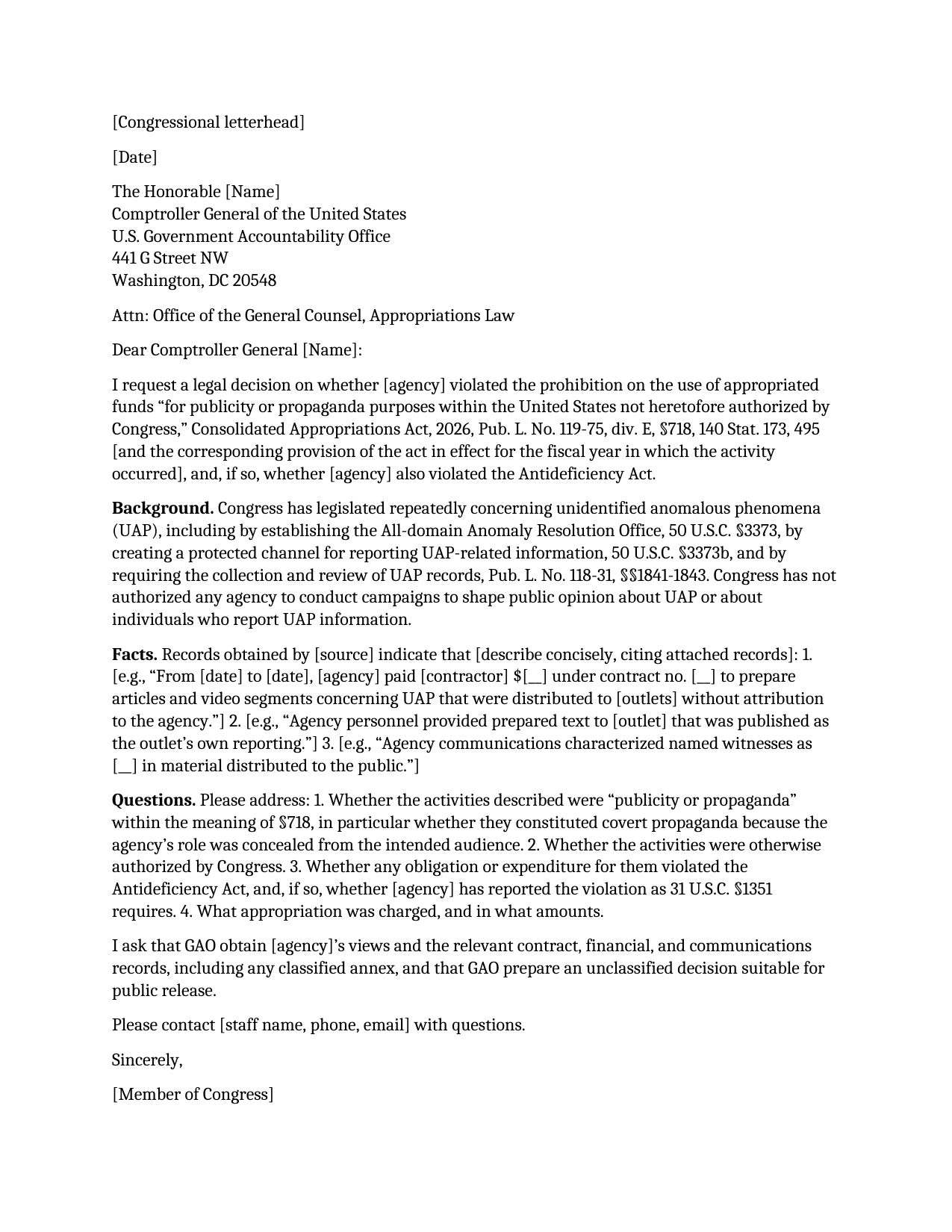
[Congressional letterhead]

[Date]

The Honorable [Name] Comptroller General of the United States U.S. Government Accountability Office 441 G Street NW Washington, DC 20548

Attn: Office of the General Counsel, Appropriations Law

Dear Comptroller General [Name]:

I request a legal decision on whether [agency] violated the prohibition on the use of appropriated funds “for publicity or propaganda purposes within the United States not heretofore authorized by Congress,” Consolidated Appropriations Act, 2026, Pub. L. No. 119-75, div. E, §718, 140 Stat. 173, 495 [and the corresponding provision of the act in effect for the fiscal year in which the activity occurred], and, if so, whether [agency] also violated the Antideficiency Act.

Background. Congress has legislated repeatedly concerning unidentified anomalous phenomena (UAP), including by establishing the All-domain Anomaly Resolution Office, 50 U.S.C. §3373, by creating a protected channel for reporting UAP-related information, 50 U.S.C. §3373b, and by requiring the collection and review of UAP records, Pub. L. No. 118-31, §§1841-1843. Congress has not authorized any agency to conduct campaigns to shape public opinion about UAP or about individuals who report UAP information.

Facts. Records obtained by [source] indicate that [describe concisely, citing attached records]: 1. [e.g., “From [date] to [date], [agency] paid [contractor] $[__] under contract no. [__] to prepare articles and video segments concerning UAP that were distributed to [outlets] without attribution to the agency.”] 2. [e.g., “Agency personnel provided prepared text to [outlet] that was published as the outlet’s own reporting.”] 3. [e.g., “Agency communications characterized named witnesses as [__] in material distributed to the public.”]

Questions. Please address: 1. Whether the activities described were “publicity or propaganda” within the meaning of §718, in particular whether they constituted covert propaganda because the agency’s role was concealed from the intended audience. 2. Whether the activities were otherwise authorized by Congress. 3. Whether any obligation or expenditure for them violated the Antideficiency Act, and, if so, whether [agency] has reported the violation as 31 U.S.C. §1351 requires. 4. What appropriation was charged, and in what amounts.

I ask that GAO obtain [agency]’s views and the relevant contract, financial, and communications records, including any classified annex, and that GAO prepare an unclassified decision suitable for public release.

Please contact [staff name, phone, email] with questions.

Sincerely,

[Member of Congress]

Enclosures: [list]
Drafting notes

  • Covert propaganda is the strongest theory. GAO’s covert propaganda test focuses on concealment of the government’s role from the audience. Materials the agency openly attributed to itself are much harder to reach under the rider even if they are one-sided.
  • Intelligence elements. If the activity was conducted by an intelligence element, EO 12333 §2.13 and intelligence oversight rules also apply. Refer that aspect to the intelligence committees and the relevant inspector general, since GAO’s access to intelligence activities is limited.
  • Fiscal year. The rider appears in each year’s appropriations act. Cite the act covering the period when the funds were obligated.
  • Antideficiency Act. 31 U.S.C. §1341(a)(1)(A) bars obligations or expenditures exceeding an amount available in an appropriation, and GAO treats a purpose violation that cannot be corrected by adjustment as an Antideficiency Act violation; 31 U.S.C. §1351 requires the agency head to report violations to the President and Congress.
  • Related: Issue F4; Form F4-1.
↑