Form F5-1. Committee Letter to the Secretary of State Under the Case-Zablocki Act Concerning Any Agreement or Arrangement with a Non-Human Intelligence Entity

Version 1.10 · October 2026 Download: PDF Word

Template. Sample template for use by or with a licensed attorney. Not legal advice. Laws differ by jurisdiction and change; adapt the document to your facts and check every citation before relying on it.

Use. Issue F5 asks how Congress would learn of any agreement, understanding, or cooperation arrangement between the United States and an NHI group. The Case-Zablocki Act, as rewritten by the FY2023 NDAA (Pub. L. No. 117-263, §5947), requires the Secretary of State to report to congressional leadership and the appropriate committees, every month, the text of every “international agreement” and every “qualifying non-binding instrument” concluded in the prior month, with “a detailed description of the legal authority” for each, in unclassified form with a classified annex if needed. 1 U.S.C. §112b(a)(1)-(2). A non-binding instrument becomes “qualifying” if it is made with “foreign governments, international organizations, or foreign entities, including non-state actors,” and either could reasonably be expected to have a significant impact on U.S. foreign policy or “is the subject of a written communication from the Chair or Ranking Member of either of the appropriate congressional committees to the Secretary.” §112b(k)(5)(A). This letter is that written communication. It also asks the Secretary to state the executive branch’s position on whether an NHI group can be a party to an “international agreement.”

When to use. Committee leaders asking the State Department to report NHI arrangements under the Case-Zablocki Act. Not for: Treaties submitted for advice and consent.

Deadlines. None in the letter; the Act requires transmission of qualifying arrangements within 30 days after signature (1 U.S.C. §112b(a)).

The document

2 pages, laid out as in the PDF and Word downloads. Select a page to open the PDF at that page.
Form F5-1, page 1 of 2. The text version follows the pages. Form F5-1, page 2 of 2. The text version follows the pages.
Text version of the document

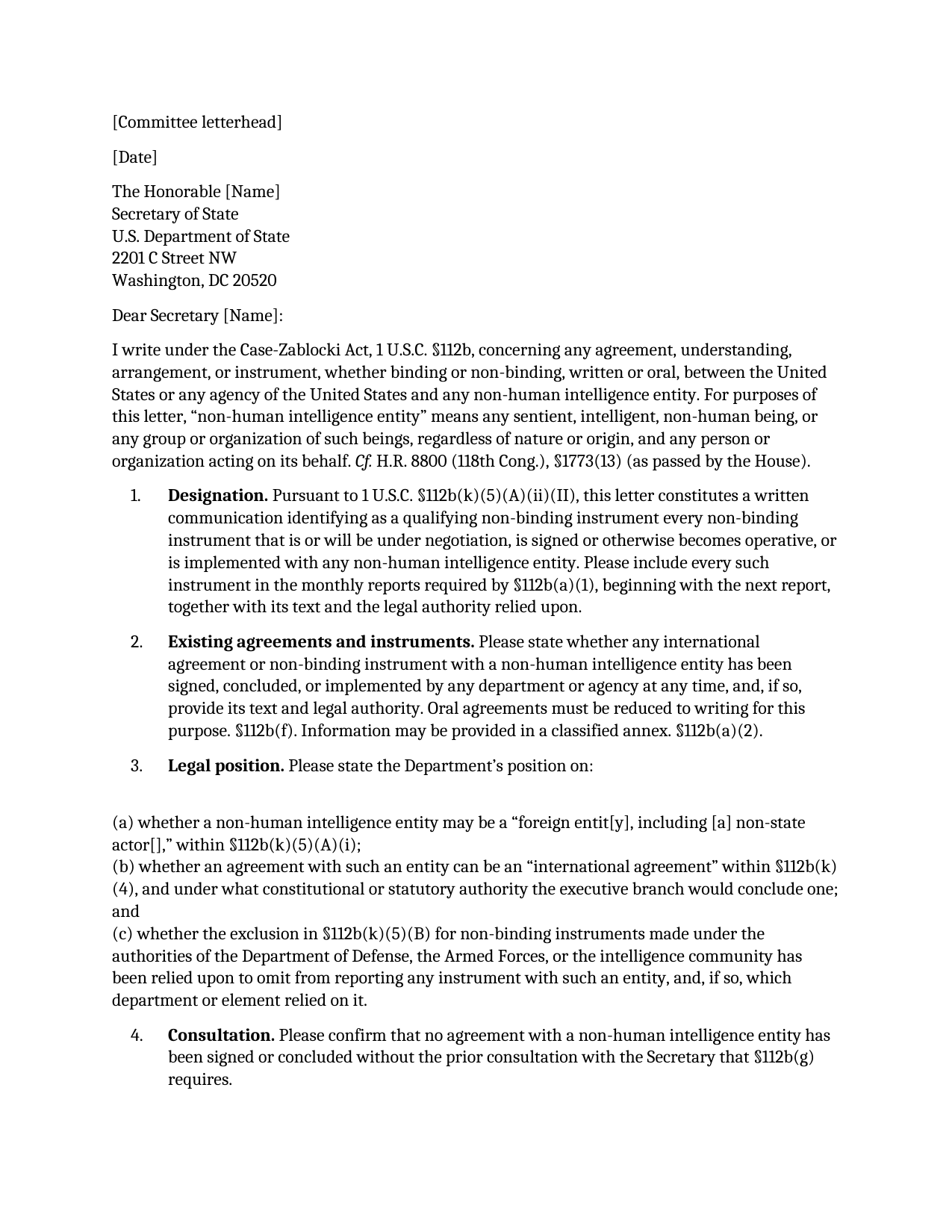
[Committee letterhead]

[Date]

The Honorable [Name] Secretary of State U.S. Department of State 2201 C Street NW Washington, DC 20520

Dear Secretary [Name]:

I write under the Case-Zablocki Act, 1 U.S.C. §112b, concerning any agreement, understanding, arrangement, or instrument, whether binding or non-binding, written or oral, between the United States or any agency of the United States and any non-human intelligence entity. For purposes of this letter, “non-human intelligence entity” means any sentient, intelligent, non-human being, or any group or organization of such beings, regardless of nature or origin, and any person or organization acting on its behalf. Cf. H.R. 8800 (118th Cong.), §1773(13) (as passed by the House).

  1. Designation. Pursuant to 1 U.S.C. §112b(k)(5)(A)(ii)(II), this letter constitutes a written communication identifying as a qualifying non-binding instrument every non-binding instrument that is or will be under negotiation, is signed or otherwise becomes operative, or is implemented with any non-human intelligence entity. Please include every such instrument in the monthly reports required by §112b(a)(1), beginning with the next report, together with its text and the legal authority relied upon.

  2. Existing agreements and instruments. Please state whether any international agreement or non-binding instrument with a non-human intelligence entity has been signed, concluded, or implemented by any department or agency at any time, and, if so, provide its text and legal authority. Oral agreements must be reduced to writing for this purpose. §112b(f). Information may be provided in a classified annex. §112b(a)(2).

  3. Legal position. Please state the Department’s position on:

(a) whether a non-human intelligence entity may be a “foreign entit[y], including [a] non-state actor[],” within §112b(k)(5)(A)(i); (b) whether an agreement with such an entity can be an “international agreement” within §112b(k)(4), and under what constitutional or statutory authority the executive branch would conclude one; and (c) whether the exclusion in §112b(k)(5)(B) for non-binding instruments made under the authorities of the Department of Defense, the Armed Forces, or the intelligence community has been relied upon to omit from reporting any instrument with such an entity, and, if so, which department or element relied on it.

  1. Consultation. Please confirm that no agreement with a non-human intelligence entity has been signed or concluded without the prior consultation with the Secretary that §112b(g) requires.

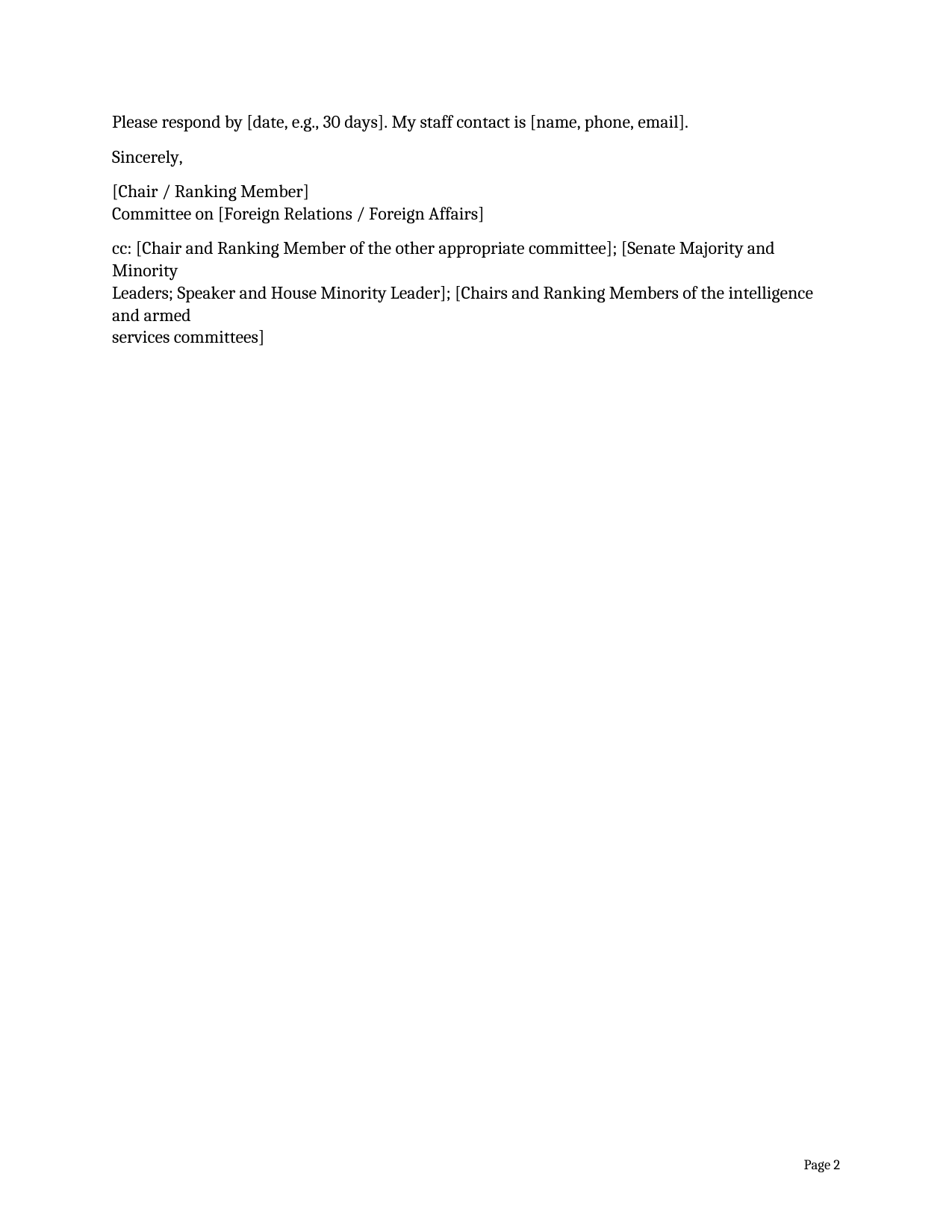
Please respond by [date, e.g., 30 days]. My staff contact is [name, phone, email].

Sincerely,

[Chair / Ranking Member] Committee on [Foreign Relations / Foreign Affairs]

cc: [Chair and Ranking Member of the other appropriate committee]; [Senate Majority and Minority Leaders; Speaker and House Minority Leader]; [Chairs and Ranking Members of the intelligence and armed services committees]

Drafting notes

  • State Department criteria. The letter targets non-binding instruments because the State Department’s rule limits binding “international agreements” to those whose parties are “a state, a state agency, or an intergovernmental organization” (22 C.F.R. §181.2(a)(1)), while qualifying non-binding instruments may involve “foreign entities, including non-state actors” (§181.4(a)(1), (b)(2)). Ask the Secretary to say whether the Department would treat any NHI group as a state for §181.2 purposes.
  • Who may send it. The designation in paragraph 1 works only if the letter comes from the Chair or Ranking Member of the Senate Foreign Relations or House Foreign Affairs Committee. A letter from another Member can still ask the questions in paragraphs 2-4.
  • DoD and IC carve-out. Section 112b(k)(5)(B) removes from the “qualifying non-binding instrument” category any instrument made under DoD, Armed Forces, or intelligence community authorities. Binding international agreements made by those entities remain reportable. If an arrangement with an NHI group exists, it is most likely to sit within that carve-out, which is why paragraph 3(c) asks about it directly. Consider a parallel letter from the intelligence committees under 50 U.S.C. §3091 (general duty to keep the committees “fully and currently informed”).
  • Definition. The letter borrows the House-passed UAPDA definition of NHI to avoid inventing a new one (Issue A3). Adjust if a later enacted statute defines the term.
  • War powers. If the concern is participation in hostilities between NHI groups, add a request for any report submitted under the War Powers Resolution, 50 U.S.C. §1543, and for the legal authority relied on (Issue F5).
  • Verified against the current text of 1 U.S.C. §112b (govinfo, October 14, 2026).
  • Related: Issue F5, F6, D1.
↑