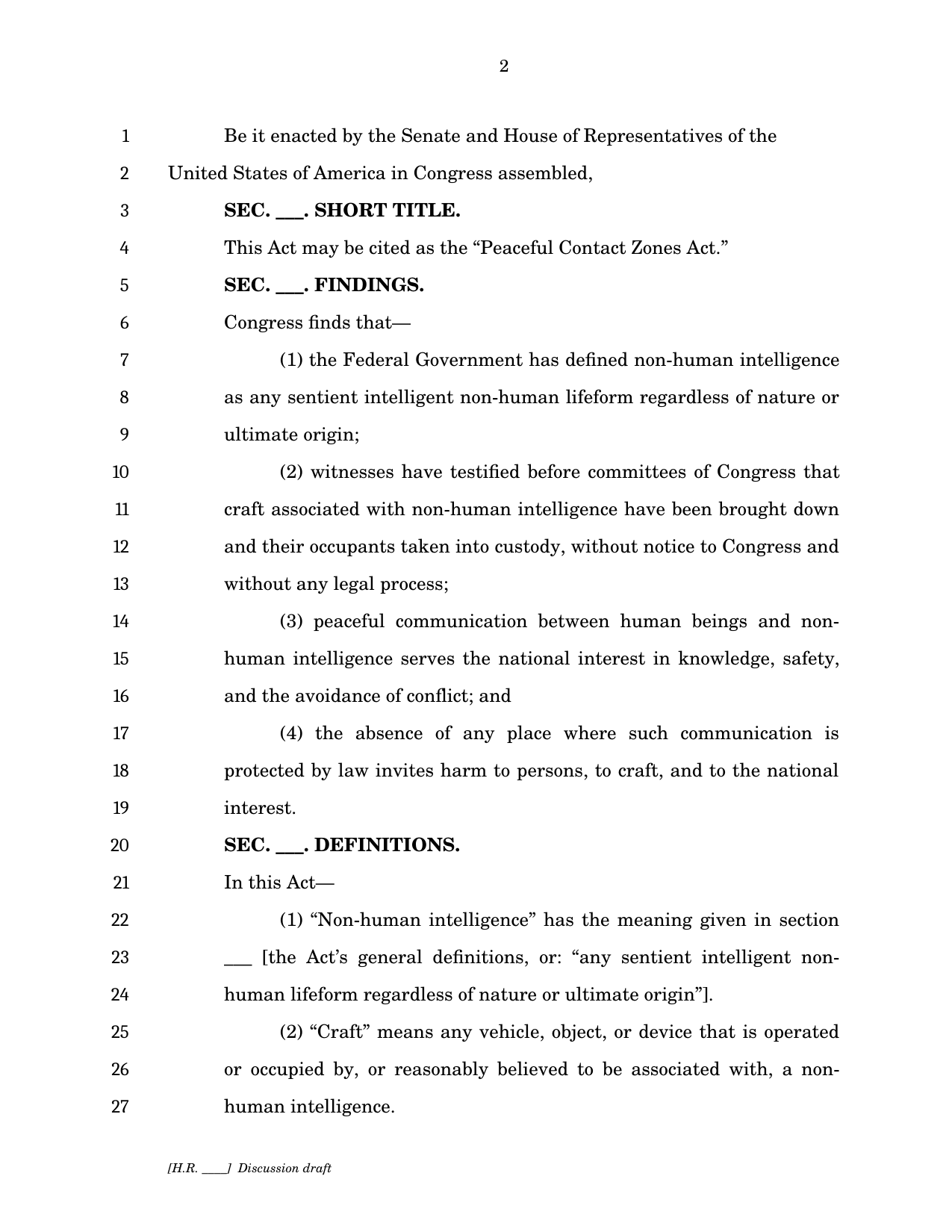
SEC. ___. SHORT TITLE. This Act may be cited as the “Peaceful Contact Zones Act.”
SEC. ___. FINDINGS. Congress finds that– (1) the Federal Government has defined non-human intelligence as any sentient intelligent non-human lifeform regardless of nature or ultimate origin; (2) witnesses have testified before committees of Congress that craft associated with non-human intelligence have been brought down and their occupants taken into custody, without notice to Congress and without any legal process; (3) peaceful communication between human beings and non-human intelligence serves the national interest in knowledge, safety, and the avoidance of conflict; and (4) the absence of any place where such communication is protected by law invites harm to persons, to craft, and to the national interest.
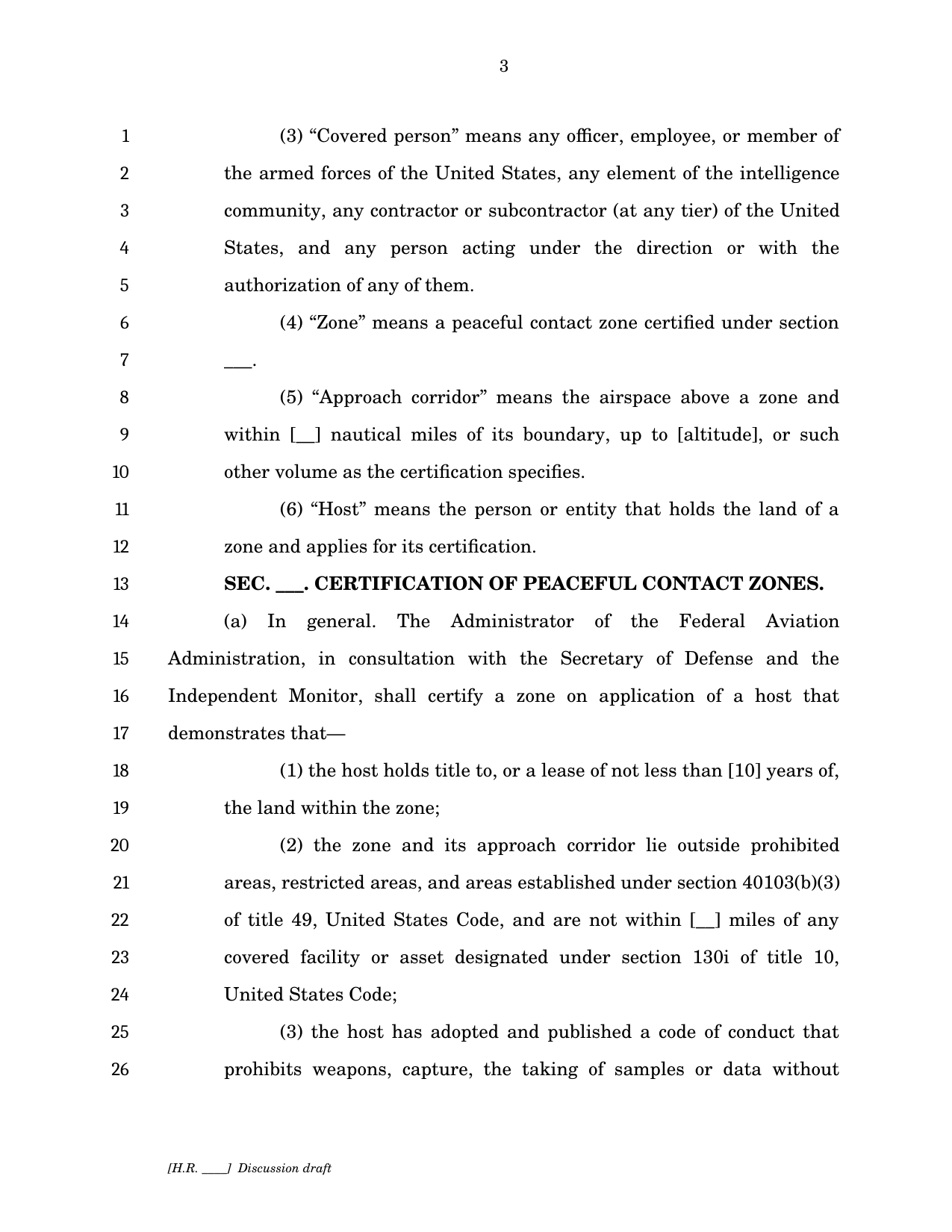
SEC. ___. DEFINITIONS. In this Act– (1) “Non-human intelligence” has the meaning given in section ___ [the Act’s general definitions, or: “any sentient intelligent non-human lifeform regardless of nature or ultimate origin”]. (2) “Craft” means any vehicle, object, or device that is operated or occupied by, or reasonably believed to be associated with, a non-human intelligence. (3) “Covered person” means any officer, employee, or member of the armed forces of the United States, any element of the intelligence community, any contractor or subcontractor (at any tier) of the United States, and any person acting under the direction or with the authorization of any of them. (4) “Zone” means a peaceful contact zone certified under section ___. (5) “Approach corridor” means the airspace above a zone and within [__] nautical miles of its boundary, up to [altitude], or such other volume as the certification specifies. (6) “Host” means the person or entity that holds the land of a zone and applies for its certification.
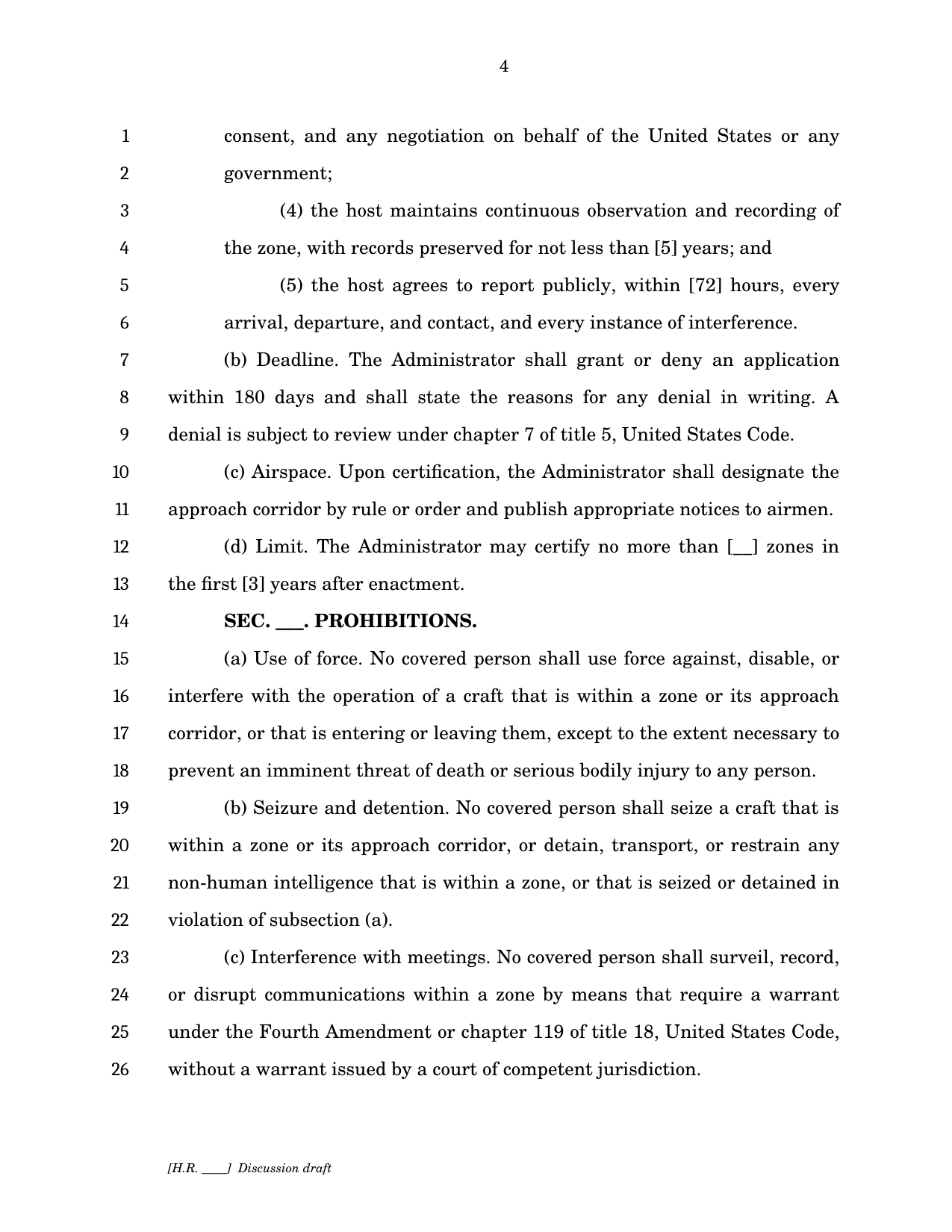
SEC. ___. CERTIFICATION OF PEACEFUL CONTACT ZONES. (a) In general. The Administrator of the Federal Aviation Administration, in consultation with the Secretary of Defense and the Independent Monitor, shall certify a zone on application of a host that demonstrates that– (1) the host holds title to, or a lease of not less than [10] years of, the land within the zone; (2) the zone and its approach corridor lie outside prohibited areas, restricted areas, and areas established under section 40103(b)(3) of title 49, United States Code, and are not within [__] miles of any covered facility or asset designated under section 130i of title 10, United States Code; (3) the host has adopted and published a code of conduct that prohibits weapons, capture, the taking of samples or data without consent, and any negotiation on behalf of the United States or any government; (4) the host maintains continuous observation and recording of the zone, with records preserved for not less than [5] years; and (5) the host agrees to report publicly, within [72] hours, every arrival, departure, and contact, and every instance of interference. (b) Deadline. The Administrator shall grant or deny an application within 180 days and shall state the reasons for any denial in writing. A denial is subject to review under chapter 7 of title 5, United States Code. (c) Airspace. Upon certification, the Administrator shall designate the approach corridor by rule or order and publish appropriate notices to airmen. (d) Limit. The Administrator may certify no more than [__] zones in the first [3] years after enactment.
SEC. ___. PROHIBITIONS. (a) Use of force. No covered person shall use force against, disable, or interfere with the operation of a craft that is within a zone or its approach corridor, or that is entering or leaving them, except to the extent necessary to prevent an imminent threat of death or serious bodily injury to any person. (b) Seizure and detention. No covered person shall seize a craft that is within a zone or its approach corridor, or detain, transport, or restrain any non-human intelligence that is within a zone, or that is seized or detained in violation of subsection (a). (c) Interference with meetings. No covered person shall surveil, record, or disrupt communications within a zone by means that require a warrant under the Fourth Amendment or chapter 119 of title 18, United States Code, without a warrant issued by a court of competent jurisdiction. (d) Relationship to other law. Section 130i of title 10, United States Code, section 124n of title 6, United States Code, and any other authority to mitigate threats from unmanned aircraft shall not apply to a craft within a zone or its approach corridor, except as provided in subsection (a).
SEC. ___. NOTICE AND EMERGENCY ACTION. (a) Notice. A covered person who takes any action under the exception in section ___(a) shall report the action within 24 hours to the Independent Monitor and to the appropriate congressional committees. (b) Emergency order. If the President determines that a craft within a zone poses an imminent threat to the national security of the United States, the President may authorize action otherwise prohibited by this Act. The President shall notify the appropriate congressional committees in writing within 48 hours, stating the facts on which the determination rests. No such authorization may extend beyond [72] hours without a further determination and notice.
SEC. ___. INDEPENDENT MONITOR. (a) Establishment. There is established an Independent Monitor for Peaceful Contact Zones, appointed by [the Comptroller General / the President by and with the advice and consent of the Senate] for a term of [6] years, who may be removed only for cause. (b) Duties. The Monitor shall– (1) receive the reports required by this Act; (2) investigate any credible allegation of a violation, with access to all relevant records and personnel of any covered person, at every level of classification, including special access programs; (3) report to the appropriate congressional committees not less than every 6 months, in unclassified form with a classified annex if necessary; and (4) publish an unclassified summary of each report. (c) Clearances. The heads of the relevant departments and agencies shall grant the Monitor and staff the clearances and program accesses necessary to perform these duties within 90 days of a request.
SEC. ___. CIVIL ACTION. (a) In general. A host, or any person present in a zone, injured by a violation of section ___ may bring a civil action in a district court of the United States against any covered person, other than the United States, for declaratory and injunctive relief, damages, and reasonable attorney’s fees. (b) Next friend. A civil action for injunctive relief on behalf of a non-human intelligence detained in violation of this Act may be brought by a next friend. (c) Classified information. The court shall apply the procedures of [section ___ / the Classified Information Procedures Act, as adapted] to protect classified information. The assertion of a privilege over classified information shall not by itself require dismissal of an action under this section.
SEC. ___. OFFENSE. Whoever, being a covered person, knowingly violates section ___(a) or (b) shall be fined under title 18, United States Code, imprisoned not more than [10] years, or both.
SEC. ___. RULES OF CONSTRUCTION. Nothing in this Act shall be construed– (1) to determine the legal status of any non-human intelligence; (2) to recognize any government, to confer diplomatic status or immunity on any person, or to authorize any person to conduct relations on behalf of the United States; (3) to limit the authority of the United States to respond to an imminent threat to persons; or (4) to authorize any person to violate any other law of the United States.
SEC. ___. APPROPRIATE CONGRESSIONAL COMMITTEES. In this Act, “appropriate congressional committees” means the committees on armed services, intelligence, commerce or transportation, and the judiciary of the Senate and the House of Representatives.