[Requester name, address, email, phone]
[Date]
[Privacy Act Officer] [Agency and component] [Address or portal]
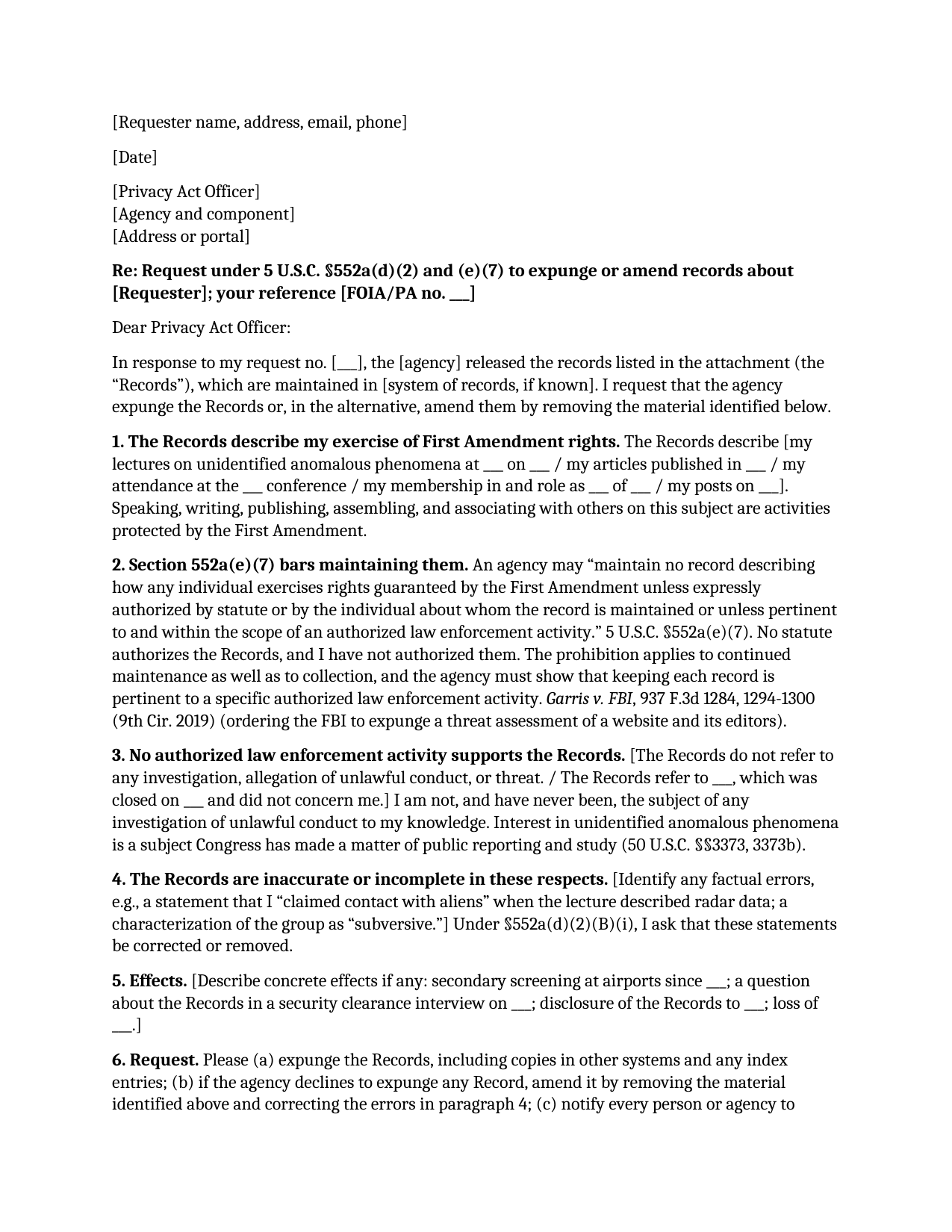
Re: Request under 5 U.S.C. §552a(d)(2) and (e)(7) to expunge or amend records about [Requester]; your reference [FOIA/PA no. ___]
Dear Privacy Act Officer:
In response to my request no. [___], the [agency] released the records listed in the attachment (the “Records”), which are maintained in [system of records, if known]. I request that the agency expunge the Records or, in the alternative, amend them by removing the material identified below.
1. The Records describe my exercise of First Amendment rights. The Records describe [my lectures on unidentified anomalous phenomena at ___ on ___ / my articles published in ___ / my attendance at the ___ conference / my membership in and role as ___ of ___ / my posts on ___]. Speaking, writing, publishing, assembling, and associating with others on this subject are activities protected by the First Amendment.
2. Section 552a(e)(7) bars maintaining them. An agency may “maintain no record describing how any individual exercises rights guaranteed by the First Amendment unless expressly authorized by statute or by the individual about whom the record is maintained or unless pertinent to and within the scope of an authorized law enforcement activity.” 5 U.S.C. §552a(e)(7). No statute authorizes the Records, and I have not authorized them. The prohibition applies to continued maintenance as well as to collection, and the agency must show that keeping each record is pertinent to a specific authorized law enforcement activity. Garris v. FBI, 937 F.3d 1284, 1294-1300 (9th Cir. 2019) (ordering the FBI to expunge a threat assessment of a website and its editors).
3. No authorized law enforcement activity supports the Records. [The Records do not refer to any investigation, allegation of unlawful conduct, or threat. / The Records refer to ___, which was closed on ___ and did not concern me.] I am not, and have never been, the subject of any investigation of unlawful conduct to my knowledge. Interest in unidentified anomalous phenomena is a subject Congress has made a matter of public reporting and study (50 U.S.C. §§3373, 3373b).
4. The Records are inaccurate or incomplete in these respects. [Identify any factual errors, e.g., a statement that I “claimed contact with aliens” when the lecture described radar data; a characterization of the group as “subversive.”] Under §552a(d)(2)(B)(i), I ask that these statements be corrected or removed.
5. Effects. [Describe concrete effects if any: secondary screening at airports since ___; a question about the Records in a security clearance interview on ___; disclosure of the Records to ___; loss of ___.]
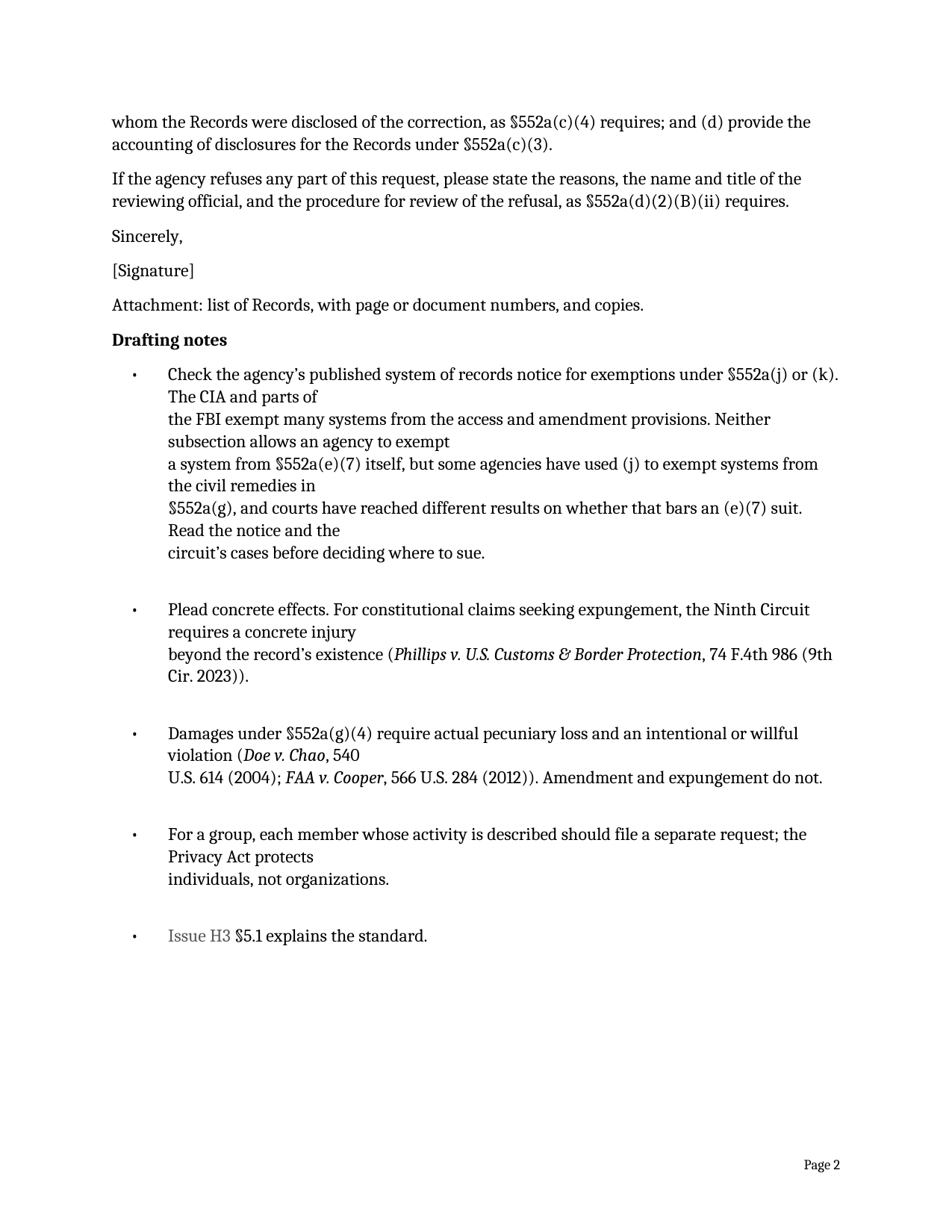
6. Request. Please (a) expunge the Records, including copies in other systems and any index entries; (b) if the agency declines to expunge any Record, amend it by removing the material identified above and correcting the errors in paragraph 4; (c) notify every person or agency to whom the Records were disclosed of the correction, as §552a(c)(4) requires; and (d) provide the accounting of disclosures for the Records under §552a(c)(3).
If the agency refuses any part of this request, please state the reasons, the name and title of the reviewing official, and the procedure for review of the refusal, as §552a(d)(2)(B)(ii) requires.
Sincerely,
[Signature]
Attachment: list of Records, with page or document numbers, and copies.