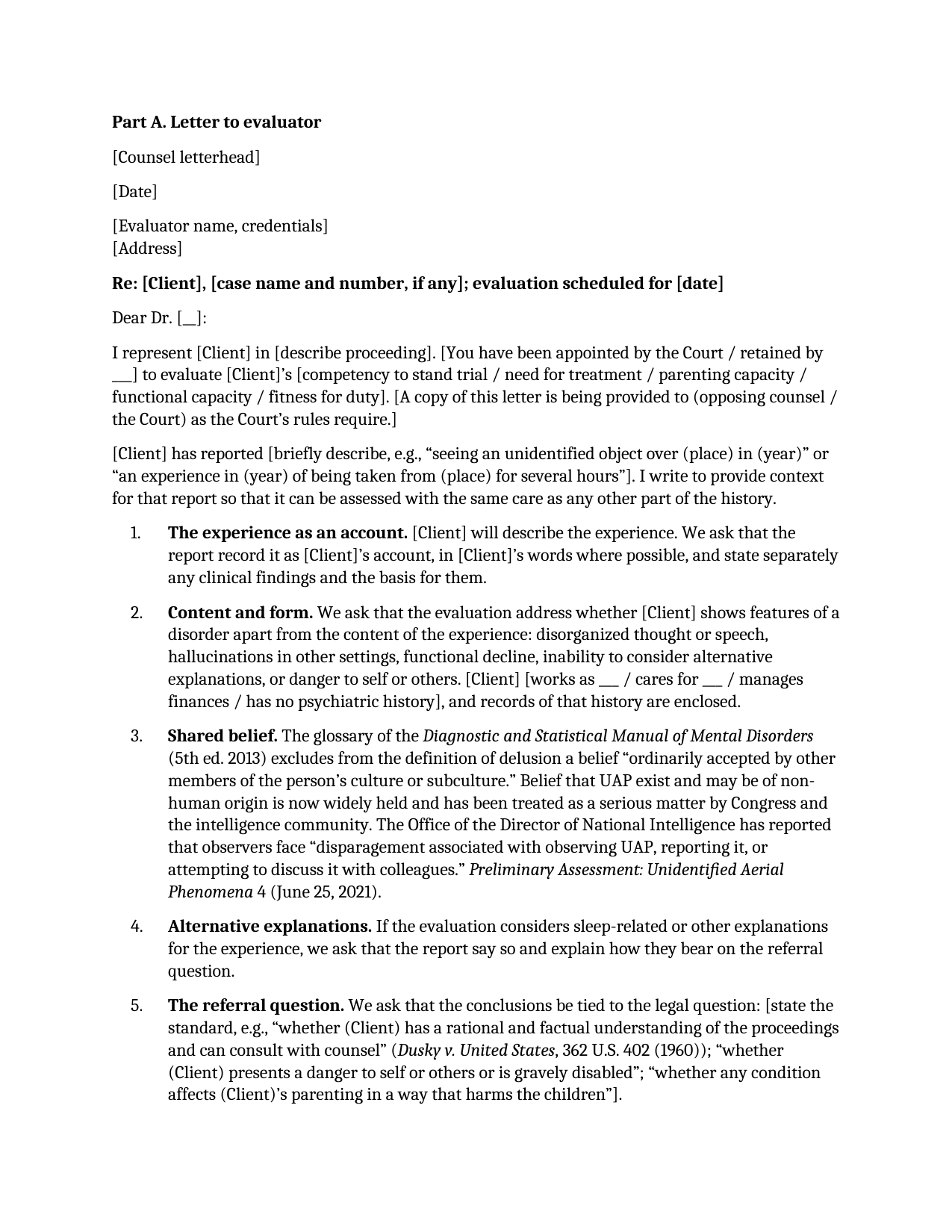
Part A. Letter to evaluator
[Counsel letterhead]
[Date]
[Evaluator name, credentials] [Address]
Re: [Client], [case name and number, if any]; evaluation scheduled for [date]
Dear Dr. [__]:
I represent [Client] in [describe proceeding]. [You have been appointed by the Court / retained by ___] to evaluate [Client]’s [competency to stand trial / need for treatment / parenting capacity / functional capacity / fitness for duty]. [A copy of this letter is being provided to (opposing counsel / the Court) as the Court’s rules require.]
[Client] has reported [briefly describe, e.g., “seeing an unidentified object over (place) in (year)” or “an experience in (year) of being taken from (place) for several hours”]. I write to provide context for that report so that it can be assessed with the same care as any other part of the history.
- The experience as an account. [Client] will describe the experience. We ask that the report record it as [Client]’s account, in [Client]’s words where possible, and state separately any clinical findings and the basis for them.
- Content and form. We ask that the evaluation address whether [Client] shows features of a disorder apart from the content of the experience: disorganized thought or speech, hallucinations in other settings, functional decline, inability to consider alternative explanations, or danger to self or others. [Client] [works as ___ / cares for ___ / manages finances / has no psychiatric history], and records of that history are enclosed.
- Shared belief. The glossary of the Diagnostic and Statistical Manual of Mental Disorders (5th ed. 2013) excludes from the definition of delusion a belief “ordinarily accepted by other members of the person’s culture or subculture.” Belief that UAP exist and may be of non-human origin is now widely held and has been treated as a serious matter by Congress and the intelligence community. The Office of the Director of National Intelligence has reported that observers face “disparagement associated with observing UAP, reporting it, or attempting to discuss it with colleagues.” Preliminary Assessment: Unidentified Aerial Phenomena 4 (June 25, 2021).
- Alternative explanations. If the evaluation considers sleep-related or other explanations for the experience, we ask that the report say so and explain how they bear on the referral question.
- The referral question. We ask that the conclusions be tied to the legal question: [state the standard, e.g., “whether (Client) has a rational and factual understanding of the proceedings and can consult with counsel” (Dusky v. United States, 362 U.S. 402 (1960)); “whether (Client) presents a danger to self or others or is gravely disabled”; “whether any condition affects (Client)’s parenting in a way that harms the children”].
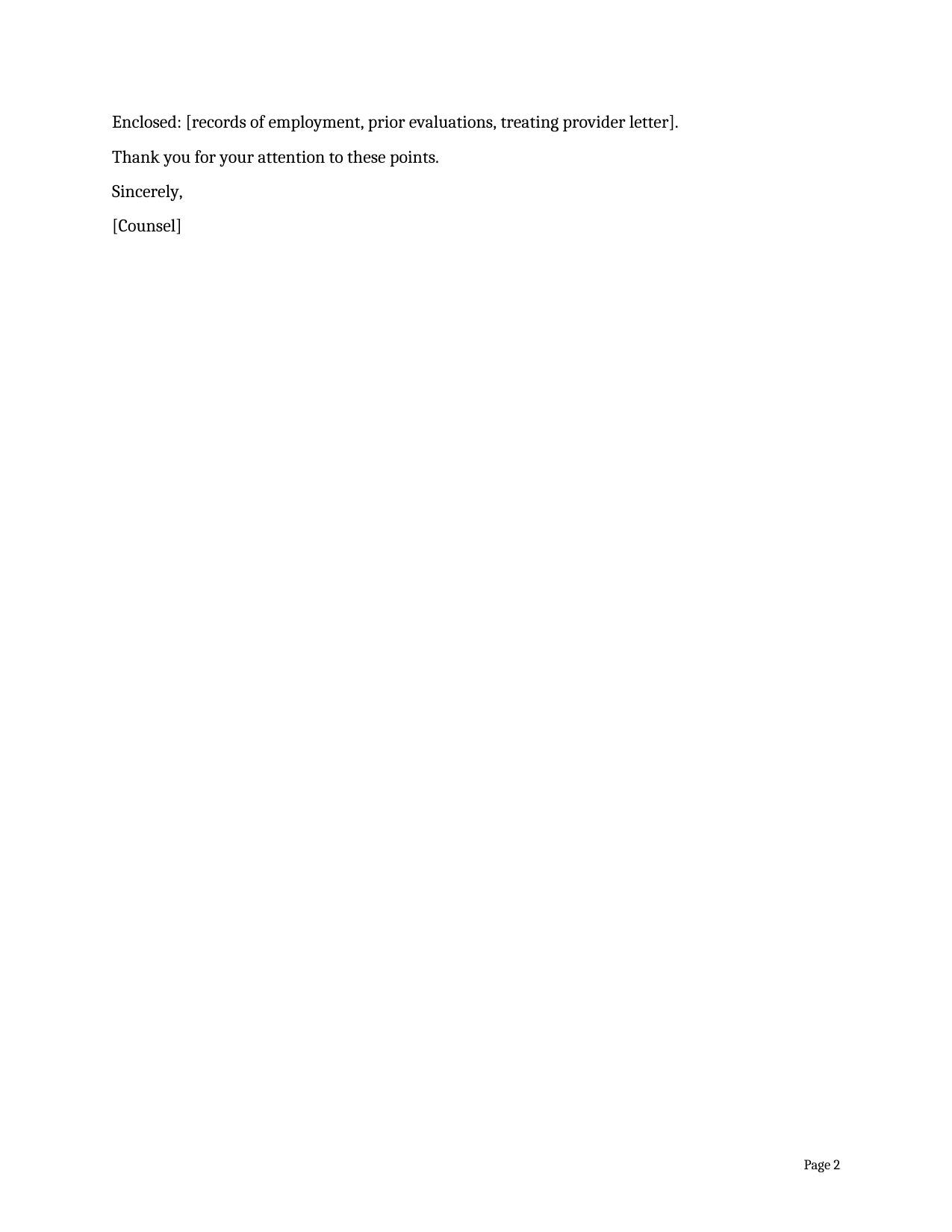
Enclosed: [records of employment, prior evaluations, treating provider letter].
Thank you for your attention to these points.
Sincerely,
[Counsel]
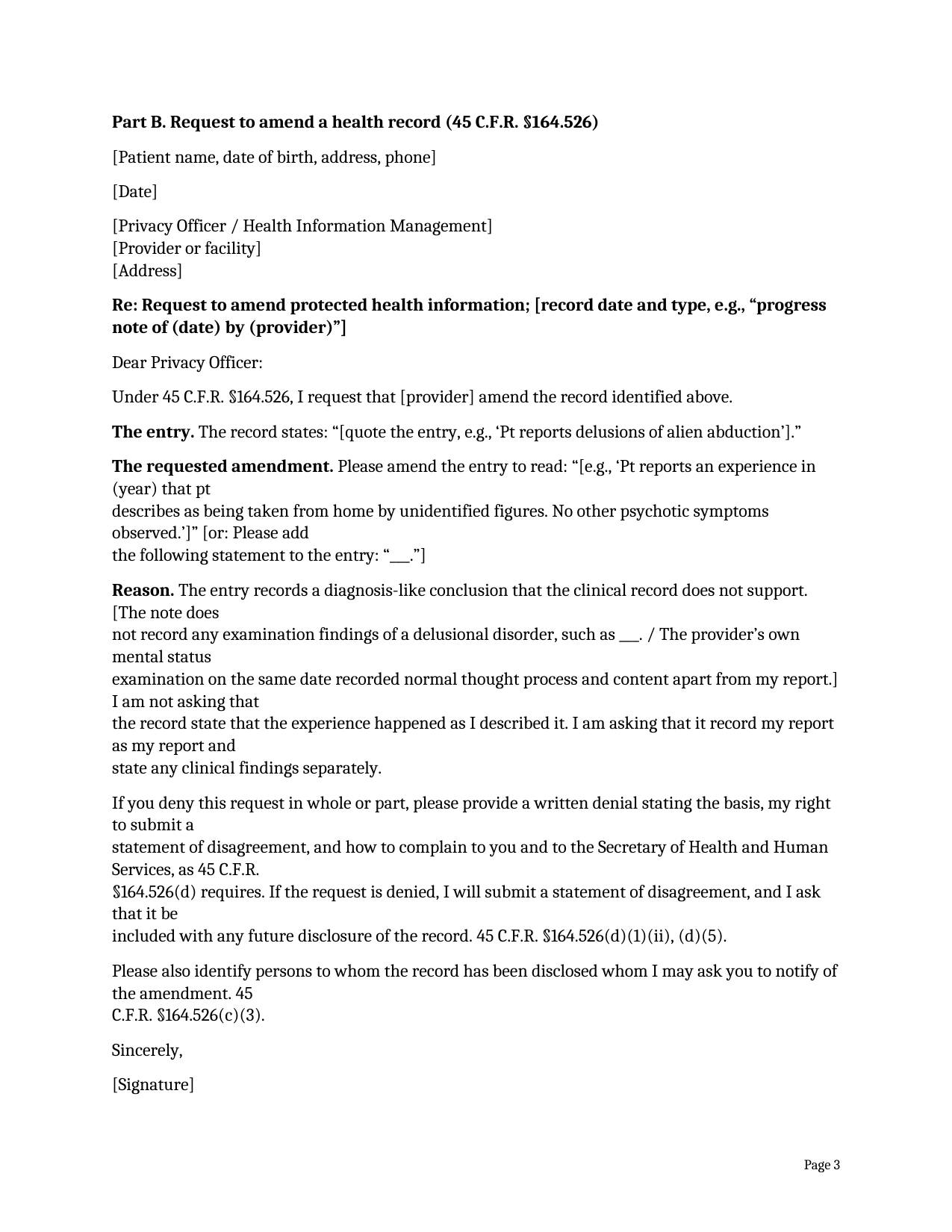
Part B. Request to amend a health record (45 C.F.R. §164.526)
[Patient name, date of birth, address, phone]
[Date]
[Privacy Officer / Health Information Management] [Provider or facility] [Address]
Re: Request to amend protected health information; [record date and type, e.g., “progress note of (date) by (provider)”]
Dear Privacy Officer:
Under 45 C.F.R. §164.526, I request that [provider] amend the record identified above.
The entry. The record states: “[quote the entry, e.g., ‘Pt reports delusions of alien abduction’].”
The requested amendment. Please amend the entry to read: “[e.g., ‘Pt reports an experience in (year) that pt describes as being taken from home by unidentified figures. No other psychotic symptoms observed.’]” [or: Please add the following statement to the entry: “___.”]
Reason. The entry records a diagnosis-like conclusion that the clinical record does not support. [The note does not record any examination findings of a delusional disorder, such as ___. / The provider’s own mental status examination on the same date recorded normal thought process and content apart from my report.] I am not asking that the record state that the experience happened as I described it. I am asking that it record my report as my report and state any clinical findings separately.
If you deny this request in whole or part, please provide a written denial stating the basis, my right to submit a statement of disagreement, and how to complain to you and to the Secretary of Health and Human Services, as 45 C.F.R. §164.526(d) requires. If the request is denied, I will submit a statement of disagreement, and I ask that it be included with any future disclosure of the record. 45 C.F.R. §164.526(d)(1)(ii), (d)(5).
Please also identify persons to whom the record has been disclosed whom I may ask you to notify of the amendment. 45 C.F.R. §164.526(c)(3).
Sincerely,
[Signature]