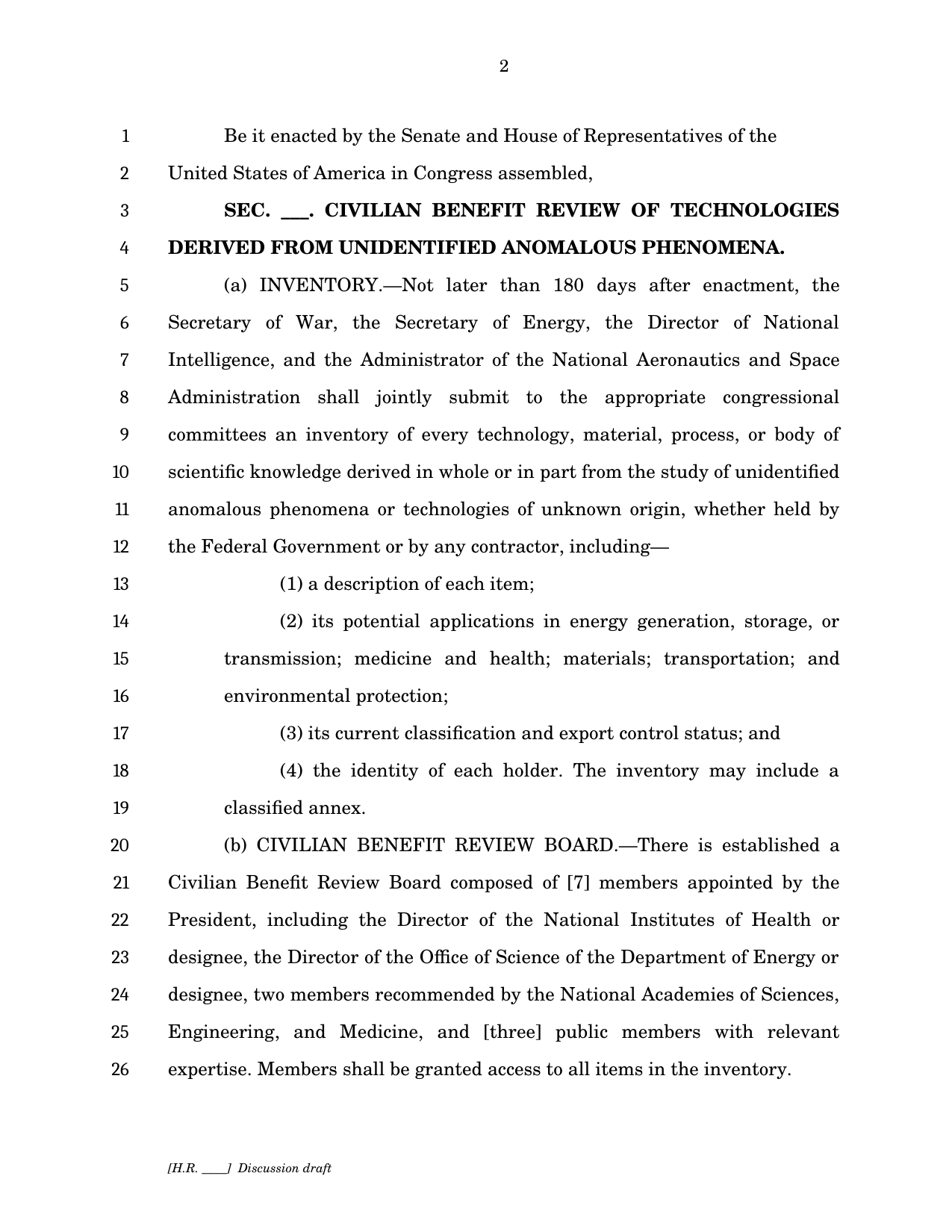
SEC. ___. CIVILIAN BENEFIT REVIEW OF TECHNOLOGIES DERIVED FROM UNIDENTIFIED ANOMALOUS PHENOMENA.
(a) Inventory. Not later than 180 days after enactment, the Secretary of War, the Secretary of Energy, the Director of National Intelligence, and the Administrator of the National Aeronautics and Space Administration shall jointly submit to the appropriate congressional committees an inventory of every technology, material, process, or body of scientific knowledge derived in whole or in part from the study of unidentified anomalous phenomena or technologies of unknown origin, whether held by the Federal Government or by any contractor, including– (1) a description of each item; (2) its potential applications in energy generation, storage, or transmission; medicine and health; materials; transportation; and environmental protection; (3) its current classification and export control status; and (4) the identity of each holder. The inventory may include a classified annex.
(b) Civilian Benefit Review Board. There is established a Civilian Benefit Review Board composed of [7] members appointed by the President, including the Director of the National Institutes of Health or designee, the Director of the Office of Science of the Department of Energy or designee, two members recommended by the National Academies of Sciences, Engineering, and Medicine, and [three] public members with relevant expertise. Members shall be granted access to all items in the inventory.
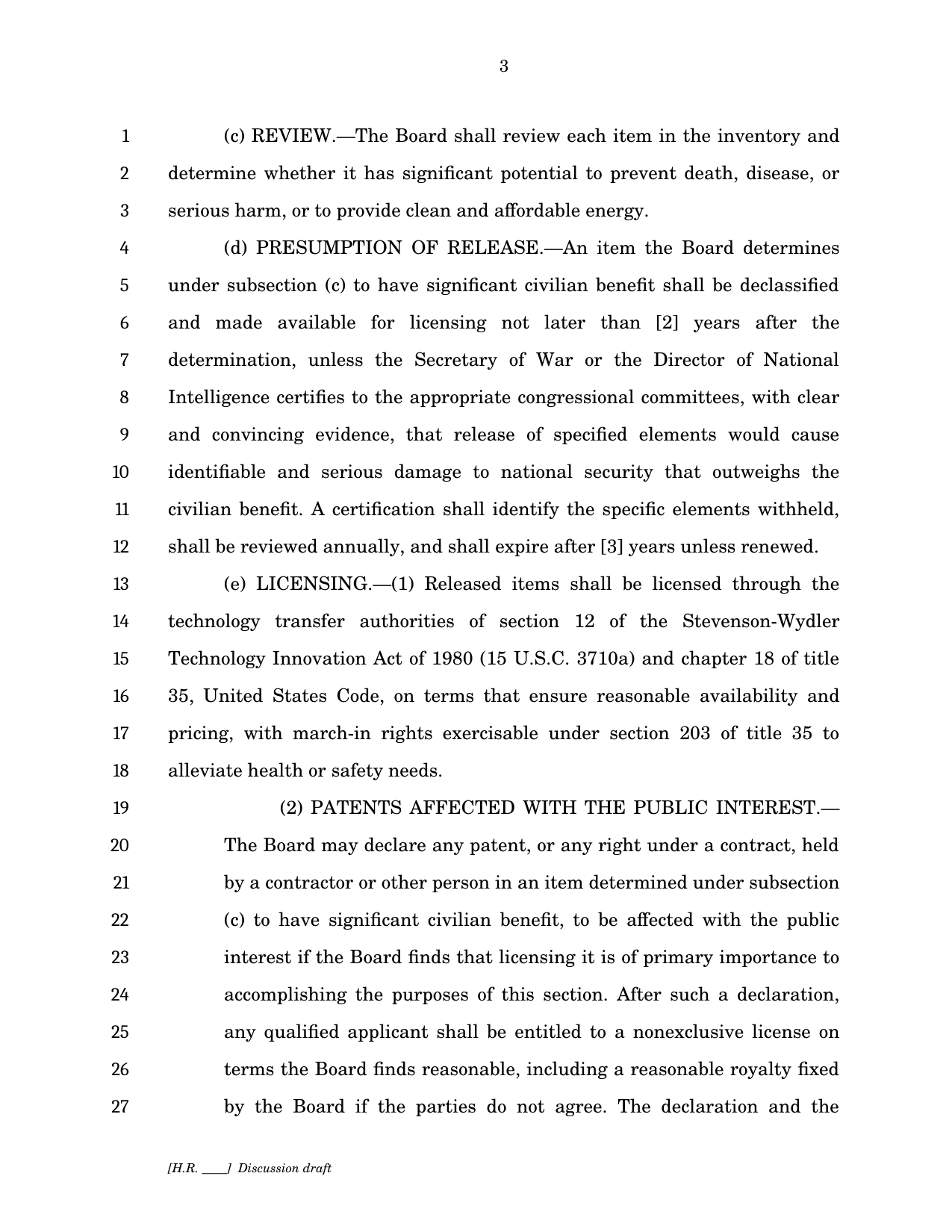
(c) Review. The Board shall review each item in the inventory and determine whether it has significant potential to prevent death, disease, or serious harm, or to provide clean and affordable energy.
(d) Presumption of release. An item the Board determines under subsection (c) to have significant civilian benefit shall be declassified and made available for licensing not later than [2] years after the determination, unless the Secretary of War or the Director of National Intelligence certifies to the appropriate congressional committees, with clear and convincing evidence, that release of specified elements would cause identifiable and serious damage to national security that outweighs the civilian benefit. A certification shall identify the specific elements withheld, shall be reviewed annually, and shall expire after [3] years unless renewed.
(e) Licensing. (1) Released items shall be licensed through the technology transfer authorities of section 12 of the Stevenson-Wydler Technology Innovation Act of 1980 (15 U.S.C. 3710a) and chapter 18 of title 35, United States Code, on terms that ensure reasonable availability and pricing, with march-in rights exercisable under section 203 of title 35 to alleviate health or safety needs. (2) Patents affected with the public interest. The Board may declare any patent, or any right under a contract, held by a contractor or other person in an item determined under subsection (c) to have significant civilian benefit, to be affected with the public interest if the Board finds that licensing it is of primary importance to accomplishing the purposes of this section. After such a declaration, any qualified applicant shall be entitled to a nonexclusive license on terms the Board finds reasonable, including a reasonable royalty fixed by the Board if the parties do not agree. The declaration and the royalty determination are subject to review under chapter 7 of title 5, United States Code.
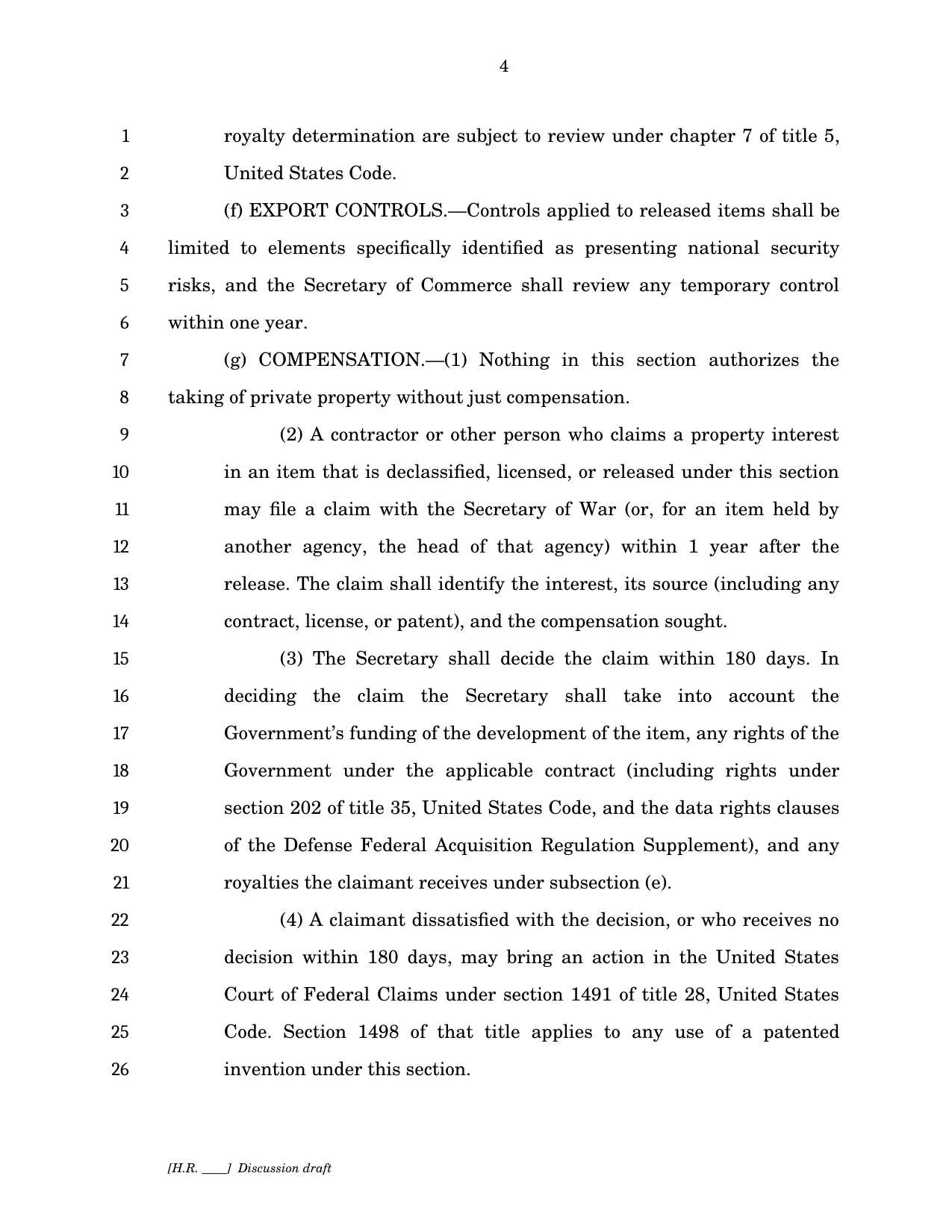
(f) Export controls. Controls applied to released items shall be limited to elements specifically identified as presenting national security risks, and the Secretary of Commerce shall review any temporary control within one year.
(g) Compensation. (1) Nothing in this section authorizes the taking of private property without just compensation. (2) A contractor or other person who claims a property interest in an item that is declassified, licensed, or released under this section may file a claim with the Secretary of War (or, for an item held by another agency, the head of that agency) within 1 year after the release. The claim shall identify the interest, its source (including any contract, license, or patent), and the compensation sought. (3) The Secretary shall decide the claim within 180 days. In deciding the claim the Secretary shall take into account the Government’s funding of the development of the item, any rights of the Government under the applicable contract (including rights under section 202 of title 35, United States Code, and the data rights clauses of the Defense Federal Acquisition Regulation Supplement), and any royalties the claimant receives under subsection (e). (4) A claimant dissatisfied with the decision, or who receives no decision within 180 days, may bring an action in the United States Court of Federal Claims under section 1491 of title 28, United States Code. Section 1498 of that title applies to any use of a patented invention under this section. (5) A claim under this subsection does not stay the review, release, or licensing of any item.
(h) Reports. The Board shall report annually to Congress and the public on its determinations, with a classified annex.
(i) Definitions. In this section: (1) The term “unidentified anomalous phenomena” has the meaning given that term in section 3373(n) of title 50, United States Code. (2) The term “technologies of unknown origin” means any materials or meta-materials, ejecta, crash debris, mechanisms, machinery, equipment, assemblies or sub-assemblies, engineering models or processes, damaged or intact aerospace vehicles, and damaged or intact ocean-surface and undersea craft associated with unidentified anomalous phenomena or incorporating science and technology that lacks prosaic attribution or known means of human manufacture. (3) The term “contractor” includes a subcontractor at any tier and any person performing work under an other transaction agreement.