CHAPTER 19. TECHNOLOGY DERIVED FROM NON-HUMAN INTELLIGENCE
§ 191. Definitions. In this chapter:
(1) Non-human intelligence. The term “non-human intelligence” means any sentient intelligent non-human lifeform regardless of nature or ultimate origin that may be presumed responsible for unidentified anomalous phenomena or of which the Federal Government has become aware.
(2) Technology of unknown origin. The term “technology of unknown origin” means any materials or meta-materials, ejecta, crash debris, mechanisms, machinery, equipment, assemblies or sub-assemblies, engineering models or processes, damaged or intact aerospace vehicles, and damaged or intact ocean-surface and undersea craft associated with unidentified anomalous phenomena or incorporating science and technology that lacks prosaic attribution or known means of human manufacture.
(3) NHI-derived subject matter. The term “NHI-derived subject matter” means subject matter that is embodied in a technology of unknown origin, or was learned from a technology of unknown origin or from a record describing one, or is attributed by the applicant or an inventor to communication from a non-human intelligence, to the extent that the subject matter was not conceived by a named inventor.
(4) Human improvement. The term “human improvement” means subject matter conceived by one or more natural persons named as inventors, including a new use, method of manufacture, or combination, whether or not those persons studied or used a technology of unknown origin in conceiving it.
§ 192. Provenance statement.
(a) Requirement. No patent shall issue on an application that claims subject matter in a class designated by the Director under subsection (c) unless the applicant files, with the application or within 30 days after the Director’s request, a statement under oath setting forth the full facts surrounding the conception of each claimed invention, including whether any inventor had access to a technology of unknown origin or to a record describing one, and whether any claimed subject matter is attributed to communication from a non-human intelligence.
(b) Classified facts. A statement that would require classified information shall be filed through the procedure the Director and the Secretary of Defense establish under section 181, and shall be available to the examiner and to the Government agencies specified in that procedure.
(c) Designated classes. The Director, in consultation with the Secretary of Defense, the Secretary of Energy, the Administrator of the National Aeronautics and Space Administration, and the Director of National Intelligence, shall designate by notice in the Federal Register the patent classes to which subsection (a) applies, and shall review the designations annually.
(d) Penalties. A willful false statement under this section is punishable under section 1001 of title 18.
§ 193. NHI-derived subject matter not patentable.
(a) Bar. A claim is not patentable, and a patent claim is invalid, to the extent that it claims NHI-derived subject matter.
(b) Human improvements. Subsection (a) does not bar a claim limited to a human improvement. The applicant has the burden of showing, by a preponderance of the evidence, that each limitation relied on for patentability is a human improvement.
(c) No correction. Section 256 does not apply to cure invalidity under subsection (a).
(d) Defense. Invalidity under this section is a defense under section 282(b) and a ground for post-grant review under section 321 and inter partes review under section 311.
§ 194. Government objection.
(a) Objection. The head of any department or agency that holds or has studied a technology of unknown origin may file with the Director, at any time before issuance or within two years after issuance, an objection that an application or patent claims NHI-derived subject matter.
(b) Proceeding. The Director shall decide the objection on the record, which may include classified information reviewed ex parte by an administrative patent judge holding the necessary clearance. The applicant or patent owner shall receive an unclassified summary sufficient to respond and may be represented by counsel holding a clearance at the appropriate level.
(c) Review. A decision under this section is reviewable by the United States Court of Appeals for the Federal Circuit, which may review classified portions of the record ex parte and in camera.
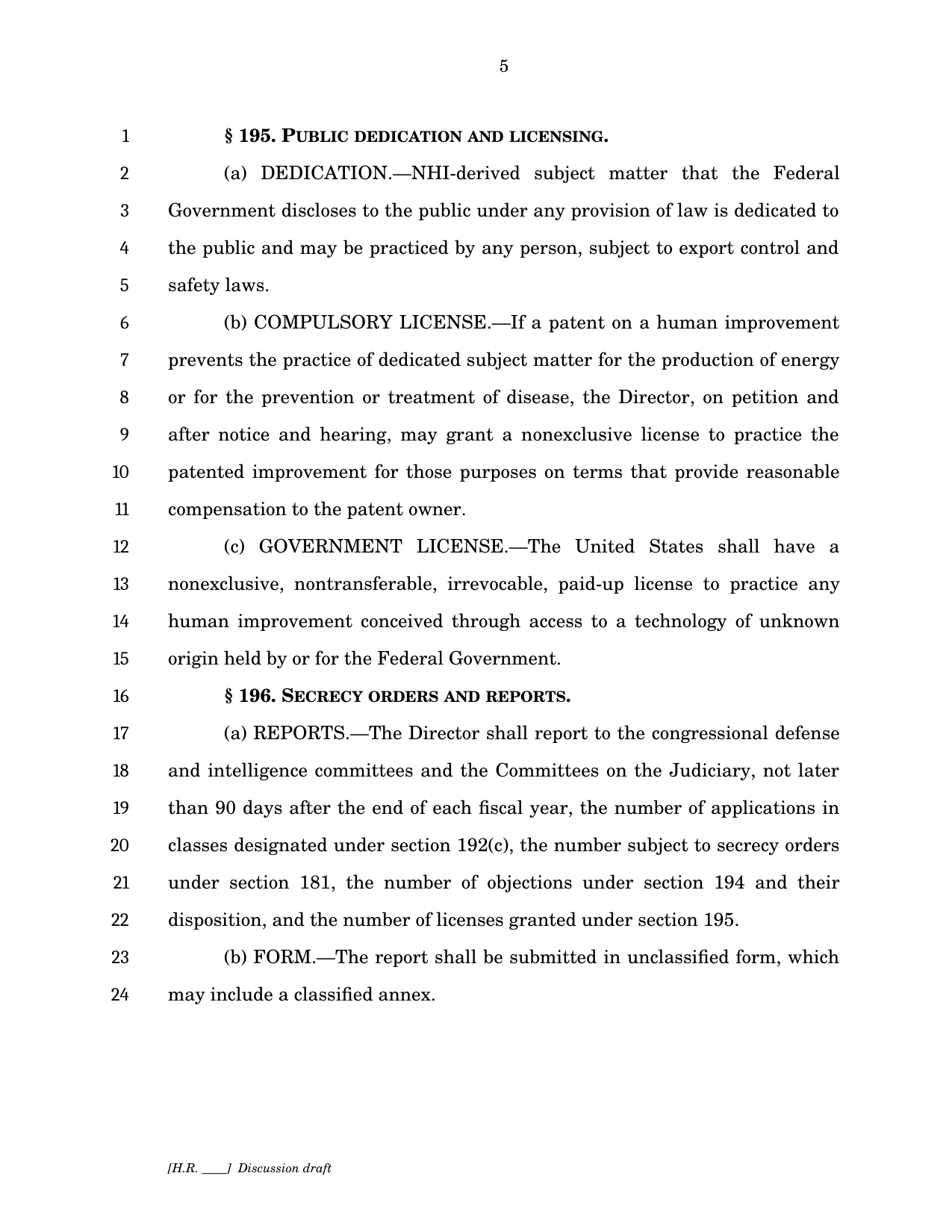
§ 195. Public dedication and licensing.
(a) Dedication. NHI-derived subject matter that the Federal Government discloses to the public under any provision of law is dedicated to the public and may be practiced by any person, subject to export control and safety laws.
(b) Compulsory license. If a patent on a human improvement prevents the practice of dedicated subject matter for the production of energy or for the prevention or treatment of disease, the Director, on petition and after notice and hearing, may grant a nonexclusive license to practice the patented improvement for those purposes on terms that provide reasonable compensation to the patent owner.
(c) Government license. The United States shall have a nonexclusive, nontransferable, irrevocable, paid-up license to practice any human improvement conceived through access to a technology of unknown origin held by or for the Federal Government.
§ 196. Secrecy orders and reports.
(a) Reports. The Director shall report to the congressional defense and intelligence committees and the Committees on the Judiciary, not later than 90 days after the end of each fiscal year, the number of applications in classes designated under section 192(c), the number subject to secrecy orders under section 181, the number of objections under section 194 and their disposition, and the number of licenses granted under section 195.
(b) Form. The report shall be submitted in unclassified form, which may include a classified annex.
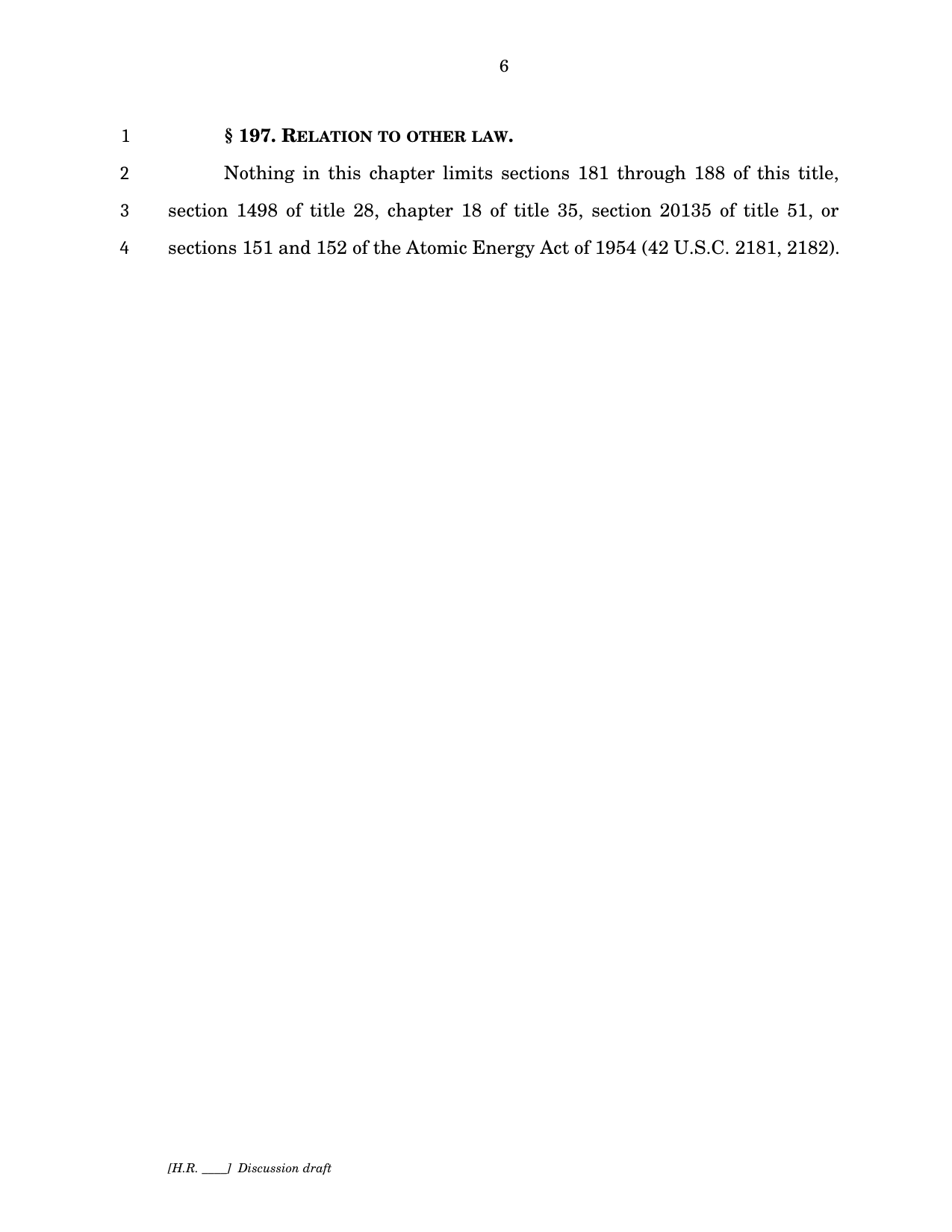
§ 197. Relation to other law. Nothing in this chapter limits sections 181 through 188 of this title, section 1498 of title 28, chapter 18 of title 35, section 20135 of title 51, or sections 151 and 152 of the Atomic Energy Act of 1954 (42 U.S.C. 2181, 2182).