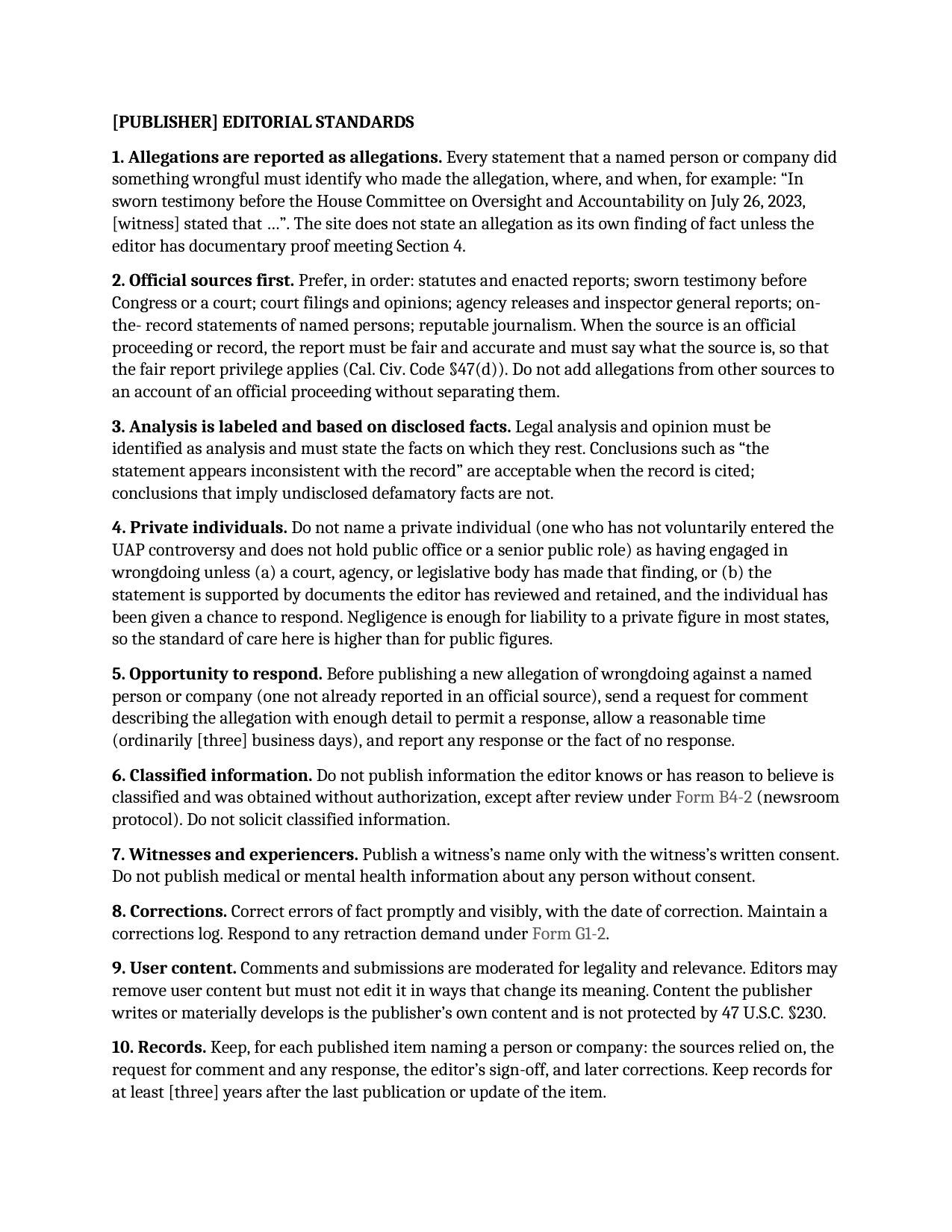
[PUBLISHER] EDITORIAL STANDARDS
1. Allegations are reported as allegations. Every statement that a named person or company did something wrongful must identify who made the allegation, where, and when, for example: “In sworn testimony before the House Committee on Oversight and Accountability on July 26, 2023, [witness] stated that …”. The site does not state an allegation as its own finding of fact unless the editor has documentary proof meeting Section 4.
2. Official sources first. Prefer, in order: statutes and enacted reports; sworn testimony before Congress or a court; court filings and opinions; agency releases and inspector general reports; on-the- record statements of named persons; reputable journalism. When the source is an official proceeding or record, the report must be fair and accurate and must say what the source is, so that the fair report privilege applies (Cal. Civ. Code §47(d)). Do not add allegations from other sources to an account of an official proceeding without separating them.
3. Analysis is labeled and based on disclosed facts. Legal analysis and opinion must be identified as analysis and must state the facts on which they rest. Conclusions such as “the statement appears inconsistent with the record” are acceptable when the record is cited; conclusions that imply undisclosed defamatory facts are not.
4. Private individuals. Do not name a private individual (one who has not voluntarily entered the UAP controversy and does not hold public office or a senior public role) as having engaged in wrongdoing unless (a) a court, agency, or legislative body has made that finding, or (b) the statement is supported by documents the editor has reviewed and retained, and the individual has been given a chance to respond. Negligence is enough for liability to a private figure in most states, so the standard of care here is higher than for public figures.
5. Opportunity to respond. Before publishing a new allegation of wrongdoing against a named person or company (one not already reported in an official source), send a request for comment describing the allegation with enough detail to permit a response, allow a reasonable time (ordinarily [three] business days), and report any response or the fact of no response.
6. Classified information. Do not publish information the editor knows or has reason to believe is classified and was obtained without authorization, except after review under Form B4-2 (newsroom protocol). Do not solicit classified information.
7. Witnesses and experiencers. Publish a witness’s name only with the witness’s written consent. Do not publish medical or mental health information about any person without consent.
8. Corrections. Correct errors of fact promptly and visibly, with the date of correction. Maintain a corrections log. Respond to any retraction demand under Form G1-2.
9. User content. Comments and submissions are moderated for legality and relevance. Editors may remove user content but must not edit it in ways that change its meaning. Content the publisher writes or materially develops is the publisher’s own content and is not protected by 47 U.S.C. §230.
10. Records. Keep, for each published item naming a person or company: the sources relied on, the request for comment and any response, the editor’s sign-off, and later corrections. Keep records for at least [three] years after the last publication or update of the item.
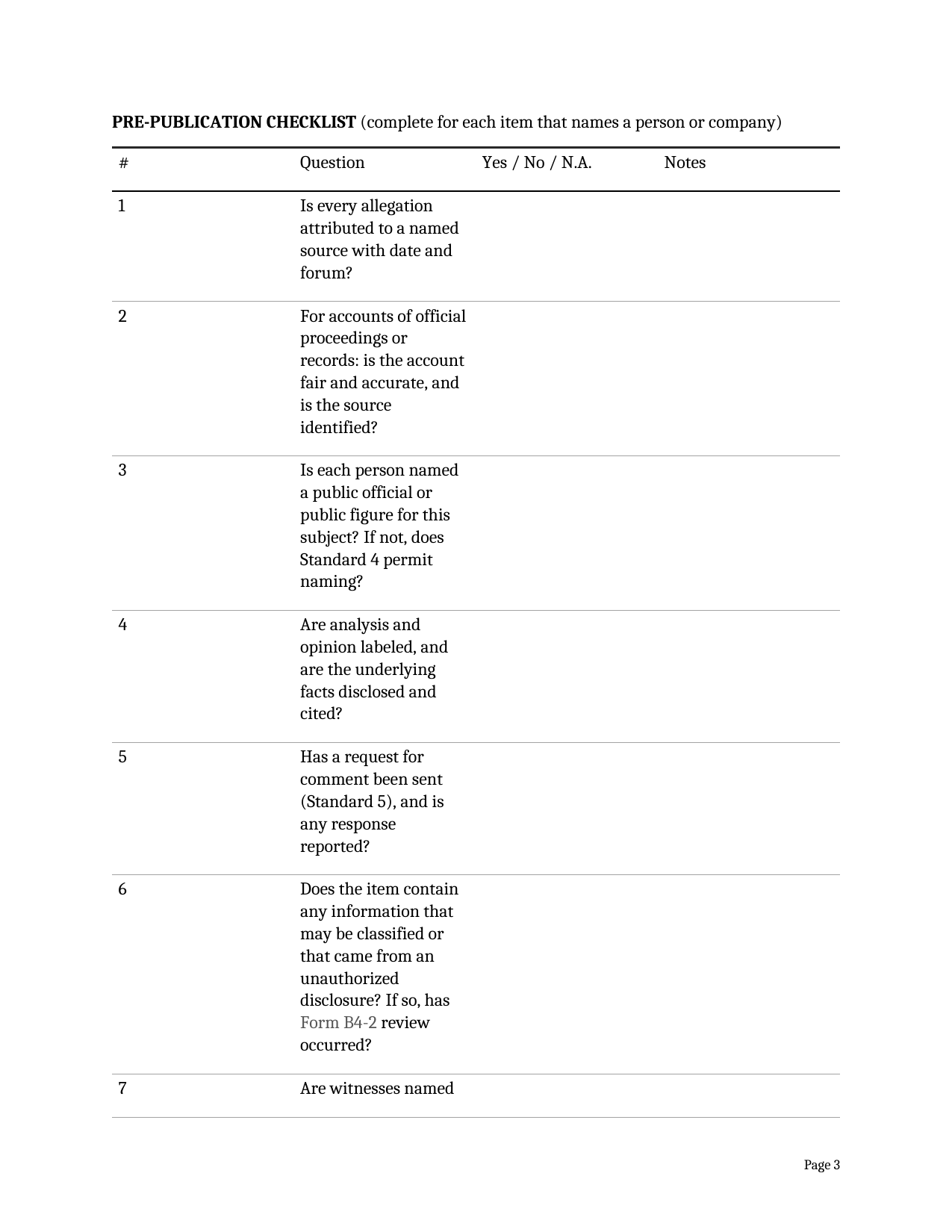
PRE-PUBLICATION CHECKLIST (complete for each item that names a person or company)
| 1 |
Is every allegation attributed to a named source with date and forum? |
|
|
| 2 |
For accounts of official proceedings or records: is the account fair and accurate, and is the source identified? |
|
|
| 3 |
Is each person named a public official or public figure for this subject? If not, does Standard 4 permit naming? |
|
|
| 4 |
Are analysis and opinion labeled, and are the underlying facts disclosed and cited? |
|
|
| 5 |
Has a request for comment been sent (Standard 5), and is any response reported? |
|
|
| 6 |
Does the item contain any information that may be classified or that came from an unauthorized disclosure? If so, has Form B4-2 review occurred? |
|
|
| 7 |
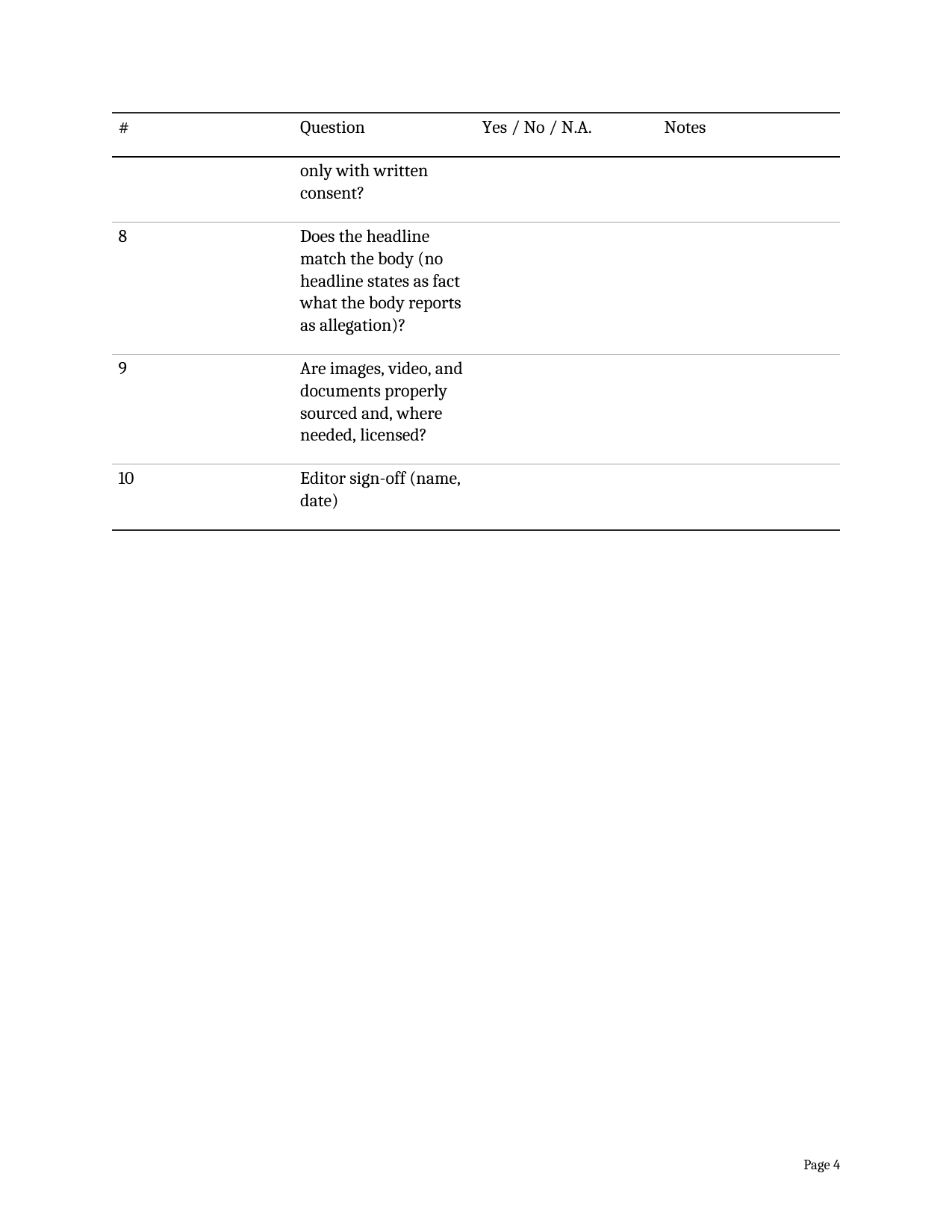
Are witnesses named only with written consent? |
|
|
| 8 |
Does the headline match the body (no headline states as fact what the body reports as allegation)? |
|
|
| 9 |
Are images, video, and documents properly sourced and, where needed, licensed? |
|
|
| 10 |
Editor sign-off (name, date) |
|
|