Form G1-2. Response to a Retraction Demand or Threat of a Defamation Claim

Version 1.10 · October 2026 Download: PDF Word

Template. Sample template for use by or with a licensed attorney. Not legal advice. Laws differ by jurisdiction and change; adapt the document to your facts and check every citation before relying on it.

Use. A demand letter starts the clock on several issues: the publisher’s notice of the claimed falsity (relevant to actual malice for later statements), possible statutory retraction procedures (Cal. Civ. Code §48a), insurance notice, and preservation of evidence. The response should be calm and precise. It should correct anything actually wrong, defend what is accurate by pointing to sources and privileges, avoid admissions, and set out the protections that would apply if suit were filed, including California’s anti-SLAPP statute. Choose Version A (correction made) or Version B (no correction warranted), or combine them item by item.

When to use. A publisher responding to a retraction demand or threat of a defamation suit. Not for: Demands concerning user content only (see Section 230).

Deadlines. Notify the insurer at once. Under Cal. Civ. Code §48a a correction demanded within 20 days must be published within three weeks.

The document

2 pages, laid out as in the PDF and Word downloads. Select a page to open the PDF at that page.

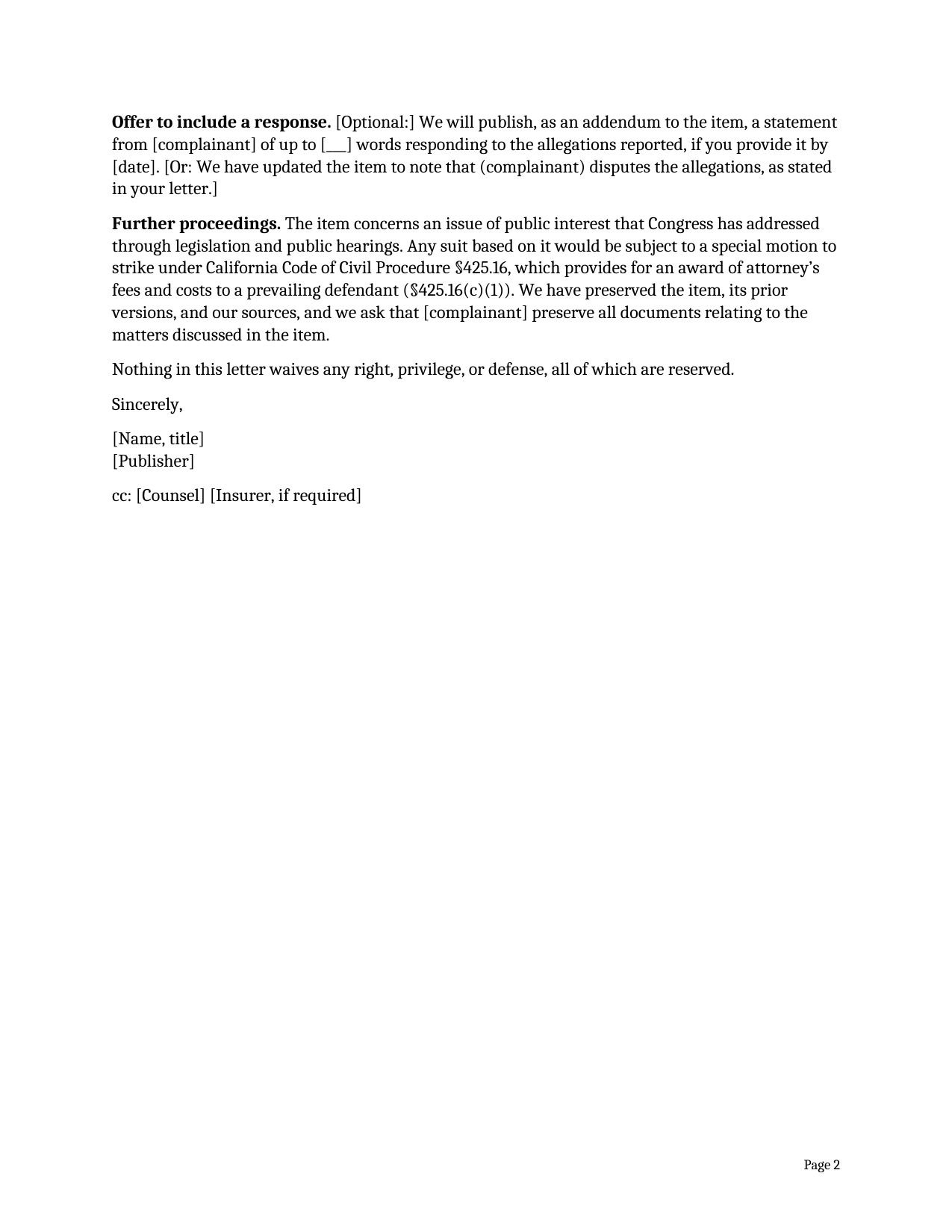
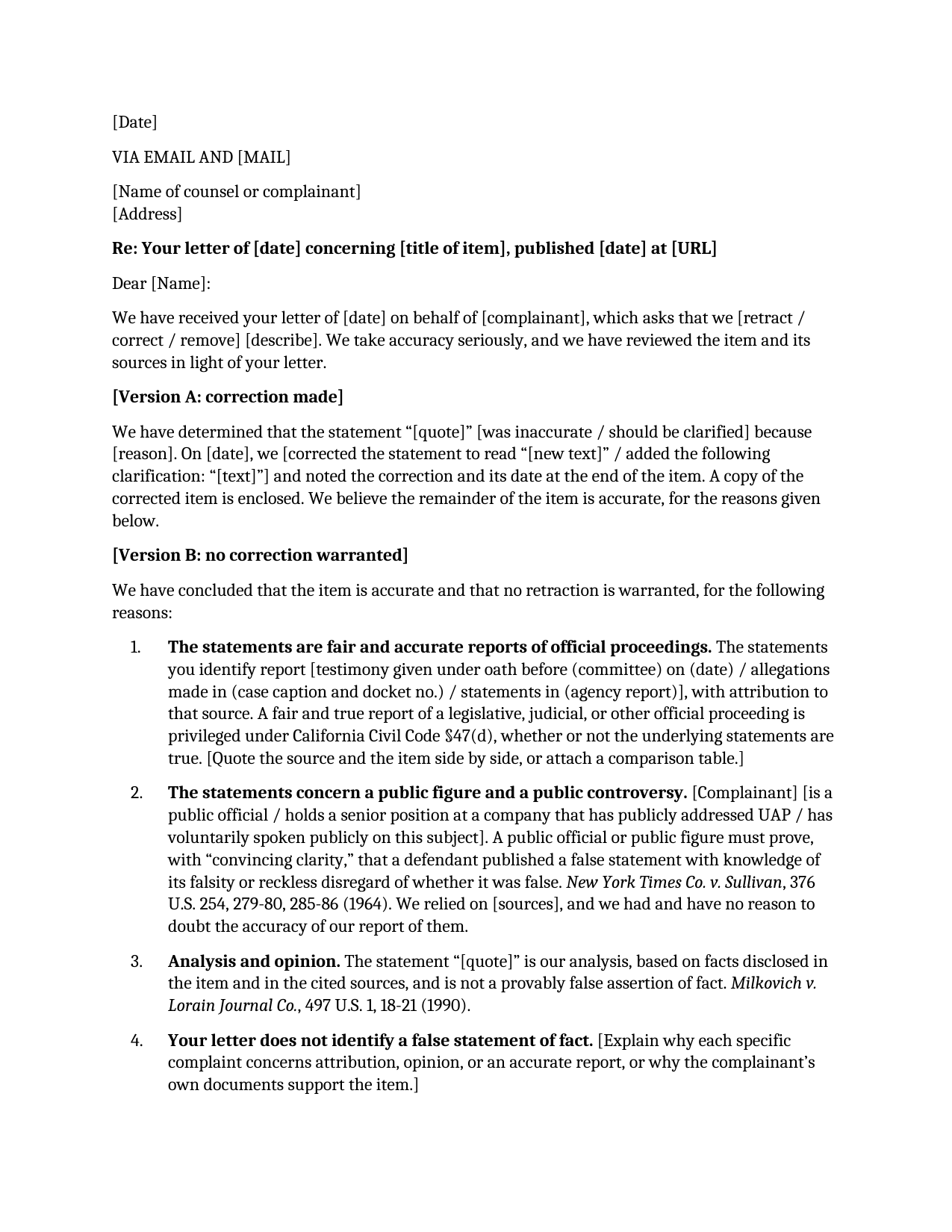
Form G1-2, page 1 of 2. The text version follows the pages. Form G1-2, page 2 of 2. The text version follows the pages.
Text version of the document

[Date]

VIA EMAIL AND [MAIL]

[Name of counsel or complainant] [Address]

Re: Your letter of [date] concerning [title of item], published [date] at [URL]

Dear [Name]:

We have received your letter of [date] on behalf of [complainant], which asks that we [retract / correct / remove] [describe]. We take accuracy seriously, and we have reviewed the item and its sources in light of your letter.

[Version A: correction made]

We have determined that the statement “[quote]” [was inaccurate / should be clarified] because [reason]. On [date], we [corrected the statement to read “[new text]” / added the following clarification: “[text]”] and noted the correction and its date at the end of the item. A copy of the corrected item is enclosed. We believe the remainder of the item is accurate, for the reasons given below.

[Version B: no correction warranted]

We have concluded that the item is accurate and that no retraction is warranted, for the following reasons:

  1. The statements are fair and accurate reports of official proceedings. The statements you identify report [testimony given under oath before (committee) on (date) / allegations made in (case caption and docket no.) / statements in (agency report)], with attribution to that source. A fair and true report of a legislative, judicial, or other official proceeding is privileged under California Civil Code §47(d), whether or not the underlying statements are true. [Quote the source and the item side by side, or attach a comparison table.]

  2. The statements concern a public figure and a public controversy. [Complainant] [is a public official / holds a senior position at a company that has publicly addressed UAP / has voluntarily spoken publicly on this subject]. A public official or public figure must prove, with “convincing clarity,” that a defendant published a false statement with knowledge of its falsity or reckless disregard of whether it was false. New York Times Co. v. Sullivan, 376 U.S. 254, 279-80, 285-86 (1964). We relied on [sources], and we had and have no reason to doubt the accuracy of our report of them.

  3. Analysis and opinion. The statement “[quote]” is our analysis, based on facts disclosed in the item and in the cited sources, and is not a provably false assertion of fact. Milkovich v. Lorain Journal Co., 497 U.S. 1, 18-21 (1990).

  4. Your letter does not identify a false statement of fact. [Explain why each specific complaint concerns attribution, opinion, or an accurate report, or why the complainant’s own documents support the item.]

Offer to include a response. [Optional:] We will publish, as an addendum to the item, a statement from [complainant] of up to [___] words responding to the allegations reported, if you provide it by [date]. [Or: We have updated the item to note that (complainant) disputes the allegations, as stated in your letter.]

Further proceedings. The item concerns an issue of public interest that Congress has addressed through legislation and public hearings. Any suit based on it would be subject to a special motion to strike under California Code of Civil Procedure §425.16, which provides for an award of attorney’s fees and costs to a prevailing defendant (§425.16(c)(1)). We have preserved the item, its prior versions, and our sources, and we ask that [complainant] preserve all documents relating to the matters discussed in the item.

Nothing in this letter waives any right, privilege, or defense, all of which are reserved.

Sincerely,

[Name, title] [Publisher]

cc: [Counsel] [Insurer, if required]
Drafting notes

  • Do not admit falsity unnecessarily. A correction should say what was wrong and what is right. It should not concede fault, intent, or damage.
  • Section 48a. In an action for libel in a “daily or weekly news publication,” the plaintiff may recover only special damages unless the plaintiff served a written correction demand within 20 days after learning of the publication and the publisher did not publish a correction “in substantially as conspicuous a manner” within three weeks. Cal. Civ. Code §48a(a)-(b). Since 2017 a “daily or weekly news publication” includes one “in print or electronic form, that contains news on matters of public concern and that publishes at least once a week” (§48a(d)(5)), so a site or newsletter that publishes weekly may qualify. If the demand arrived within 20 days of publication and a correction is warranted, publish it prominently within three weeks.
  • Actual malice and later statements. After receiving a demand that identifies a specific error with evidence, republishing the statement without checking can support a finding of reckless disregard for the republication. Review and decide promptly.
  • Comparison table. Showing the source text next to the published text is the most persuasive answer to a fair-report challenge.
  • Insurance notice. Media liability policies usually require notice of a “claim” as soon as practicable, and many define a claim to include a written demand for retraction or correction, not only a lawsuit. Many also require the insurer’s consent before the insured admits liability or publishes a correction that concedes fault, and claims-made policies require notice within the policy period or a short extended reporting period. Send the demand to the insurer the day it arrives, before responding, and keep proof of the notice.
  • Pin cites: Sullivan at 279-80, 285-86; Milkovich at 18-21.
  • Federal court. In the Ninth Circuit the special motion to strike applies in federal court (*CoreCivic, Inc. v. Candide Group, LLC, 46 F.4th 1136 (9th Cir. 2022)), but a denial is no longer immediately appealable (Gopher Media LLC v. Melone*, 154 F.4th 696 (9th Cir. 2025) (en banc), cert. denied, 146 S. Ct. 2726 (2026)). The fee-shifting warning in the letter holds in either forum.
  • Lawyer-publishers. The fair report privilege does not cover a communication to a public journal that violates Rule 3.6 of the Rules of Professional Conduct (trial publicity), breaches a court order, or violates a legal confidentiality requirement. Cal. Civ. Code §47(d)(2). A lawyer who comments on a pending case the lawyer is handling should check Rule 3.6 first.
  • Related: Issue G1; Form G1-1.
↑